
What's Recurring Payment? Your 2026 Guide to SaaS Success

Ayush Soni
Founder, Revcover

On this page
- The Foundation of the Subscription Economy
- Why SaaS teams need to care beyond checkout
- How a Recurring Payment Actually Works
- The first charge is different from the rest
- Why webhooks matter more than people expect
- Common Recurring Billing Models Explained
- The trade-off behind each model
- When Payments Fail Understanding Involuntary Churn
- What involuntary churn really means
- Where SaaS teams usually misread the problem
- A Practical Playbook for Revenue Recovery
- Build recovery around the billing event stream
- Use dunning as a customer experience system
- Decide when to gate and when to wait
- From Transaction to Customer Relationship
A recurring payment is an automated transaction a customer authorizes once for goods or services delivered over time, and it now powers a global transaction volume of about $15.4 trillion, up from $13.2 trillion in 2023. It's the engine of the subscription economy because it turns one checkout event into an ongoing revenue relationship.
If you're running SaaS, you've probably already felt the gap between the simple definition and the operational reality. Setting up a monthly plan in Stripe looks straightforward. The hard part starts later, when renewals fail, cards expire, customers miss update emails, and revenue slips out through billing issues instead of product dissatisfaction.
That's why “what's recurring payment” is the wrong stopping point. The useful question is how recurring payments behave in production, and what your team should do when the billing system meets real customers, real banks, and real churn risk.
The Foundation of the Subscription Economy
A founder launches a new SaaS product, adds a monthly plan, connects Stripe, and assumes billing is solved. At first, it feels solved. A customer signs up, enters a card, and gets access.
Then the second month arrives.
A renewal fails. Another account upgrades mid-cycle. A customer asks why they were charged after a trial. Finance wants cleaner reporting. Support wants to know whether a failed renewal should lock the account or trigger a grace period. Billing stops being a checkout feature and becomes an operating system for retention.
That's what recurring payments really are in practice. They're not just scheduled charges. They're the mechanism that keeps access, revenue, and customer expectation aligned over time.
The scale matters here. The global recurring payment market is valued at approximately $15.4 trillion in transaction volume and rose from $13.2 trillion in 2023, according to Juniper Research on recurring payment transactions. That tells you this isn't a niche payment pattern. It's standard commercial infrastructure for SaaS, streaming, memberships, utilities, and more.
Why SaaS teams need to care beyond checkout
Recurring billing creates predictability, but only if the full lifecycle is managed well. Finance depends on it for revenue visibility. Product depends on it for access control. Support depends on it for clean customer communication. RevOps depends on it because every billing failure has downstream effects on churn, expansion, and reporting.
Practical rule: If billing only lives with engineering or finance, you'll usually discover problems after revenue is already lost.
A healthy subscription business also needs a clean understanding of how billed value becomes recognized value over time. If your team needs a refresher on that layer, this deferred revenue definition is worth reviewing alongside your subscription setup.
How a Recurring Payment Actually Works
Recurring payments feel invisible to customers when they work well. Under the hood, they're a sequence of tightly connected events that depend on consent, secure credential storage, and correct handling of asynchronous outcomes.
The first charge is different from the rest
Think about a scheduled grocery delivery. On day one, the customer chooses a plan, enters payment details, and agrees to the billing terms. That initial action matters because it creates the consent framework for future charges.
After that, the merchant doesn't need the customer to re-enter card details each cycle. The technical core is the Merchant-Initiated Transaction (MIT), which lets the merchant trigger later charges without real-time customer input after the initial authorization and secure credential storage, as explained in Dodo Payments' guide to recurring payments.
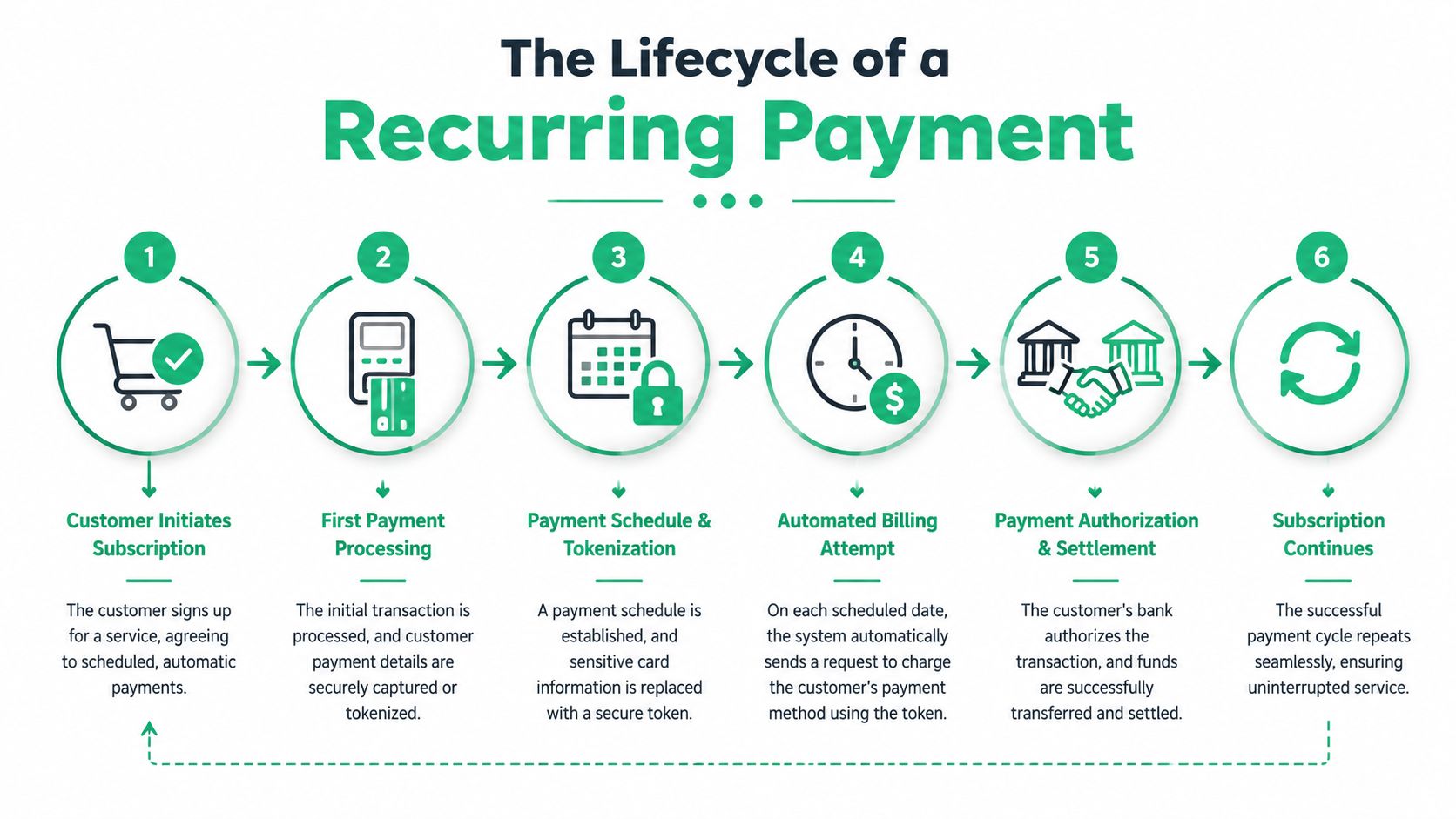
In practical terms, the lifecycle usually looks like this:
- Signup and consent. The customer selects a plan and agrees to recurring charges.
- Initial payment. The processor authorizes the first transaction.
- Credential storage. Sensitive card data is typically replaced with a token so the merchant doesn't store raw card details directly.
- Billing schedule creation. The system records when and how future charges should run.
- Automated renewal attempt. On the billing date, the platform sends the next charge request using the stored credential reference.
- Settlement and access update. If payment succeeds, the account remains active and the billing cycle continues.
What trips teams up is assuming the API response at charge time is the whole story. It isn't. For recurring payments, later events often determine the final operational state.
Why webhooks matter more than people expect
A recurring payment stack only works cleanly if your webhook handler is reliable. Payment events arrive asynchronously. That means your app can't rely only on the synchronous response from a billing call and call the job done.
You need to handle webhooks with a few disciplines in place:
- Verify signatures so your system only accepts legitimate events from Stripe or your billing provider.
- Process idempotently so duplicate event delivery doesn't trigger duplicate account changes or duplicate internal actions.
- Separate billing state from product state so a payment failure doesn't accidentally revoke access before your grace-period logic runs.
- Log event transitions because support and finance will ask what happened on a specific account.
A lot of recurring billing bugs aren't payment bugs. They're state-management bugs.
That's one reason ACH and bank-based methods can change the operational picture. Their timelines, settlement expectations, and failure handling differ from card rails. If you're evaluating non-card options, this guide on accepting ACH payments is a useful complement to card-based subscription flows.
Common Recurring Billing Models Explained
The payment mechanism might stay similar, but the business logic can vary a lot. The right model depends on how customers receive value and how much billing complexity your team can absorb.
The trade-off behind each model
Some SaaS products are easiest to sell with a flat monthly fee. Others need usage sensitivity because customer value scales with activity. Many end up with a hybrid approach because one clean model doesn't fit both acquisition and expansion.
Here's a practical comparison.
| Model | How It Works | Best For | Key Challenge |
|---|---|---|---|
| Fixed subscription | Customer pays the same amount on a regular cadence | B2B SaaS with stable seat or feature packaging | Can feel misaligned when customer usage varies a lot |
| Usage-based or metered | Charges vary based on consumption during the billing period | Infrastructure, API, communications, or data products | Harder for customers to predict invoices |
| Hybrid | A base subscription plus variable charges, add-ons, or overages | SaaS products with both platform value and measurable consumption | More billing logic, more edge cases, more support questions |
Fixed billing is easiest to explain and easiest to forecast. It also simplifies customer expectations. The downside is fairness pressure. If light users pay the same as heavy users, someone will eventually question the fit.
Usage-based billing aligns price with value better for some products. It also introduces invoice anxiety if customers don't have visibility into what's accumulating during the period.
Hybrid models are often the most commercially realistic. A platform fee covers baseline value, while usage or add-ons capture expansion. They also create the most operational surface area. Proration rules, invoice previews, plan transitions, and overage messaging all need to be handled clearly.
A few decision criteria help:
- Choose fixed billing when your product's core value is access, not consumption.
- Choose usage-based billing when the product naturally maps to transactions, API calls, data volume, or compute.
- Choose hybrid billing when customers want a predictable baseline but your business still needs a path to monetize growing usage.
If customers can't explain their next invoice before they receive it, your billing model is probably too opaque.
When Payments Fail Understanding Involuntary Churn
Recurring billing problems don't always show up as cancellations. Often, they show up as silent payment failures that eventually become churn.
What involuntary churn really means
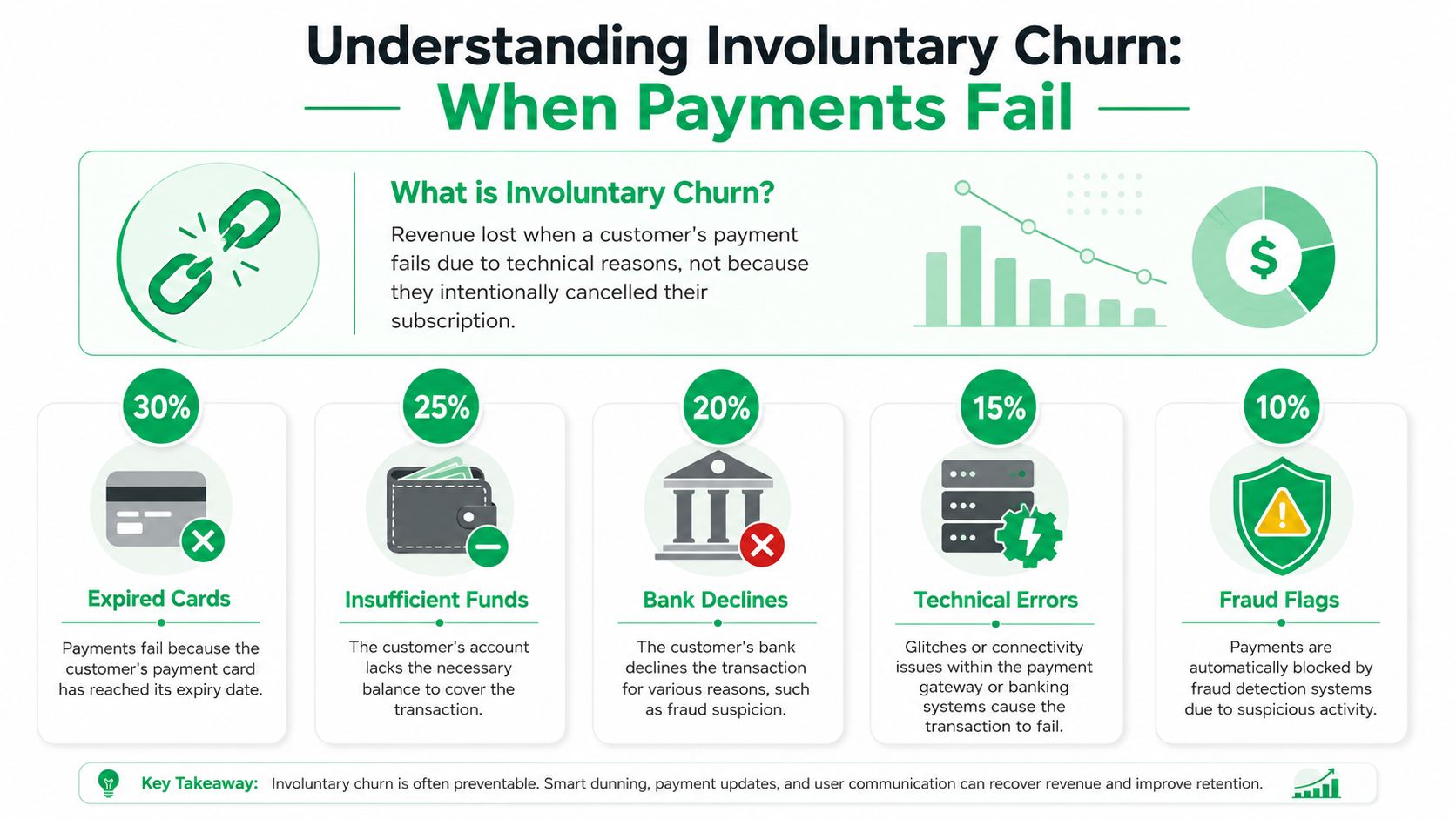
Involuntary churn is revenue loss caused by failed payments rather than a customer intentionally deciding to leave. In SaaS, that distinction matters because the recovery motion is completely different. You don't need to resell product value first. You need to fix collection.
For many SaaS businesses, involuntary churn can account for 20% to 30% of total customer churn, according to this analysis of common recurring payment mistakes. That's large enough to distort how teams interpret retention performance.
Here's the common failure pattern. The customer still wants the product. The subscription renews. The card is expired, the bank declines the charge, or the payment method details are outdated. If your system doesn't recover the payment, the account eventually lapses and gets counted as churn.
Later in the lifecycle, the distinction between voluntary and billing-driven loss becomes operationally important. This overview of voluntary vs involuntary churn is useful if your reporting currently lumps both together.
Where SaaS teams usually misread the problem
The first mistake is treating every failed renewal as a customer decision. That leads to bad product conclusions. A decline code is not a cancellation reason.
The second mistake is overreacting too early. Teams sometimes suspend access immediately after the first failed attempt. That creates avoidable friction for customers who would have paid if given a short grace period and a clean update path.
This short video gives a useful visual explanation before going deeper into the workflow issues:
The operational signals to monitor are simple, even if the recovery work isn't:
- Watch failed renewal patterns by plan, payment method, geography, and billing age.
- Separate cancellation intent from collection failure so your retention analysis stays honest.
- Map payment failures to MRR impact instead of tracking only count of failed invoices.
- Review support tickets tied to billing confusion because they often reveal friction your dashboards miss.
A failed payment is a recoverable operations event until your process turns it into churn.
A Practical Playbook for Revenue Recovery
A working recovery system doesn't rely on one retry email and hope. It combines billing logic, customer messaging, and product access rules into one coordinated motion.
Build recovery around the billing event stream
If you use Stripe, start with the event model. Failed invoice payment, upcoming invoice events, payment method updates, and subscription status changes should trigger explicit actions inside your product and your messaging systems.
The baseline pattern is straightforward:
- Listen for failure events and create a recovery workflow immediately.
- Attach the workflow to the subscription record so support and success can see current billing state.
- Route customers to a direct payment update path instead of sending them through general account settings.
- Restore access automatically after successful payment so the fix feels immediate.
The technical side matters because recurring payment outcomes arrive asynchronously. If your Stripe webhook processing is sloppy, your recovery process will be sloppy too. Teams often think they have a dunning problem when they have event-timing and state-sync problems.
Use dunning as a customer experience system
A lot of teams hear “dunning” and think “collections.” That mindset usually produces robotic reminders and unnecessary irritation. Better systems treat dunning as customer guidance during a billing interruption.
A practical sequence comes from Midrocket's recurring payments guide, which notes that a typical dunning flow includes an immediate retry, a second attempt at 24 to 48 hours with customer notification, and a third at 5 to 7 days before service suspension.
That sequence works because it balances urgency with restraint. You're not panicking after one failure, and you're not waiting so long that access and revenue drift apart.
What tends to work best:
- Retry quickly after the first failure when the issue may be temporary.
- Notify the customer with context. Tell them billing needs attention, not that their account is “delinquent.”
- Offer one-click payment update access so they don't hunt through settings.
- Retry again on a different schedule rather than hammering the same moment repeatedly.
- Warn before access changes so the customer understands the consequence and timeline.
What usually doesn't work:
- Aggressive feature lockouts on day one
- Vague emails that don't explain what failed
- Generic “payment unsuccessful” banners with no action path
- Disconnect between email reminders and in-app state
Decide when to gate and when to wait
Most “what's recurring payment” articles stop short. They explain the charge, not the policy.
A mature SaaS team decides in advance which accounts should get grace, which should see reduced functionality, and which should be paused faster. The answer shouldn't be one-size-fits-all.
Use decision rules tied to account context:
- High-value active accounts may deserve more time and a human follow-up.
- Low-engagement accounts may move through the standard automated sequence.
- Accounts with known billing issues should see the clearest possible card-update path.
- Usage-heavy workspaces may need a softer gating model so you don't create an outsized customer incident from a recoverable billing problem.
Recovery works best when the product, billing system, and messaging all tell the customer the same thing.
Another useful tactic is pre-dunning. If you know a card is about to expire or a payment method looks stale, notify the customer before the renewal date. That's easier on the customer and easier on your revenue than trying to recover after a decline.
From Transaction to Customer Relationship
Recurring payments start as a billing mechanism, but they end up shaping the customer relationship. Every renewal tells the customer whether your company is easy to do business with. Every failed payment tests whether your systems are coordinated or fragmented.
That's why the full answer to “what's recurring payment” isn't just “an automatic charge on a schedule.” In SaaS, it's a chain of consent, credential storage, billing logic, retries, communication, and access control. If one part breaks, retention suffers.
The strongest teams treat billing as part of product experience. They don't wait for churn reports to reveal revenue leakage. They instrument the payment lifecycle, separate voluntary churn from billing failures, and build recovery flows that are direct, polite, and measurable.
Customers rarely thank you for a smooth renewal. They notice immediately when it goes badly.
If you want a cleaner way to manage cancellation flows, payment recovery, and recovered MRR inside a Stripe-connected SaaS stack, Revcover is built for that job. It helps teams coordinate save offers, failed-payment recovery, and churn insights without turning the cancellation experience into a maze.