
What Is Unit Economics? a Guide to SaaS Profitability In

Ayush Soni
Founder, Revcover
On this page
- Introduction to Unit Economics for SaaS
- Understanding the Main Unit Economics Concepts
- Start with the unit
- Why SaaS looks different from one-time sales
- Measuring Core Metrics in Subscription Businesses
- The five metrics that matter most
- Where teams measure badly
- Working Through Real SaaS Examples
- Example one with weak retention
- Example two with stronger fit but slower recovery
- Improving Unit Economics in Subscription Businesses
- Retention is a unit economics lever
- Pricing and segmentation shape the value of saved accounts
- Payment recovery protects revenue that is easy to miss
- Conclusion and Next Steps
You're adding customers, monthly recurring revenue looks better every month, and the team is busy. Yet cash still feels tight. Sales and marketing spend keeps going out. Some customers cancel before they've been around long enough to pay back what it cost to win them. Others don't mean to leave at all. Their card fails, the charge doesn't go through, and revenue slips out the back door.
That's the moment when founders, growth leaders, and product teams start asking a sharper question. Not “Are we growing?” but “Are we making money on each customer?” That question sits at the heart of what unit economics is. In SaaS, it helps you see whether growth is healthy or whether each new signup adds pressure.
It also reveals something many teams miss. Cancellation flows and payment recovery aren't just retention tactics. They directly affect the levers underneath your SaaS model: lifetime value, churn, and how fast acquisition cost gets paid back.
Introduction to Unit Economics for SaaS
A lot of SaaS teams learn this lesson late. They celebrate signups, close new accounts, and report growing ARR. Then finance asks a harder question: are those customers profitable after acquisition and service costs?
Unit economics answers that by shrinking the business down to one repeatable unit. In SaaS, that unit is usually one customer or one account. Instead of looking at the whole company first, you ask whether one customer creates enough gross profit to justify the cost of acquiring them.
That sounds simple, but it changes how you evaluate growth. A business can look strong from the outside and still have weak unit economics if customers churn too early, if pricing is too low, or if acquisition costs are too high.
Practical rule: Growth only helps when each added customer makes the model stronger, not weaker.
This is also where hidden revenue loss matters. If a customer clicks cancel and leaves without any save path, or if a payment fails and no recovery flow catches it, those events don't just reduce revenue. They weaken the economics of the customer you already paid to acquire.
Understanding the Main Unit Economics Concepts
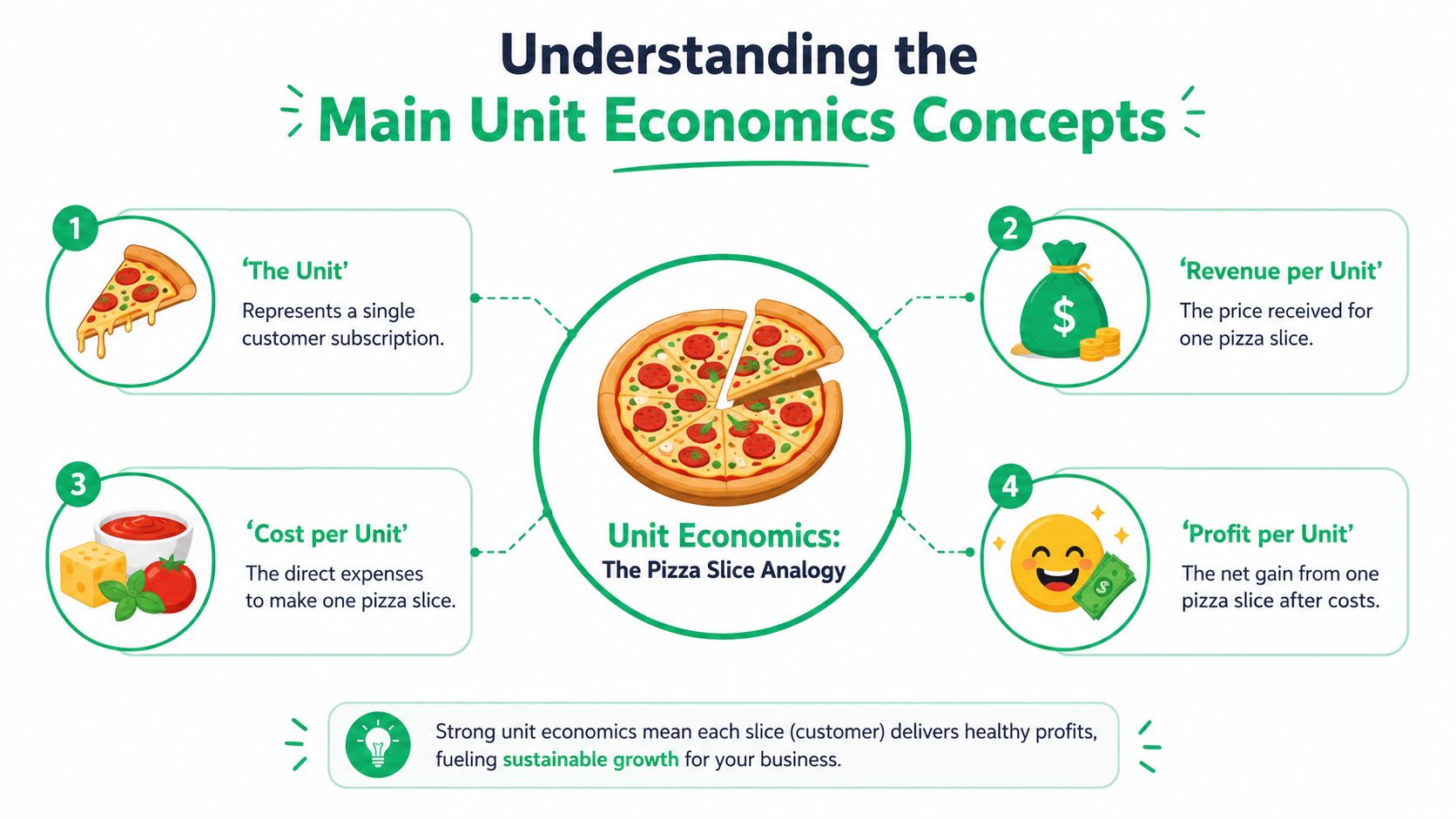
The easiest way to understand what unit economics is is to stop thinking like a SaaS operator for a minute and think like a pizza shop owner.
If you sell one pizza slice, you earn a price for that slice. You also spend money on dough, cheese, labor, and delivery. The question is simple: after the direct costs, did that slice leave money behind?
In SaaS, the “slice” is usually one subscription customer.
Start with the unit
For a subscription business, the unit isn't a one-time purchase. It's an ongoing customer relationship. That means the value of the unit depends on three things working together:
- Revenue per customer grows from what the customer pays over time.
- Direct service economics depend on the gross profit left after serving that customer.
- Retention determines how long the customer stays active.
- Acquisition cost determines how much you had to spend to win that customer in the first place.
That's why SaaS teams care so much about metrics like ARPU, churn, and customer lifetime. If you want a clean foundation, this guide to ARR calculation in SaaS helps frame the recurring revenue side of the model.
Why SaaS looks different from one-time sales
A one-time sale can be profitable immediately. SaaS usually works differently. You often spend money upfront to acquire the customer, then earn that investment back over time through recurring revenue and gross profit.
That's why the LTV:CAC ratio is such a central measure. A healthy sustainable benchmark in B2B SaaS is 3:1, meaning lifetime value should be at least three times customer acquisition cost, according to Build Up Labs' SaaS unit economics benchmark guide. The same source notes that early-stage startups may accept 2:1 while proving viability, mature businesses often reach 4:1 to 6:1, and a ratio below 1:1 means the business loses money on every customer acquired.
A high-level profit and loss statement can hide this problem. Unit economics usually exposes it fast.
Here's where readers often get confused: unit economics is not the same as total company profitability. Your company can still lose money overall while your unit economics are sound, especially if fixed costs are still heavy. But if the unit itself doesn't work, scale won't rescue you.
Measuring Core Metrics in Subscription Businesses
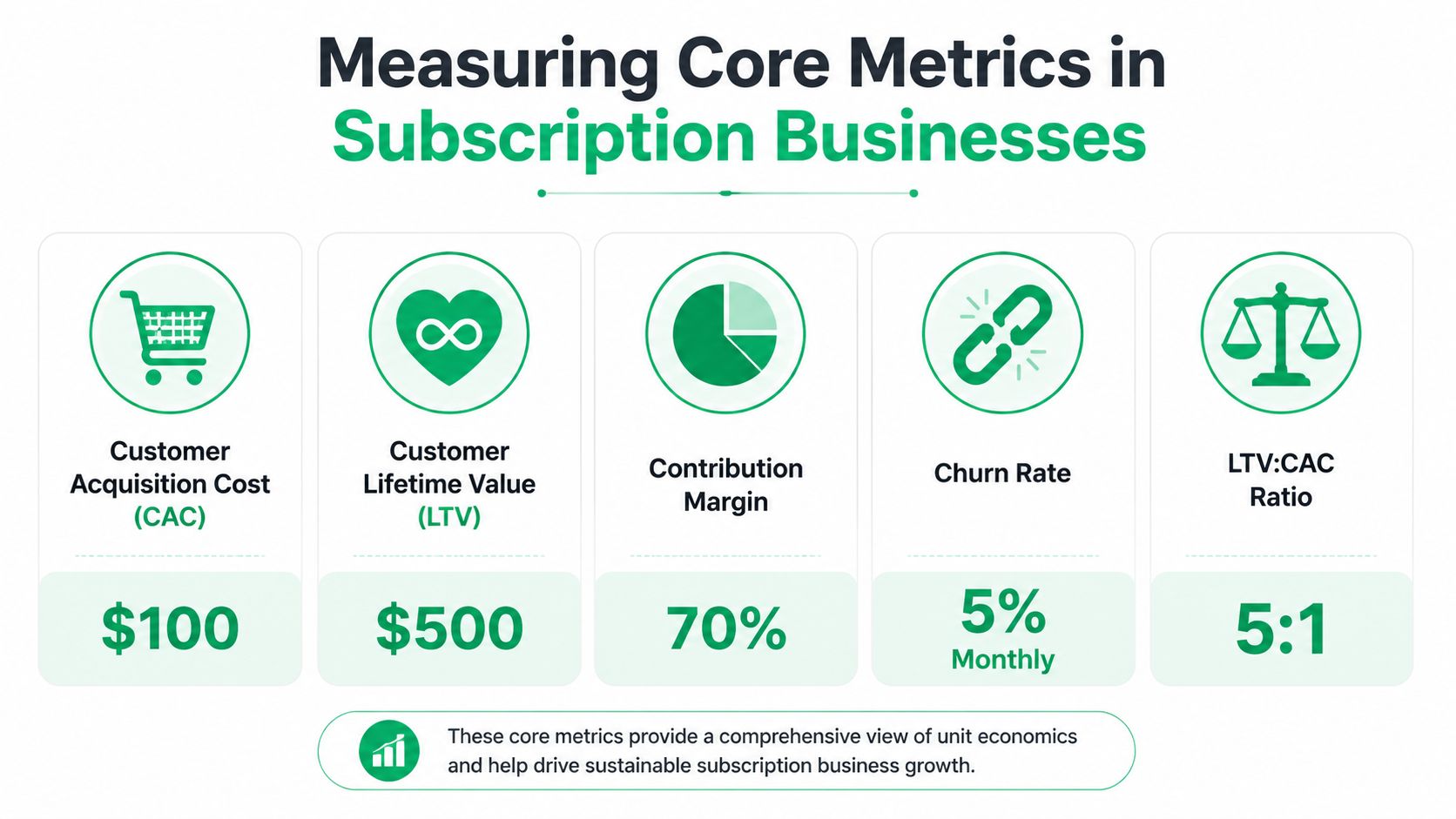
A SaaS model becomes easier to judge when you break it into a small set of metrics. These metrics don't live separately. They push on one another. Churn changes LTV. ARPU affects payback. Gross margin changes how much cash you recover from each customer.
A visual summary helps before you calculate anything:
The five metrics that matter most
Customer Acquisition Cost (CAC) is the cost to win a customer. In practice, teams usually include marketing spend, sales effort, and the tools and programs tied directly to acquisition. If CAC is understated, the rest of your model looks healthier than it really is.
Customer Lifetime Value (LTV) is the total gross profit you expect from a customer over the life of the relationship. In subscription businesses, LTV depends heavily on average revenue per user and churn. If your revenue model needs a refresher, this walkthrough on how to calculate average revenue is useful context.
Contribution margin is the gross profit left after direct costs to serve the customer. For SaaS, that usually means you're looking at subscription revenue minus the direct costs of delivering and supporting the product.
Churn rate tells you how often customers leave. This is one of the fastest ways to distort unit economics, because retention affects both LTV and payback. If customers leave before acquisition cost is recovered, the model can break even when top-line revenue still looks stable.
A short explainer is useful here:
CAC payback period measures how long gross profit takes to recover CAC. According to Mercury's explanation of SaaS unit economics, top-tier SaaS companies typically target a payback period of under 12 months. That matters because payback is really a cash question. Faster recovery gives the business more room to reinvest.
The broad formula logic looks like this:
| Metric | What it asks | Why it matters |
|---|---|---|
| CAC | What did it cost to win one customer? | It sets the upfront investment per account |
| LTV | How much gross profit will that customer generate over time? | It tells you whether the relationship is worth acquiring |
| Contribution margin | How much gross profit is left after direct costs? | It shows how much value each active customer contributes |
| Churn rate | How quickly do customers leave? | It shortens customer life and weakens LTV |
| CAC payback period | How long until gross profit repays CAC? | It shows how much cash strain growth creates |
The most common benchmark in SaaS combines two of those numbers. The LTV:CAC ratio should be 3:1 or higher for a healthy model, and below 1:1 means growth destroys value, according to Centric Marketing's guide to SaaS unit economics.
Where teams measure badly
The math isn't the hard part. The discipline is.
Some teams undercount CAC by excluding part of the sales motion. Others overestimate LTV by assuming customers stay longer than the data supports. Many treat churn as a reporting metric instead of a financial input.
If a customer leaves before you recover acquisition cost, a “good” theoretical LTV doesn't help much.
This is one reason cancellation reasons and failed payment behavior deserve operational attention. They're not side notes for support or billing. They tell you why churn happens and whether a customer left by choice, frustration, or accident.
Working Through Real SaaS Examples
A concrete example makes the math easier to believe. You can watch one change in customer behavior ripple through LTV, payback, and monthly recurring revenue.
Example one with weak retention
Start with a self-serve SaaS product that charges a modest monthly fee and gets signups without much sales effort. New customers arrive at a healthy pace, so growth looks fine at first glance. Then the leaks show up. Some users cancel in the first few months because the product does not fit their workflow. Others mean to stay but drop off after a failed payment.
Unit economics works like a bucket test. Acquisition fills the bucket. Early cancellations and unpaid renewals punch holes in the bottom.
In this case, CAC may look efficient because the company acquires users cheaply. But cheap acquisition does not guarantee a healthy model. If customers leave before they generate enough gross profit, LTV shrinks and the business struggles to recover what it spent to acquire them.
A simple way to check that pressure is the CAC payback formula introduced earlier:
CAC Payback = CAC ÷ (Monthly Net ARPU × Gross Margin %)
Now put rough numbers behind it. If CAC is $300, monthly net ARPU is $30, and gross margin is 80%, the business earns about $24 in gross profit per month. That means payback takes about 12.5 months.
That might seem workable until retention enters the picture.
If many customers cancel in month 3, 4, or 5, the company never reaches month 12 for a large share of accounts. Failed payments make the problem worse because some churn is avoidable. A customer who wanted to continue but had an expired card still disappears from revenue unless billing recovery catches them.
So the hidden unit economics problem is not only “we lose customers.” It is “we lose customers before CAC is repaid, including some we could have kept.”
A team in this position often gets more value from fixing the cancellation flow and dunning process than from buying more traffic. Practical churn reduction tactics for subscription teams usually focus on the same levers: learn why people leave, offer a better-fit path such as pause or downgrade, and recover revenue that would otherwise slip away through failed payments.
Example two with stronger fit but slower recovery
Now consider a B2B SaaS product with a higher price and a sales-assisted motion. CAC is heavier because demos, follow-up, and onboarding take time. On paper, that can make the business look less efficient at the start.
But stronger retention changes the picture. Customers stay longer, expand more often, and give the company more months to earn back acquisition cost. Even if payback starts slower, the account becomes more profitable after that recovery point.
Here is the useful comparison:
| Scenario | CAC | LTV | Churn Rate | Payback Period | MRR Impact |
|---|---|---|---|---|---|
| Low-price SaaS with early cancellations | Lower relative spend | Weaker because customers leave sooner | Higher | Harder to recover reliably | New MRR is offset by faster loss |
| Premium B2B SaaS with steadier retention | Higher relative spend | Stronger because accounts stay longer | Lower | Slower at first, steadier over time | MRR compounds more predictably |
The table shows why retention operations belong inside unit economics, not off to the side in support or billing. In the first scenario, a better cancellation experience can save accounts that are leaving for solvable reasons, such as pricing, timing, or low usage. Better payment recovery can save accounts that were never trying to churn in the first place.
Those two fixes change the same core equation from different angles. Cancellation flows reduce voluntary churn. Payment recovery reduces involuntary churn. Together, they extend customer life, preserve more MRR, and give CAC more time to pay back. That revenue often stays hidden until a team measures churn by cause instead of treating every lost subscriber as the same kind of loss.
Improving Unit Economics in Subscription Businesses
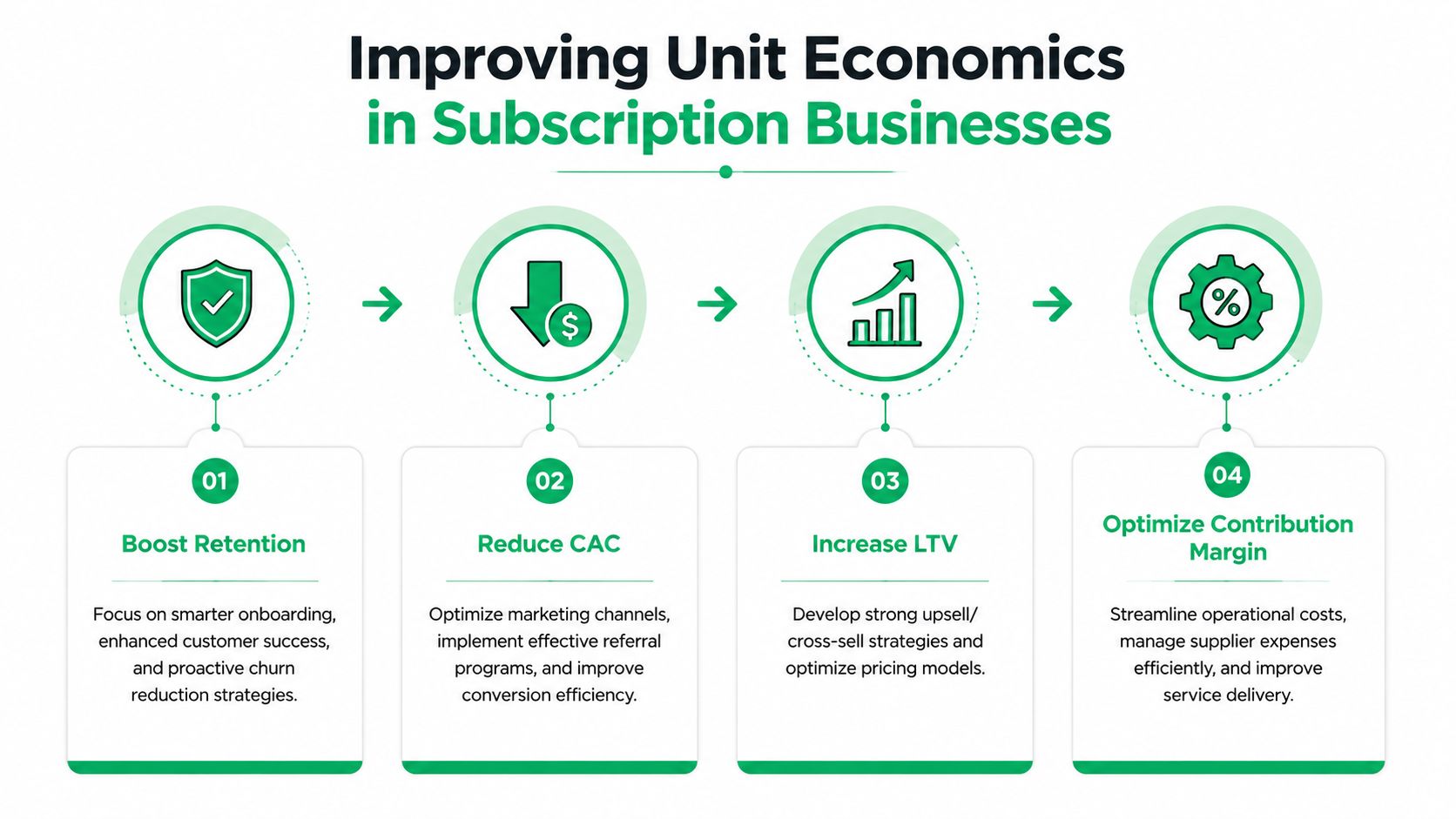
A SaaS company can add new customers every month and still weaken its unit economics if too many of those customers leave through cancellation or failed payments before the business recovers CAC.
Retention is a unit economics lever
Unit economics improves when each acquired customer produces more gross profit over time. Retention affects that outcome directly because it changes how long revenue keeps arriving after the initial sale.
A useful way to picture it is a bucket with two holes. New acquisition fills the bucket from the top. Voluntary cancellations and failed payments drain it from the bottom. If a team focuses only on pouring in more leads, the bucket can still empty faster than it fills.
That is why cancellation flows deserve attention from finance and growth teams, not only support.
A strong cancellation flow does two jobs at once. It learns why the customer wants to leave, and it gives the business one relevant response instead of one generic plea to stay. A customer leaving because of budget may need a downgrade. A customer leaving because setup stalled may need onboarding help. A customer leaving because the timing is wrong may respond to a pause option better than a discount.
Useful approaches include:
- Reason-based routing for causes like budget pressure, missing features, low usage, or bad timing
- Offer variety such as pause paths, plan downgrades, support follow-up, or a limited save offer
- Clean exits for customers who are not a fit, which protects brand trust and can improve later win-back rates
If your team wants practical ideas for cancellation and retention design, this guide on how to reduce churn rate is a helpful next step.
Pricing and segmentation shape the value of saved accounts
Improvement is not only about saving more accounts. It is about saving the right accounts in the right way.
Two customers can cancel for very different reasons even if they are on the same plan. One may be a healthy long-term customer who chose too much capacity too early. Another may be a poor-fit account that will continue churning through support time and discounts. Good segmentation helps teams tell the difference before offering a save path.
That makes pricing and packaging part of unit economics work. If a plan structure pushes small customers into expensive tiers, the business may create avoidable cancellations that look like churn problems but begin as packaging problems. If enterprise accounts need procurement time or billing flexibility, a rigid renewal path can create preventable loss even when product value is strong.
Segment by plan, usage, tenure, and account value. Then match each group to a cancellation response that protects future LTV instead of only trying to stop the immediate exit.
Payment recovery protects revenue that is easy to miss
Failed payments are often treated as back-office noise. In subscription businesses, they are a direct unit economics input.
The difference matters. A customer who actively cancels is sending a product or budget signal. A customer whose card expired may still want the service and may continue for many more months if the billing problem is fixed quickly. When those two cases are grouped together, teams understate how much revenue is recoverable.
Payment recovery improves unit economics in four clear ways:
- It preserves customer lifetime by keeping active subscribers from dropping off for billing reasons.
- It reduces avoidable churn that has nothing to do with product satisfaction.
- It protects CAC payback because retained customers keep contributing margin after acquisition.
- It improves cash consistency by reducing revenue leakage from failed collections.
For many SaaS teams, a healthy payback target is often discussed as under 12 months. Better payment recovery helps keep more accounts active long enough to support that goal, especially when acquisition costs are already fixed.
A good recovery flow works like a follow-up system for revenue the company has already earned. It usually includes smart retries, reminders timed around the failed charge, a fast path to update billing details, and internal alerts for high-value accounts. The hidden gain is not only recovered invoices. It is the extra subscription life that follows after the payment issue is resolved.
That is the angle many unit economics discussions miss. Cancellation flows reduce voluntary churn. Payment recovery reduces involuntary churn. Both act on the same levers, customer lifetime, retained MRR, and CAC payback, which means retention operations belong inside the unit economics model rather than beside it.
Conclusion and Next Steps
The simplest answer to what unit economics is is this: it tells you whether one customer makes your SaaS business stronger or weaker.
For subscription companies, that judgment depends on more than acquisition. It depends on whether customers stay long enough to create value, whether gross profit is healthy, and whether the business recovers CAC fast enough to keep cash moving. That's why churn, cancellation behavior, and failed payments deserve a place in every unit economics review.
A practical operating rhythm helps:
- Track LTV:CAC and payback regularly
- Review churn reasons, not just churn totals
- Separate voluntary churn from failed-payment churn
- Test save offers and downgrade paths
- Watch whether recovered accounts remain healthy afterward
Unit economics becomes useful when it changes decisions. The teams that improve fastest don't just study dashboards. They turn cancellation intent and payment friction into measurable retention experiments.
If you want to turn cancellation intent and failed payments into measurable revenue recovery, Revcover gives SaaS teams a way to do it inside their existing Stripe workflow. It helps you capture churn reasons at the moment of intent, route customers to specific save paths, coordinate payment recovery, and tie outcomes back to recovered MRR so you can see which interventions improve your unit economics.