
What Is Net Cash Flow in Subscription Software Businesses

Ayush Soni
Founder, Revcover
On this page
- Introduction to Net Cash Flow in Subscription Businesses
- Understanding Net Cash Flow Principles
- Why subscription teams should care
- Components of Cash Flow Activities
- Operating activities carry the business
- Investing activities reflect long-term bets
- Financing activities change the capital structure
- Comparing Net Cash Flow and Related Metrics
- Which number should you trust first
- Subscription Business Cash Flow Scenarios
- Scenario one, the save offer that flatters the short term
- Scenario two, the retry cycle that improves collections
- Why timing changes the story
- Interpreting Net Cash Flow and Avoiding Mistakes
- Read the source of cash, not just the sign
- Don't ignore the ending balance
- Improving Net Cash Flow with Practical Strategies
- Start with the gaps
- Tighten retry and recovery paths
- Segment customers by risk
- Reduce unnecessary cash drag
- Conclusion and Next Steps
You can have a healthy-looking subscription business on paper and still feel the cash squeeze in real time. One founder sees steady recurring revenue, yet payroll is due, a vendor invoice lands, and the bank balance looks tighter than expected because cash is still sitting in receivables, tied up in timing gaps, or leaking through failed payments and churn.
That's the practical problem behind what is net cash flow. For subscription software teams, it isn't a textbook accounting term, it's the answer to a simple question, do we have spendable cash right now, or just revenue that hasn't turned into cash yet? If you want a broader lens on subscription commerce mechanics, Paylithix has an expert guide on subscription commerce that helps frame the billing side of the business.
Introduction to Net Cash Flow in Subscription Businesses
A SaaS founder can look at the dashboard and feel fine. MRR is stable, churn hasn't spiked, and the team is still closing deals. Then the cash balance tells a different story, because the business has already paid for growth, is waiting on collection, or is carrying the cost of failed payments and refunds.
That gap is exactly why net cash flow matters. It's a liquidity measure, not a profit measure, and it tells you whether cash came in faster than it went out during a period, not whether the business looked healthy on an accrual basis. In subscription businesses, recurring billing creates an extra layer of timing risk, since revenue, customer retention, payment retries, and recovery timing don't always line up neatly with spend.
If you're running a subscription software company, you already know the pressure points. Payroll doesn't wait for a late retry cycle. Vendors don't care that a cancellation save offer improved this month's reported numbers. Cash flow is the part of the model that keeps the lights on while the rest of the business keeps moving.
The core idea is simple. Net cash flow asks whether the business ended the period with more cash coming in than going out, and that answer can diverge sharply from revenue growth or net income. For SaaS operators, that's the difference between a company that looks strong in a board deck and a company that can pay its obligations.
Understanding Net Cash Flow Principles
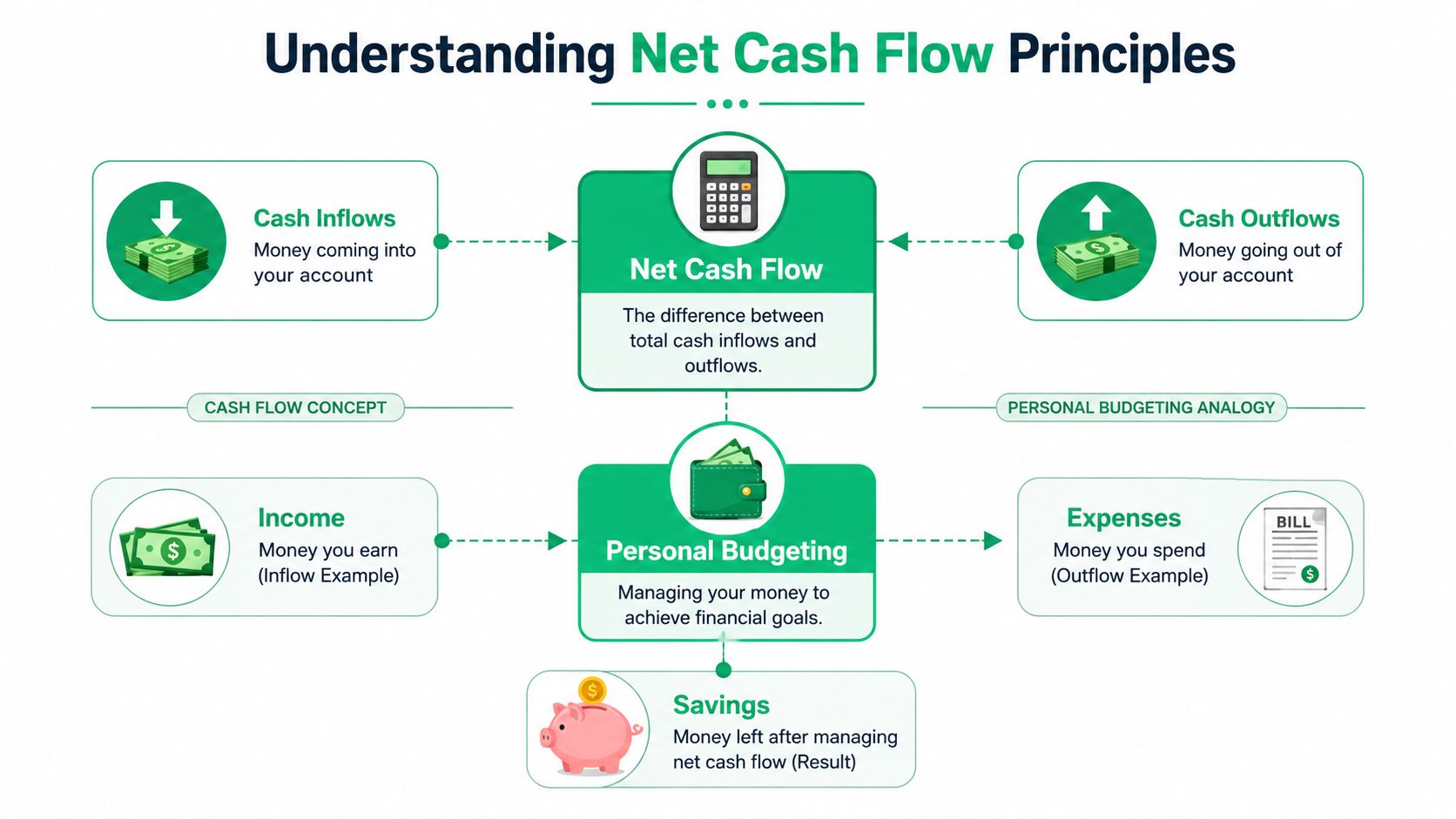
Think of net cash flow like a household budget at the end of the month. Money coming in from salary is one side, bills and groceries are the other, and the amount left over is what you can use. The same logic applies to a subscription business, except the timing is messier because card failures, refunds, and billing cycles can shift cash in ways that don't show up in the revenue line right away.
The core formula is total cash inflows minus total cash outflows. That formula is why net cash flow is a liquidity measure, not a profitability measure, and why a business can show accounting profit while still being short on usable cash. As the source guide notes, net cash flow can also be expressed as operating cash flow plus investing cash flow plus financing cash flow, which helps separate day-to-day operations from long-term spending and capital structure changes (Investopedia).
Why subscription teams should care
In a subscription model, the issue isn't just whether customers bought. It's whether their payments cleared, whether refunds landed, whether failed cards were recovered, and whether cancellations were offset by save offers or reactivation paths. Those timing details change the cash picture even when top-line revenue looks steady.
Practical rule: if the cash balance is your fuel tank, net cash flow tells you whether the tank filled up or drained during the period.
That's why many finance teams read it alongside the cash account movement on the statement of cash flows, and not in isolation. A useful internal reference for accrual timing is this guide on accrued revenue journal entry, since billed revenue and collected cash don't always move together.
The operational takeaway is straightforward. If inflows exceeded outflows, net cash flow is positive. If outflows won, it's negative. For a SaaS operator, that sign matters more than almost anything else in the short run because it tells you whether the business can pay near-term obligations without scrambling.
Components of Cash Flow Activities
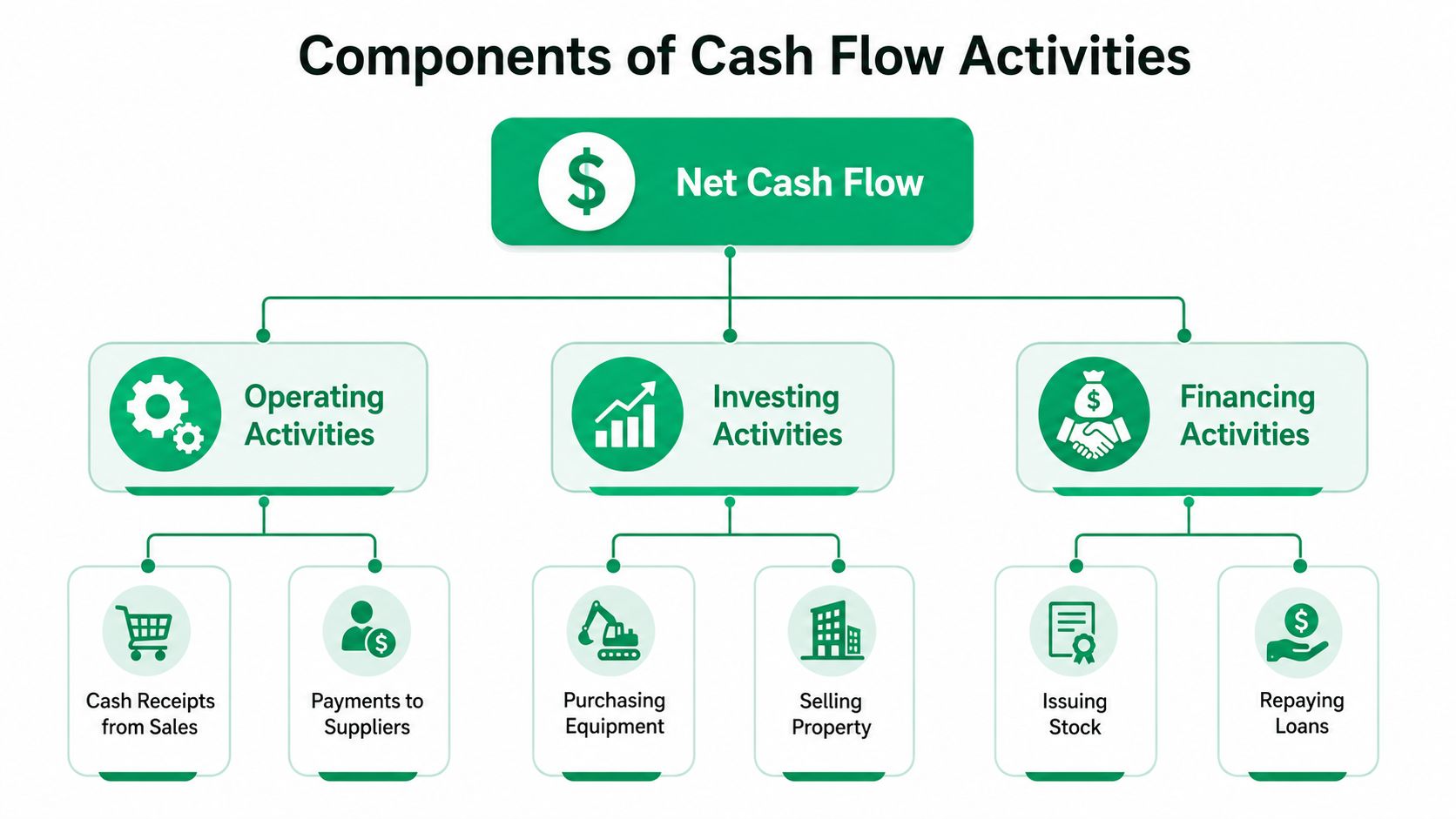
The cash flow statement breaks movement into operating, investing, and financing activities. That structure is now widely taught because it separates cash generated by the core business from cash used to buy long-term assets or reshape capital structure, and that framework is a standard way to interpret cash movement across major markets (Capital City Training).
Operating activities carry the business
Operating cash flow comes from the core subscription engine. Cash receipts from customers, refunds, supplier payments, payroll, and collection timing all land here. For a SaaS company, this is the section most closely tied to retention quality and billing performance, because recurring revenue only becomes cash when customers pay.
Cash from operations tells you whether the business is self-funding its day-to-day engine.
Investing activities reflect long-term bets
Investing cash flow includes spending on long-lived assets, like software development that's capitalized, equipment, or other buildout costs. These outflows can make net cash flow look weaker even when the business is growing, because the company is converting cash into future capacity. That's why a subscription company can look profitable and still be cash negative during expansion.
Financing activities change the capital structure
Financing cash flow covers things like raising capital or repaying loans. A financing round can make net cash flow positive for a period even if operations are still negative, while debt repayment can pull cash out faster than revenue can replenish it. That's also why finance teams should never confuse a cash inflow from funding with operating strength.
A simple way to categorize each movement is to ask what produced it, the customer base, a long-term asset decision, or the capital stack. If you want a practical companion to revenue timing and recognition issues, the internal guide on deferred revenue definition pairs well with this framework.
Comparing Net Cash Flow and Related Metrics
For subscription operators, one number rarely tells the full story. Net cash flow tells you how cash moved. Net income tells you how accounting profit moved. Operating cash flow isolates cash from core operations. Those are related, but they answer different questions.
| Metric | Definition | Focus |
|---|---|---|
| Net cash flow | Cash inflows minus cash outflows across operating, investing, and financing activities | Liquidity |
| Net income | Revenue minus expenses under accrual accounting | Profitability |
| Operating cash flow | Cash generated or used by core business operations | Operational cash generation |
| Free cash flow | Cash remaining after operating needs and capital spending | Financial flexibility |
The key distinction is that a SaaS business can post strong accounting profit and still have weak or negative net cash flow if it spends heavily on customer acquisition, capitalized software, or debt service. That point is especially important in subscription models, where revenue recognition and cash collection don't always match up cleanly (Wall Street Prep).
Which number should you trust first
For runway planning, net cash flow deserves immediate attention because it shows what happened to the actual cash. For product and growth decisions, operating cash flow can be more useful because it filters out financing noise. For board discussions, net income still matters, but only when you already understand whether the business is generating usable cash.
If you want to connect these metrics to broader SaaS reporting, this internal overview of subscription business metrics helps frame where cash flow sits in the full operating picture.
A founder who only watches net income can miss a slow liquidity problem. A founder who only watches net cash flow can miss whether the business is building a durable engine. The best operators use both, but they lead with cash when deciding whether to hire, spend, or wait.
Subscription Business Cash Flow Scenarios
Subscription businesses have a different cash flow personality than one-time sale businesses. Churn, retries, failed cards, save offers, and recovery timing can all shift cash without changing the headline revenue story, which is why generic cash flow guides often miss the key pressure points (SumUp).
Scenario one, the save offer that flatters the short term
A customer clicks cancel, sees a targeted offer, and stays for another billing cycle. On paper, that looks like a win because revenue was preserved. In cash terms, the result is more complicated, because the immediate cash bump may hide a product problem, a pricing issue, or a support gap that will show up again later.
The business may feel better this month and still be weaker next quarter. If the underlying churn driver stays unresolved, the save offer improves cash timing, not necessarily cash quality. That distinction matters because a one-time retention intervention can create a temporary net cash flow lift without fixing the reason customers wanted out.
Scenario two, the retry cycle that improves collections
A failed payment doesn't always mean a lost customer. Smart retries, card update prompts, and gentle recovery messaging can turn a missed charge into collected cash later in the period. That improves net cash flow directly because money that would have leaked out of MRR is converted into actual receipts.
But the experience has to be managed carefully. If the retry sequence is too aggressive, support tickets rise and trust falls. If it's too weak, you leave cash on the table. The right design depends on whether the business is trying to rescue involuntary churn, preserve customer experience, or both.
The right question isn't just whether cash came back. It's whether the recovery path created durable retention or only delayed the loss.
Why timing changes the story
In both cases, the core issue is timing. Cash can improve before retention improves, and retention can look stable while cash erodes. That's why subscription finance teams should treat churn, payment failures, and recovery as cash flow variables, not just customer success metrics.
Interpreting Net Cash Flow and Avoiding Mistakes
A positive net cash flow number can be reassuring, but it doesn't automatically mean the business is safe. A financing round can inflate cash for a period. A delayed vendor payment can make cash look better than it really is. A collection spike can hide the fact that receivables are still dragging the balance sheet.
The most common mistake is treating positive net cash flow as the same thing as overall financial health. It isn't. Another source of confusion is the ending cash balance, which is closely related but not identical to the flow itself. Many explanations define net cash flow as inflows minus outflows and stop there, without answering the manager's real question, whether the period ended with more available cash (Baremetrics).
Read the source of cash, not just the sign
A subscription business should always ask where the cash came from. If the answer is operations, that's usually more durable than if the answer is financing. If the answer is aggressive collections but weak retention, the cash improvement may be temporary.
| Good question | Why it matters |
|---|---|
| Was the cash generated by customers or investors? | Investor cash can mask operating weakness |
| Did a retry system recover failed payments? | Recovery timing affects spendable liquidity |
| Are cancellations being delayed, or truly reduced? | Delays can flatter the current period |
| Are debt payments consuming cash? | Obligations can erode runway quickly |
Don't ignore the ending balance
Net cash flow is a flow measure. The ending cash balance is a stock measure. You need both to understand whether the business is moving in the right direction and whether it still has enough cash to survive the next billing cycle, payroll run, or vendor payment.
Watch for this: a positive month can still leave the company under pressure if the opening balance was already thin.
That's why cash flow interpretation should sit alongside runway thinking, not replace it. In SaaS, the wrong read on cash often comes from focusing on the story the revenue line tells instead of the story the bank account tells.
Improving Net Cash Flow with Practical Strategies
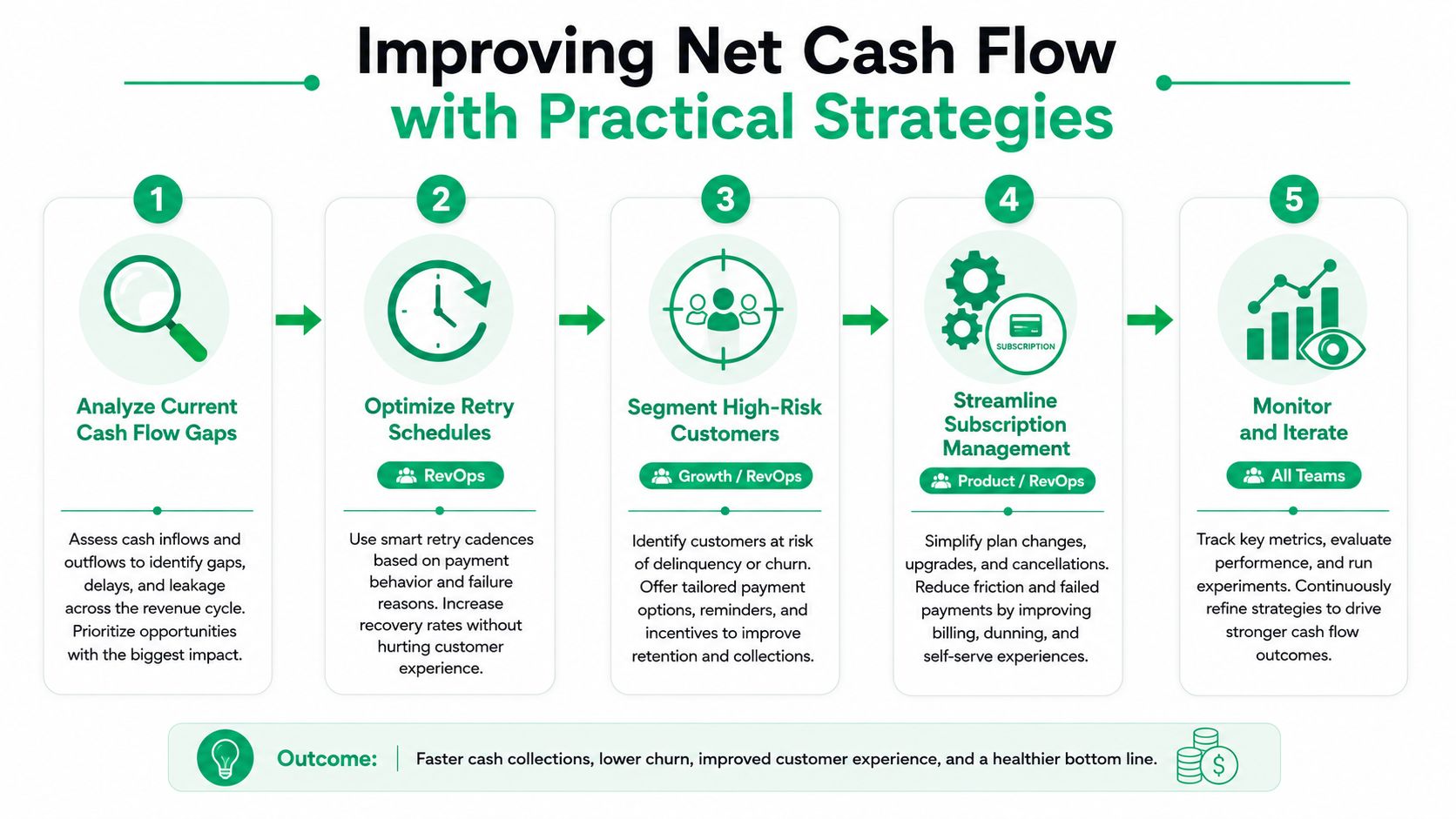
The most useful cash flow improvements in SaaS usually come from better timing, better recovery, and less leakage. In working-capital terms, shortening collection cycles and managing payables timing improve net cash flow because they keep more cash in the business in the short term (Agicap).
Start with the gaps
First, identify where cash is slipping. Look at failed payments, cancellation reasons, invoice lag, and vendor timing together, not as separate problems. If the business is losing money at the collection stage, growth spend won't fix the gap.
Tighten retry and recovery paths
Retry schedules should match the customer base, not just a generic billing rule. A team that monitors failed payments can recover more cash by coordinating email reminders, in-app prompts, and card update flows. That's also where a tool like Revcover can fit, since it connects cancellation intent, save offers, and payment recovery into one workflow.
Segment customers by risk
Not every customer should receive the same save offer or retry sequence. High-value accounts, card-expiry risks, and customers showing repeated billing friction need different treatment. That's a cash flow decision, not just a customer success decision, because the wrong intervention can add cost without improving recovery.
Reduce unnecessary cash drag
Invoice faster, review vendor terms, and cut spending that doesn't support retention or recovery. Those moves won't solve a product issue, but they can buy time while the team fixes the leak. If you want a broader checklist for operational improvements, AmbitionCFO's cash flow management tips can complement the subscription-specific tactics here.
If the business can collect sooner, lose less to involuntary churn, and avoid unnecessary outflows, cash gets easier to manage without waiting for a funding event.
The best way to improve net cash flow is to treat it like an operating system, not a monthly report. Measure the leak, change the process, and check whether the cash shows up.
Conclusion and Next Steps
Net cash flow is the clearest short-term answer to whether a subscription business has enough cash to keep moving. It's a liquidity metric, and it becomes more useful, not less, when you break it into operating, investing, and financing activities and then read it through the lens of churn, retries, and recovery timing.
The biggest mistake SaaS operators make is assuming stable revenue means stable cash. It doesn't. Cash flow can weaken while revenue looks fine, and it can improve temporarily when financing or one-time recovery events mask a deeper retention problem.
The next step is simple. Review net cash flow on a regular cadence, separate operating movement from financing noise, and treat billing recovery and churn reduction as cash disciplines, not just growth tactics. If you're already tracking subscription signals in your stack, connect them to cash outcomes so the team can see which interventions put money back in the account.
If you want a clearer way to connect churn recovery, save offers, and payment retries to actual revenue outcomes, Revcover gives subscription teams a workflow for capturing cancellation intent and recovering failed payments in one place. It helps you see which interventions convert into recovered cash, so your team can make decisions based on liquidity, not guesses.