
Accrued Revenue Journal Entry for SaaS & Subscriptions

Ayush Soni
Founder, Revcover

On this page
- Why Accrued Revenue Matters for SaaS Reporting
- The mismatch SaaS teams run into every month
- What accrued revenue fixes
- The Complete Accrued Revenue Journal Entry Lifecycle
- The initial accrual
- The reversal and invoice step
- The cash collection entry
- Aligning Accruals with ASC 606 Revenue Recognition
- What counts as satisfying a performance obligation
- Why the invoice date often gives the wrong answer
- Accrued revenue and deferred revenue are mirror issues, but they create different close risks
- The SaaS Challenge Accrued Revenue in a Stripe World
- Where automation helps and where it breaks the model
- Failed payments create earned but awkward revenue
- What works in practice
- Practical Accrual Examples for Subscription Models
- Annual contract with implementation work
- Usage-based billing recognized before invoicing
- Recovered failed payment after a pause period
- Common Mistakes and Month-End Best Practices
- Errors that distort SaaS reporting
- A month-end process that holds up
Your close is tomorrow. Stripe has already generated some invoices, delayed others, and retried a few failed payments. Customer success says the enterprise account is live and using the product. Finance says the invoice date sits in the next period. Growth is looking at MRR movement, but accounting needs the books to reflect what was earned.
That's where accrued revenue stops being a textbook term and becomes an operating requirement.
In a SaaS business, the gap between service delivery and billing is everywhere. It shows up in off-cycle contracts, implementation work, usage-based billing, mid-cycle plan changes, and accounts stuck in dunning. If you wait for the invoice to tell you when revenue exists, your reporting will drift away from the business your team ran.
Why Accrued Revenue Matters for SaaS Reporting
A subscription business can deliver a full month of service and still look artificially soft if billing lands later. That problem gets worse when you have enterprise contracts with custom billing dates, services that finish before invoicing, or product access that starts before the invoice is issued. Finance sees a timing gap. Leadership sees a reporting problem.
Under GAAP, accrued revenue is recognized when the performance obligation is satisfied. If a company delivers a service worth $25,500 at month-end but hasn't billed yet, the entry is to debit Accrued Revenue for $25,500 and credit Sales Revenue for $25,500, as explained in Chargebee's overview of GAAP treatment for accrued revenue.
The mismatch SaaS teams run into every month
In SaaS, the mismatch usually looks like this:
- Service starts before billing because the customer was activated quickly and invoicing follows an internal approval flow.
- Implementation work is complete but the bill goes out after signoff.
- Usage is known at month-end while the invoice is generated later.
- Renewal dates don't match reporting periods so earned revenue and invoice timing drift apart.
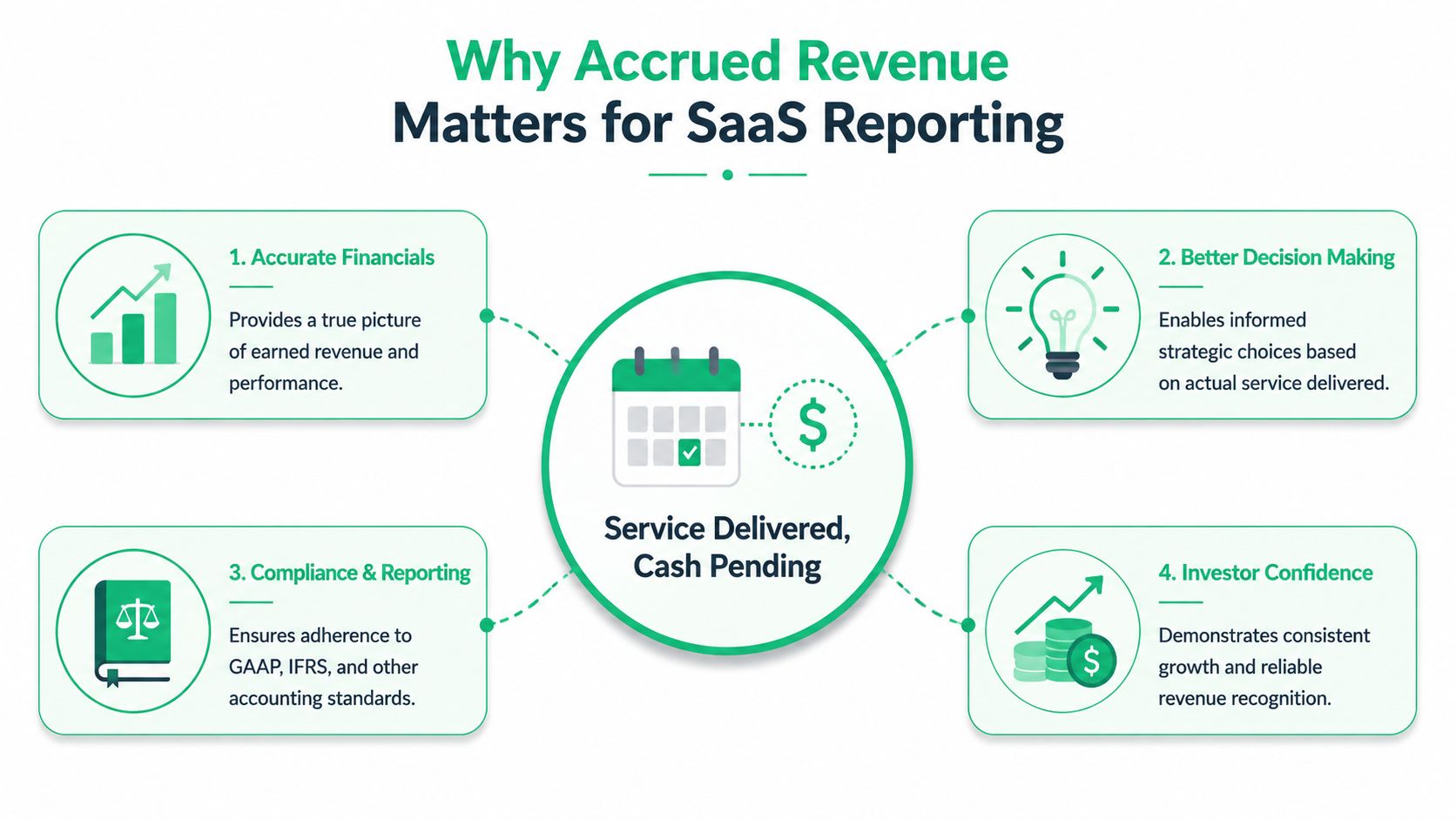
That's why accrued revenue matters beyond compliance. It protects management reporting from billing mechanics.
When teams skip accruals, they usually create second-order problems:
| What happens | Why it hurts |
|---|---|
| Revenue looks lower in the current period | Leadership underestimates actual delivery |
| The next period looks inflated | Trend lines become less reliable |
| MRR discussions get noisy | Ops and finance stop speaking the same language |
| Collections reporting gets mixed with earned revenue | Teams lose sight of what was delivered vs. what was paid |
What accrued revenue fixes
Accrued revenue applies the matching logic SaaS operators need. You recognize what the team has already delivered, even when the billing system hasn't caught up. It records an asset on the balance sheet and keeps the income statement aligned with the period that earned the revenue.
Practical rule: If the customer received the service in this period and the invoice comes later, you likely need an accrued revenue review before you close.
This is also why finance teams that care about retention and collections often pair accrual reviews with receivables discipline. A clean aging report workflow helps separate three very different questions: what was earned, what was billed, and what is overdue.
The Complete Accrued Revenue Journal Entry Lifecycle
The mechanics are simple once you separate the stages. Many accounting departments get into trouble because they post the first entry and forget the rest, or they let billing automation create duplicate revenue.
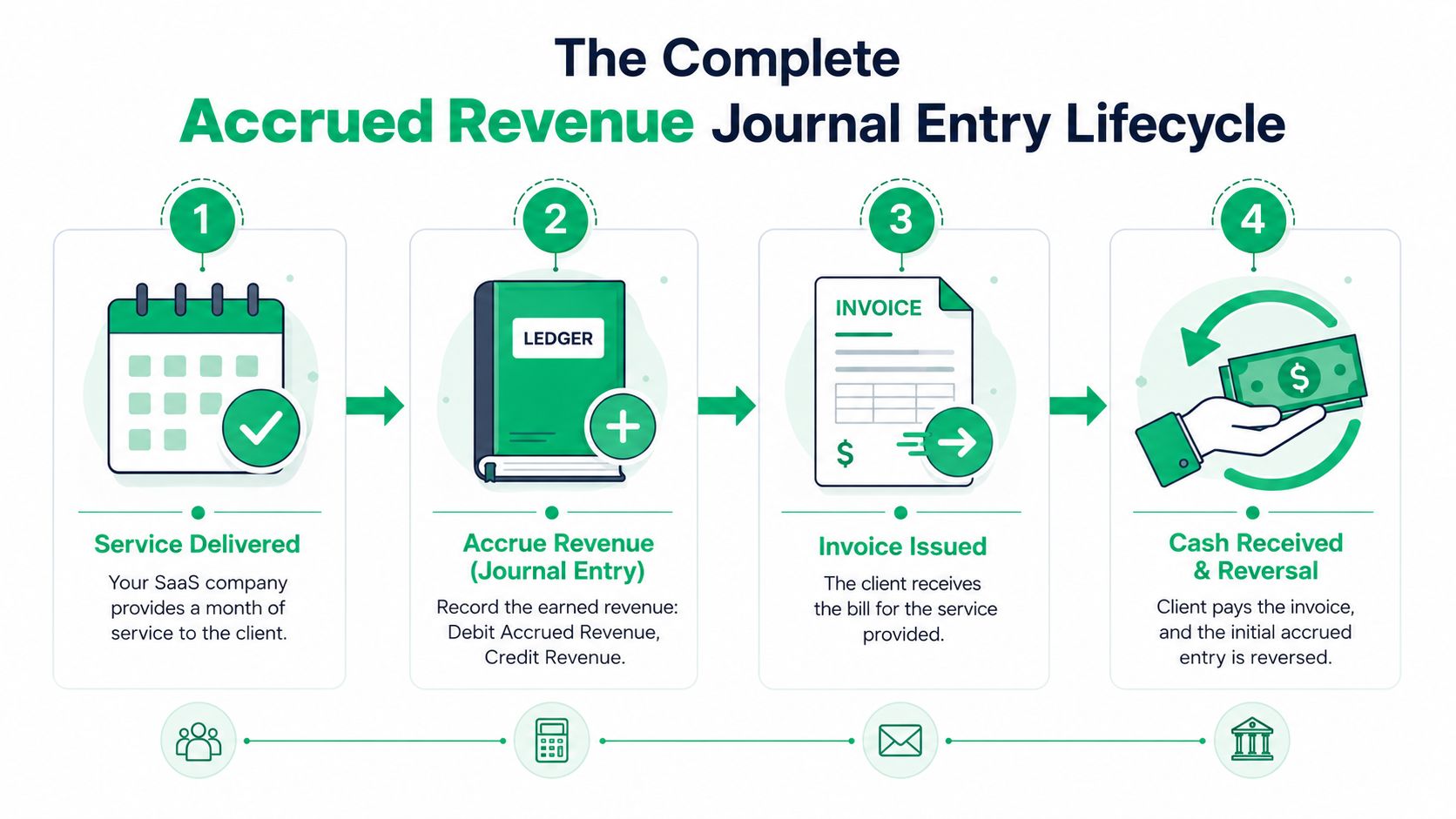
Tipalti describes the lifecycle clearly in its guide to how accrued revenue moves from accrual to invoicing to cash collection. For a $25,500 service, the flow is the initial accrual, the reversal upon invoicing, and the cash receipt entry. In practice, many SaaS teams think of this as four operational moments because the invoice entry is its own bookkeeping event.
The initial accrual
Start with earned but unbilled revenue. The service has been delivered, but no invoice exists yet.
For the $25,500 example, the adjusting entry is:
- Debit Accrued Revenue for $25,500
- Credit Sales Revenue for $25,500
This puts the earned amount on the income statement and creates a current asset on the balance sheet. The asset reflects the value you expect to convert into a formal receivable once invoicing happens.
A good explainer is useful here if you're training a team member or aligning with a controller:
The reversal and invoice step
When billing catches up, the accrued amount needs to come off the temporary asset account. This is the step teams miss most often.
First, reverse the accrual:
- Debit Sales Revenue for $25,500
- Credit Accrued Revenue for $25,500
Then record the invoice normally:
- Debit Accounts Receivable for $25,500
- Credit Sales Revenue for $25,500
That sequence matters. Without the reversal, you end up recognizing revenue once in the accrual period and again when the invoice posts. The result is overstated revenue.
Reverse first, invoice second. If your ERP or close checklist doesn't force that order, someone will eventually double-count revenue.
The cash collection entry
Once the customer pays, you clear the receivable:
- Debit Cash for $25,500
- Credit Accounts Receivable for $25,500
At that point, the earned revenue is unchanged. Only the asset type changes. You move from unbilled earned revenue, to billed receivable, to cash.
A simple way to think about the full lifecycle is this:
| Stage | Debit | Credit | What changed |
|---|---|---|---|
| Earned but unbilled | Accrued Revenue | Sales Revenue | Revenue recognized, asset created |
| Invoice reversal | Sales Revenue | Accrued Revenue | Temporary asset removed |
| Invoice posting | Accounts Receivable | Sales Revenue | Formal receivable created |
| Cash collection | Cash | Accounts Receivable | Receivable settled |
This is the backbone of every accrued revenue journal entry, even when the actual situation gets messy.
Aligning Accruals with ASC 606 Revenue Recognition
Month-end usually exposes the gap between billing activity and revenue reality. A customer may have had access all month, used the product, and even expanded seats mid-cycle, while the invoice is still pending or stuck behind a failed charge. Under ASC 606, revenue recognition follows the performance obligation, not the billing event.
For a SaaS company, that means the accounting team has to answer a practical question: what did the customer receive during the period?
What counts as satisfying a performance obligation
The answer depends on what you sold.
For a standard subscription, the performance obligation is often satisfied over time as the customer receives access to the platform. For onboarding, migration, or implementation work, recognition may depend on whether those services are distinct and when the promised work is completed. The FASB's ASC 606 guidance overview frames this around transfer of control, but in practice SaaS teams usually need cleaner operating evidence than accounting language alone provides.
That evidence often sits outside the general ledger. Product access dates, provisioning logs, statement-of-work milestones, usage records, and support or implementation signoff all help prove that revenue was earned, even if billing has not caught up yet.
Why the invoice date often gives the wrong answer
Invoice timing is an operational event. Revenue timing is an accounting conclusion.
Those two line up in simple subscription setups. They drift apart fast when the business gets more complex. A contract can start on the 17th while billing runs on the 1st. A customer can upgrade halfway through the month. A payment can fail while service remains active during dunning. In each case, the earned amount for the close may differ from what Stripe or the ERP has billed.
That is why accrued revenue decisions should start with service delivery and contract terms, then reconcile back to billing data. Teams that do it the other way around usually spend close week explaining variances they created themselves.
Accrued revenue and deferred revenue are mirror issues, but they create different close risks
Accrued revenue means the company has earned revenue before invoicing or cash collection. Deferred revenue means the company has billed or collected cash before delivering the service. If your team still collapses those into one bucket during close, it helps to standardize the distinction with a clear reference like this guide to deferred revenue definition.
The trade-off is speed versus precision. You can book a top-side accrual based on a reasonable estimate and close faster, or you can wait for every billing exception to resolve and slow the close. In a fast-moving SaaS business, the better approach is usually controlled estimation backed by supportable evidence, then a clean true-up once invoices, usage, or payment outcomes are final.
If revenue recognition depends entirely on whether an invoice exists, billing logic is driving the close. ASC 606 requires the opposite.
The SaaS Challenge Accrued Revenue in a Stripe World
Stripe is excellent at automating billing operations. It is not a substitute for accrual judgment. That difference is where many SaaS teams get stuck.
Stripe's own resource on accrued revenue versus deferred revenue in modern businesses notes that 68% of SaaS companies struggle with timing mismatches between service delivery and invoice generation. That's the practical gap between accounting theory and the subscription stack companies run.
Where automation helps and where it breaks the model
Automation is strong when the billing cycle lines up neatly with service delivery. Monthly subscription starts on the first, invoice goes out on the first, no mid-cycle changes, no failed payments, no manual services. In that narrow case, the billing system and revenue pattern often stay close enough to avoid special handling.
The trouble starts when the business stops being neat:
- Custom contract dates create earned revenue before the invoice run.
- Mid-cycle upgrades or downgrades split the service period into multiple pricing states.
- Usage-based billing leaves consumption earned before invoice generation.
- Implementation and onboarding services finish on a timeline that rarely matches recurring billing.
- Failed payments can interrupt the billing sequence while service access continues.
In those cases, the invoice is often late, early, partial, or mechanically correct but economically incomplete.
Failed payments create earned but awkward revenue
This is the area most generic accounting guides skip. A customer's payment fails. The subscription enters dunning. Product access may continue during recovery attempts. Customer success may be trying to save the account. Billing is now unstable, but service may still be live.
That creates a hard question. If the customer consumed service during the failed-payment window and you later recover the account, when did you earn that revenue?
Baremetrics highlights the scale of the operational blind spot in its discussion of unearned revenue and related SaaS accounting issues. It states that 42% of SaaS churn is involuntary and 95% of these companies have no standardized process for the accrued revenue question during pause and recovery scenarios.
The accounting challenge isn't abstract. It affects how you treat:
- Grace periods where access continues after payment failure
- Temporary pauses while retries or card updates are in progress
- Recovered subscriptions where billing resumes after a gap
- Eventual cancellations after some service was delivered but not cleanly billed
What works in practice
The best operating model I've seen is simple on paper and disciplined in execution.
First, don't let Stripe event timing stand in for performance timing. Use product access records, contract terms, service logs, and billing status together.
Second, define a policy for failed-payment periods. If access continues, finance needs a documented position on whether service during that window creates earned but unbilled revenue, and what evidence supports it.
Third, separate these decision layers:
| Layer | Question |
|---|---|
| Revenue recognition | Was the service delivered? |
| Billing | Has the invoice been issued? |
| Collections | Has cash been received? |
| Recovery | Was the account saved after failure or cancellation intent? |
Teams that close cleanly don't ask one system to answer all four questions. They assign each question to the right data source.
What doesn't work is relying on a single Stripe invoice timestamp and assuming the accounting follows automatically. In modern SaaS, that shortcut usually breaks as soon as you add enterprise contracts, recovery flows, or plan changes.
Practical Accrual Examples for Subscription Models
The theory gets easier once you tie it to actual subscription workflows. The numbers below stay qualitative unless a verified amount is available, but the mechanics are the same ones finance teams use during close.
Annual contract with implementation work
A customer signs an annual software deal that includes implementation services. The subscription invoice follows a standard schedule, but the implementation work is delivered unevenly. One milestone is complete at month-end, while billing for that services portion won't happen until the customer signs off.
In that case, review the contract and the completion evidence. Ramp's framework for calculating accrued revenue from work completed gives a practical formula: Accrued Revenue = Total Contract Value × (Work Completed ÷ Total Project Period). For fixed-fee work, that means assigning the earned portion based on actual completion, not invoice status.
The journal logic is straightforward:
- At close, debit Accrued Revenue and credit Sales Revenue for the earned but unbilled implementation amount.
- When invoiced, reverse the accrual and record Accounts Receivable.
- When collected, debit Cash and credit Accounts Receivable.
The key trade-off is estimation discipline. If implementation leaders overstate completion, finance records revenue too early. If they wait for signoff on everything, revenue gets pushed too late.
Usage-based billing recognized before invoicing
Usage models create one of the cleanest accrued revenue cases in SaaS. By the last day of the month, the company knows how much service was consumed. The invoice is generated later after rating, review, or customer-specific processing.
This usually works well if ops follows a three-part checklist:
- Lock the usage period so engineering and finance agree on what counts.
- Calculate the earned amount from the contract rate and actual measured consumption.
- Post the accrual before close if billing happens in the next period.
A short decision table helps:
| Situation | Accounting response |
|---|---|
| Usage is measurable and earned by month-end | Accrue earned revenue |
| Usage data is incomplete or disputed | Hold until evidence is reliable |
| Invoice posts in the next period | Reverse accrual when billing occurs |
This is one of the rare cases where the accounting answer is usually operationally clear. The harder part is data governance, not journal mechanics.
Recovered failed payment after a pause period
SaaS teams need policy, not just bookkeeping. A customer's card fails. Billing pauses while retries, reminders, or card updates run. Product access continues for part of that period. The customer is later recovered and the subscription stays active.
Baremetrics' earlier-cited figures show why this matters operationally, but the accounting answer still depends on your facts and policy. The practical approach is to ask three questions in order:
- Did the customer continue receiving service during the failed-payment window?
- Can you support that with access or delivery evidence?
- Did the later recovery result in billing for that consumed period?
If the answer is yes across those points, many teams will treat that interval as earned but temporarily unbilled revenue, then reverse and convert it when billing resumes. If the customer ultimately cancels and the company decides the amount is not collectible or not billable under the contract, the accrual may need to be reversed instead of converted into receivables.
Don't build this process around hope. Build it around contract language, access records, and a written accounting policy reviewed by finance leadership.
What usually fails here is inconsistency. One analyst accrues grace-period revenue, another doesn't. One team uses subscription status, another uses access logs. The result is noisy revenue and painful audit support.
Common Mistakes and Month-End Best Practices
Most accrued revenue problems aren't caused by difficult debits and credits. They come from weak close habits. Someone posts the accrual manually, Stripe posts the invoice later, and nobody ties the two events together.
Errors that distort SaaS reporting
These are the mistakes I'd watch first:
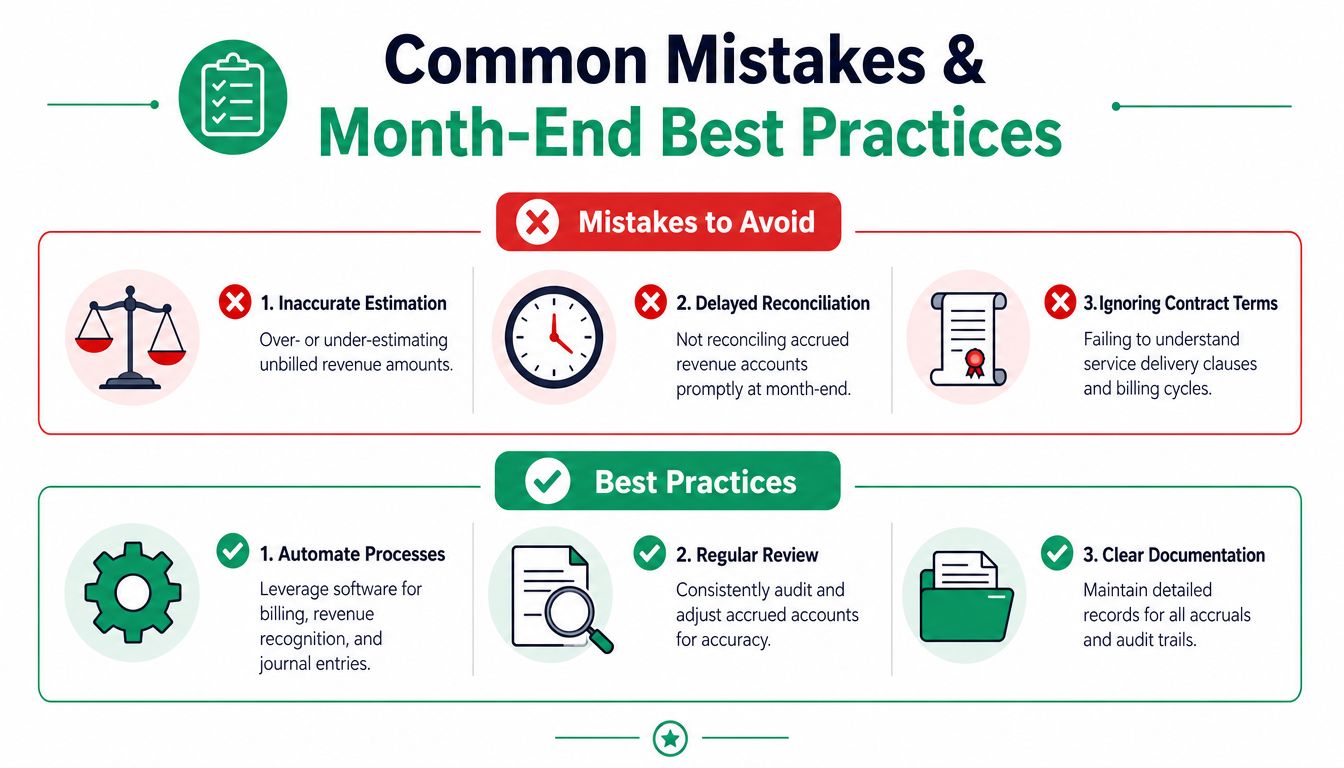
- Forgetting the reversal: Ramp notes in its guide to month-end accrued revenue workflows that failing to reverse after invoicing inflates revenue in the following period.
- Confusing accrued and deferred revenue: They solve opposite timing problems.
- Using billing dates as proof of earned revenue: That works only when service delivery and invoice timing match.
- Skipping support files: If you can't show contract terms, service logs, or access evidence, the entry won't hold up under review.
A month-end process that holds up
A stronger process is usually boring, which is exactly what you want in accounting.
- Review open contracts: Look for completed work, active service periods, and unbilled amounts before the books close.
- Track accruals by type: Separate implementation, usage-based, and subscription timing accruals so reversals are easier to audit.
- Reconcile after invoicing: Match each accrual to its invoice or reversal outcome in the next period.
- Use software, but verify manually: Billing tools are efficient. They are not a substitute for policy checks, especially if your team is comparing systems like FreshBooks, Xero, and QuickBooks for close workflows.
If there's one rule worth standardizing, it's this: every accrued revenue journal entry should have a named owner, documented support, and a scheduled reversal path. That's what keeps a fast-moving SaaS close from turning into cleanup work next month.
If your team is dealing with failed payments, cancellation intent, and messy subscription edge cases on top of normal billing, Revcover helps SaaS businesses coordinate payment recovery and retention workflows alongside Stripe. That makes it easier to reduce revenue leakage operationally while finance keeps a cleaner line between earned revenue, billed revenue, and recovered revenue.