
FreshBooks vs Xero vs QuickBooks: SaaS Accounting Guide 2026

Ayush Soni
Founder, Revcover
On this page
- Choosing Your SaaS Accounting Command Center
- A Quick Overview of the Contenders
- What each platform is really optimized for
- Why this matters for subscription companies
- Comparing Core Accounting Features for SaaS
- What matters in day-to-day finance operations
- How architecture changes reconciliation work
- The SaaS Feature Showdown Stripe RevRec and Churn Reporting
- SaaS Feature Comparison FreshBooks vs Xero vs QuickBooks
- Where the real gap appears
- Revenue attribution is the hidden decision factor
- Analyzing Pricing Models and True Scalability
- Entry price is not operating cost
- When the cost curve changes
- Migration Considerations and Integration Headaches
- What usually breaks during migration
- How to reduce switching pain
- The Final Verdict Which Platform Is Right for Your SaaS
Your finance stack probably looked fine when you had a handful of customers, one Stripe account, and a founder who could still explain every invoice from memory. Then subscriptions piled up. Refunds and prorations started muddying payout reconciliation. Someone asked for a clean view of retained revenue, and the answer was a spreadsheet no one fully trusted.
That's the moment accounting software stops being a back-office choice and becomes a revenue operations decision.
For a subscription business, the FreshBooks vs Xero vs QuickBooks debate isn't really about who has the nicest invoice template. It's about which system can stay reliable when Stripe is your billing engine, recurring revenue is your lifeblood, and churn management depends on getting clean financial signals out of messy payment events.
| Platform | Best fit for SaaS | Accounting depth | Stripe and subscription fit | Churn and recovery implications | Pricing posture |
|---|---|---|---|---|---|
| FreshBooks | Very early-stage or service-led SaaS | Lighter, invoicing-first | Works better for simple billing flows than complex subscription logic | More manual work to understand failed payments and cancellations | Lowest entry point for freelancer-style use |
| Xero | Growing SaaS with a modular stack | Strong core accounting | Better fit when you want flexibility and app-based extensibility | Usable if your team is comfortable assembling reporting across tools | Mid-market positioning |
| QuickBooks Online | Established SaaS with more reporting and compliance pressure | Deepest of the three in this comparison | Stronger base for finance rigor and broader operational workflows | Better foundation for downstream analysis, though not a native churn-recovery system | Higher ceiling, especially at advanced tiers |
Choosing Your SaaS Accounting Command Center
A subscription business needs one system that finance trusts, operators can work with, and leadership can use to explain revenue movement without rebuilding the story in spreadsheets. That system becomes your accounting command center.
The hard part is that none of these tools was built first and foremost as a SaaS retention platform. They were built as accounting products. That distinction matters because recurring billing creates edge cases that traditional bookkeeping workflows don't fully solve, especially once Stripe sits at the center of payment collection.
One data point should change how you evaluate this category. Recent analysis found that 38% of involuntary churn in subscription businesses stems from failed payment retries not properly coordinated by accounting software, and none of the major platforms offer native, sophisticated retry orchestration or real-time recovery attribution according to The Bottom Line CPA's comparison of Xero, QuickBooks, and FreshBooks.
Practical rule: If your accounting system records failed payments but can't help you connect them to retention outcomes, it's a ledger, not a churn-management layer.
That doesn't mean the choice is irrelevant. It means the right choice depends on how cleanly each platform supports your actual revenue workflow:
- Finance workflow: month-end close, deferred revenue handling, payout reconciliation, and auditability.
- Revenue workflow: linking Stripe billing events to invoices, credits, refunds, and customer records.
- Retention workflow: understanding whether a customer left by choice, by failed payment, or by process friction between systems.
In other words, the best answer in FreshBooks vs Xero vs QuickBooks depends less on bookkeeping basics and more on what breaks when a renewal fails, a downgrade hits mid-cycle, or a finance lead asks why net revenue retention slipped.
A Quick Overview of the Contenders
Some products win because they're broad. Others win because they stay narrow and simple. These three represent those philosophies clearly.

QuickBooks Online is the default benchmark for many US companies because it already fits how accountants, tax workflows, and banking connections tend to operate. QuickBooks holds about 35% to 40% of the US SMB accounting software market, while Xero holds roughly 18% and FreshBooks about 12%, based on TaxStra's QuickBooks vs Xero market analysis. Market share doesn't guarantee product fit, but it does signal familiarity, hiring convenience, and ecosystem gravity.
Xero sits in a different lane. It appeals to teams that want cloud-native workflows and a more modular setup. In practice, that often suits SaaS operators who already expect finance software to plug into a broader stack rather than serve as a single monolith.
FreshBooks is the specialist. Its center of gravity is invoicing, time tracking, and service-business simplicity. That focus is a strength when the finance motion is straightforward. It becomes a limitation when your billing model starts producing subscription complexity faster than the platform can express it cleanly.
What each platform is really optimized for
A RevOps lens changes the summary quickly:
- FreshBooks: best when billing is still human-scale, customer counts are manageable, and finance doesn't need deep subscription reporting from the accounting layer.
- Xero: best when your team wants stronger accounting foundations without immediately committing to the deepest enterprise-style reporting posture.
- QuickBooks Online: best when accounting rigor, reporting breadth, and downstream finance controls matter more than interface elegance.
The product you choose shapes who does manual cleanup later. Founders feel that first, then finance managers, then the team responsible for retention reporting.
Why this matters for subscription companies
A SaaS company doesn't just need software that closes books. It needs software that makes Stripe-generated activity interpretable. Subscription upgrades, partial refunds, coupon changes, failed charges, and reactivations all create accounting consequences.
That's where the FreshBooks vs Xero vs QuickBooks decision becomes less about brand preference and more about architectural bias. FreshBooks starts from invoicing simplicity. Xero and QuickBooks start from fuller accounting depth. If your revenue motion is becoming more system-driven than person-driven, that distinction usually decides the winner before the trial period ends.
Comparing Core Accounting Features for SaaS
SaaS companies still need the boring stuff done well. Bank feeds need to reconcile. Invoices need to map correctly. Finance needs reports that don't collapse under exceptions. The question is whether the software treats those tasks as first-class accounting work or as extensions of invoicing.
FreshBooks is optimized for service-based businesses with an invoicing-first model and lacks native inventory, while Xero and QuickBooks are full-featured accounting systems with built-in inventory tracking and more than 80 customizable reports according to Webgility's platform comparison. Inventory itself may not matter to most SaaS companies, but the underlying architecture does. A product built as a fuller accounting system usually handles complexity better even when that complexity isn't physical stock.
What matters in day-to-day finance operations
For subscription businesses, core accounting capability shows up in a few recurring pain points:
- Payout reconciliation: Stripe deposits rarely equal one invoice. They bundle fees, refunds, disputes, taxes, and multiple customer events into a single settlement flow.
- Audit trail quality: finance teams need to understand why a balance changed, not just that it changed.
- Reporting flexibility: recurring revenue businesses constantly need slices by plan, period, customer segment, and exception category.
FreshBooks can feel refreshingly simple if your team mostly sends invoices, tracks expenses, and wants quick visibility. But simplicity cuts both ways. When your finance lead needs to tie one payout back to many subscription events, a lighter accounting model often shifts work out of the platform and into manual review.
Xero and QuickBooks usually fit better once the business has more moving pieces. Their reporting depth matters less because “80+ reports” sounds impressive and more because flexible reporting helps finance answer operational questions without exporting raw data every time.
How architecture changes reconciliation work
The architecture gap is easy to miss in a demo. It becomes obvious at close.
A typical SaaS reconciliation workflow includes Stripe charges, failed renewals, recovered payments, credits, and occasional manual adjustments from support or sales. In an invoicing-first system, your team often has to interpret those events outside the product and then push a simplified accounting result inward. In a fuller accounting system, you're more likely to maintain the accounting logic inside the platform and let integrations map events into it.
That changes who owns the work.
| Workflow need | FreshBooks | Xero | QuickBooks Online |
|---|---|---|---|
| Simple invoicing | Strong | Strong | Strong |
| Deep accounting structure | More limited | Strong | Strong |
| Report customization | More limited | Strong | Strong |
| Best fit for complex reconciliation | Less ideal | Better | Better |
| Natural fit for service businesses | Very strong | Moderate | Moderate |
If Stripe is producing the truth and accounting software is only receiving a summary, your team should expect attribution gaps later.
For a SaaS operator, that's the core takeaway from freshbooks vs xero vs quickbooks at the accounting layer. FreshBooks lowers friction early. Xero and QuickBooks lower cleanup later.
The SaaS Feature Showdown Stripe RevRec and Churn Reporting
The basic accounting comparison only gets you halfway to a decision. Subscription businesses live or die on how well systems handle recurring billing logic, revenue timing, and the story behind churn.
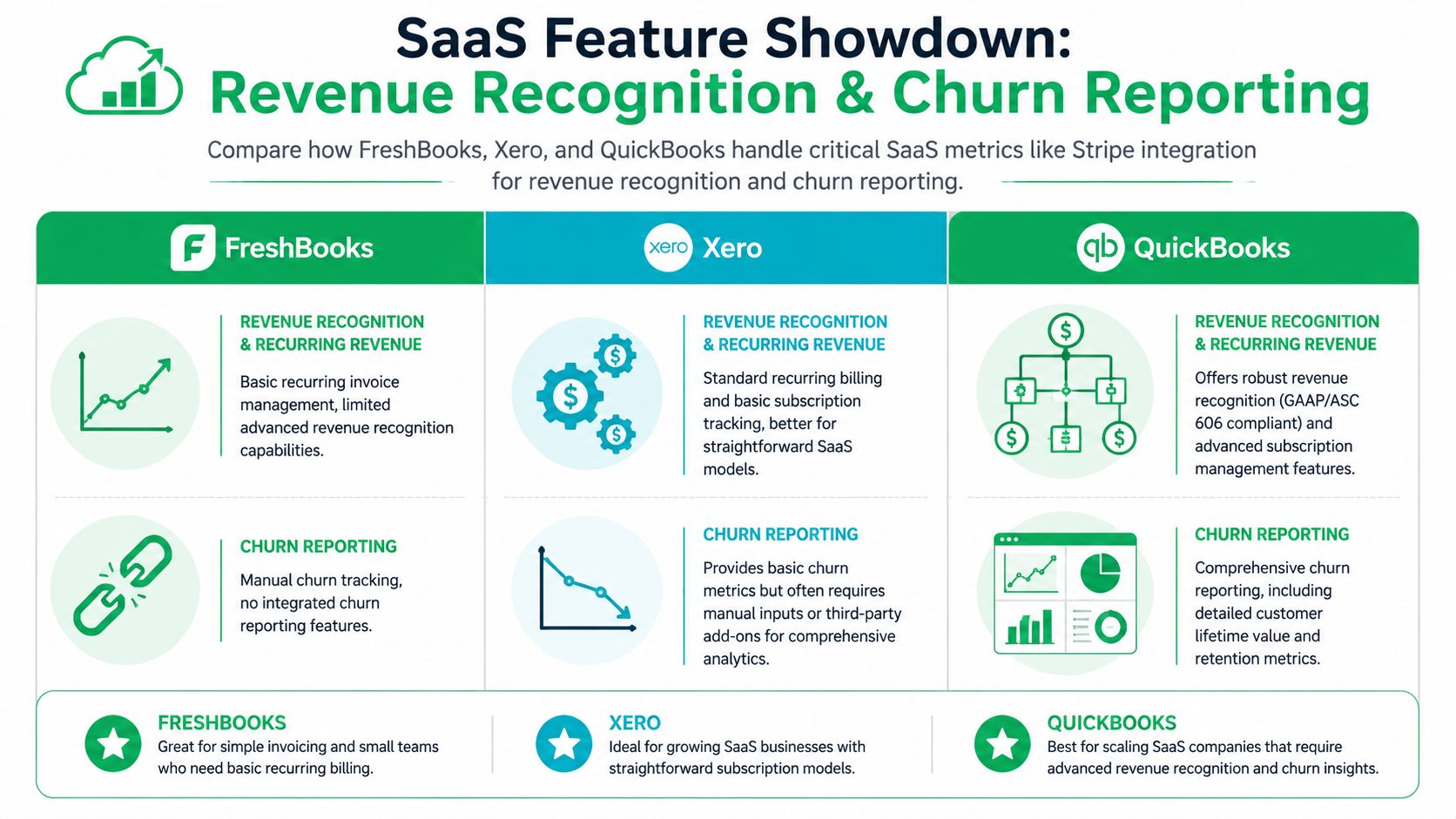
SaaS Feature Comparison FreshBooks vs Xero vs QuickBooks
| Feature | FreshBooks | Xero | QuickBooks Online |
|---|---|---|---|
| Stripe data flow fit | Better for simpler billing setups | Better for modular integration stacks | Better when finance wants broader accounting control |
| Recurring revenue visibility | Basic | Moderate with add-ons and process design | Stronger accounting foundation for advanced workflows |
| Revenue recognition readiness | Limited for complex SaaS needs | More workable for straightforward setups | Better aligned with mature finance requirements |
| Native churn reporting | Limited | Limited | Limited relative to dedicated SaaS analytics tools |
| Failed payment recovery orchestration | Not native | Not native | Not native |
| Recovery attribution to revenue | Not native | Not native | Not native |
Where the real gap appears
Here's the uncomfortable truth. Even the strongest accounting platform in this group is not a full churn operations system.
FreshBooks, Xero, and QuickBooks can all participate in the revenue data flow. None of them natively solves the operational gap between a failed charge and a recovered subscription outcome. That matters because failed payments are not just accounting events. They're preventable revenue leaks if your systems coordinate well, and invisible churn if they don't.
For RevOps teams, that creates three practical questions:
- Can Stripe events land in accounting cleanly enough for finance to trust the books?
- Can the team tell whether a lost customer was voluntary churn or billing failure?
- Can anyone attribute recovered revenue back to the intervention that saved it?
Most standard accounting comparisons stop at the first question. Subscription businesses need all three.
Revenue attribution is the hidden decision factor
The best choice often comes down to where you want complexity to live.
FreshBooks keeps the accounting environment lighter, but that usually means subscription nuance gets interpreted elsewhere. Xero supports a more composable stack, which can work well if your operations team is comfortable stitching billing, analytics, and accounting together. QuickBooks usually gives finance the strongest home base for deeper reporting and control, but it still doesn't replace specialized retention tooling.
That distinction becomes clearer when finance starts working on revenue recognition and deferred revenue treatment. If your team needs a cleaner conceptual model for how recurring revenue is earned over time, this deferred revenue definition is the right framing. The accounting platform records the impact, but your revenue process determines whether the data arrives in a usable form.
A few practical implications follow:
- FreshBooks works if finance complexity is still low. If your SaaS is early, billing plans are simple, and the main job is collecting cash and keeping books tidy, it can be enough.
- Xero works if you prefer a best-of-breed stack. It's often the better middle ground when you expect to pair accounting with dedicated billing and reporting tools.
- QuickBooks works if controller-level discipline is already emerging. Once finance needs stronger structure, it tends to hold up better under policy, reporting, and close-process pressure.
Churn reporting inside accounting software is usually a lagging view of loss. Revenue teams need something closer to the moment the risk appears.
That's why freshbooks vs xero vs quickbooks shouldn't be framed as “which one does SaaS metrics best.” None is a native leader in churn recovery. The primary decision is which one gives your finance team the cleanest base while your billing and retention systems handle the rest.
Analyzing Pricing Models and True Scalability
Sticker price leads a lot of software evaluations in the wrong direction. SaaS finance teams care less about the cheapest starting plan and more about the point where the platform stops being efficient.
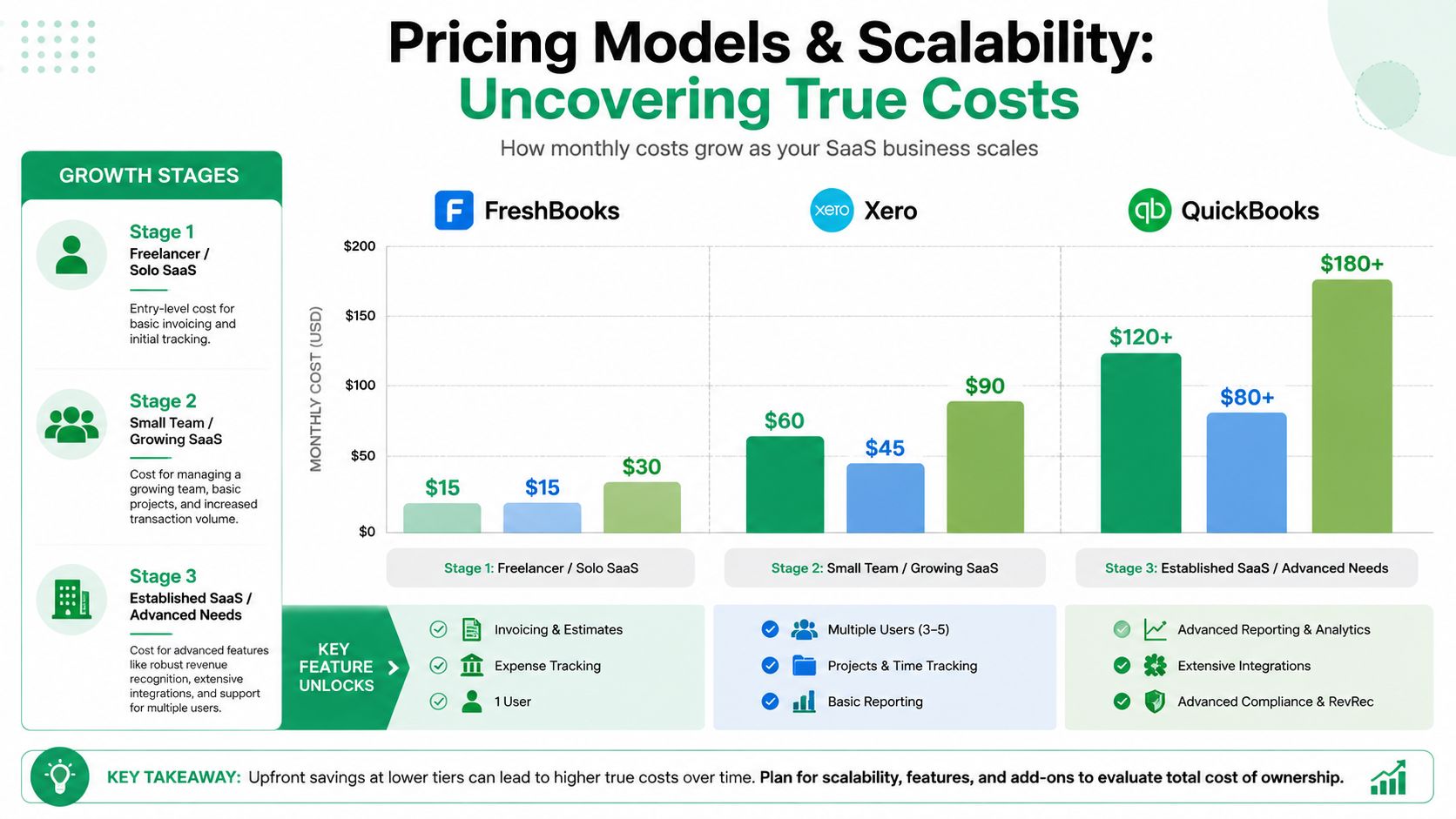
FreshBooks starts at $19 per month, QuickBooks Online starts at $35 per month, Xero pricing varies by region, FreshBooks reaches up to $55 per month at the top end, and QuickBooks can reach up to $200 per month on Advanced, based on Zapier's FreshBooks vs Xero pricing analysis.
Entry price is not operating cost
FreshBooks looks attractive early because the economics match solo operators and service-led businesses. That price logic works when the product is mostly replacing ad hoc invoicing and light bookkeeping. It works less well when your team needs more approvals, more reporting, and cleaner subscription support.
QuickBooks asks for more budget up front, but that higher ceiling reflects its role in more complex businesses. A platform can be “more expensive” on paper and still be cheaper operationally if it reduces finance cleanup, supports a stronger close process, and delays the need for another migration.
Xero sits between those poles. Since entry pricing varies by region, the smarter lens is positioning rather than a single headline number. It usually appeals to teams that want stronger accounting than FreshBooks without immediately committing to QuickBooks' higher-end spend.
When the cost curve changes
For SaaS operators, true scalability cost usually shows up in places the pricing page doesn't explain clearly:
- Process overhead: How much manual reconciliation does the finance team do every month?
- Reporting overhead: How often do teams export data to build recurring revenue views elsewhere?
- Integration overhead: How much engineering or ops support is needed to keep Stripe, CRM, and accounting data aligned?
If your team is already tracking growth efficiency, this ARR calculation guide helps frame why software cost should be evaluated against revenue clarity, not just subscription fees.
A simple way to think about freshbooks vs xero vs quickbooks on price is this:
| Pricing lens | FreshBooks | Xero | QuickBooks Online |
|---|---|---|---|
| Lowest-friction entry | Strongest | Moderate | Less favorable |
| Best value for growing finance rigor | Less favorable | Strong | Strong |
| Highest long-term ceiling | Lower | Moderate | Highest |
Cheap software becomes expensive when your controller has to rebuild reality in spreadsheets after every close.
That's why the “best value” answer changes with company stage. FreshBooks often wins the first chapter. Xero is frequently the cleanest middle chapter. QuickBooks tends to justify itself when financial operations become a strategic function rather than a founder chore.
Migration Considerations and Integration Headaches
Most finance migrations fail in the handoff points, not in the import wizard. The headline task is moving chart-of-accounts data, customers, invoices, and balances. The actual task is preserving meaning across Stripe, your CRM, and whatever reporting layer the growth team already trusts.
What usually breaks during migration
Historical data from subscription businesses has edge cases. Refunds may have been recorded inconsistently. Stripe metadata may not line up with customer records in accounting. Teams often discover that failed payments and cancellations were never categorized in a way that makes retention analysis possible.
That creates a few predictable headaches:
- Customer identity mismatches: one Stripe customer can map poorly to internal account structures if naming conventions drifted.
- Revenue event ambiguity: upgrades, downgrades, and credits may look obvious in billing but muddy in accounting.
- Support burden: the team learns the new accounting tool while still closing current-period books.
If failed payment volume has already become a visible issue, this guide on why cards get declined by issuers is useful context for finance and retention teams. It highlights why billing failures often start outside accounting, even though accounting eventually inherits the mess.
How to reduce switching pain
The cleanest migrations tend to follow a simple order:
- Define the source of truth first. Stripe should remain the billing truth if that's where subscriptions live.
- Map exception types before importing history. Decide how refunds, credits, and failed renewals should appear in accounting.
- Train by workflow, not by menu. Have finance practice reconciliation and close tasks, not just navigation.
- Test one month thoroughly. Rebuild a closed historical period and compare outputs before committing fully.
Xero and QuickBooks generally reward this discipline more because they can absorb more accounting complexity once mapped properly. FreshBooks is easier to adopt when the workflow itself is simpler. If the workflow isn't simple, ease of use won't save the migration.
The Final Verdict Which Platform Is Right for Your SaaS
The right answer depends on which problem is becoming expensive inside your business.
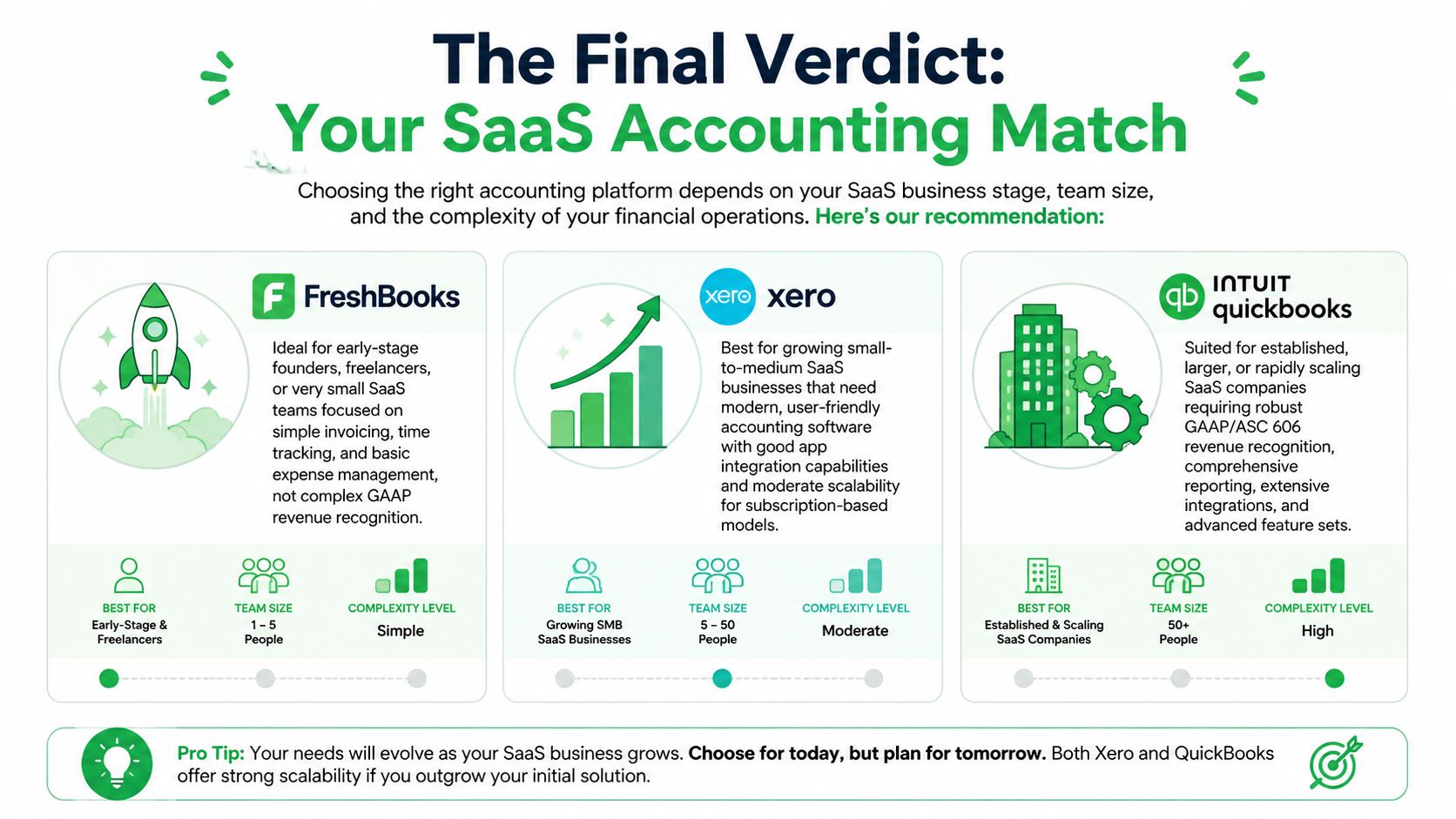
If you're an early-stage founder with straightforward billing and a small team, FreshBooks is the cleanest fit. It keeps invoicing and basic accounting approachable. For a SaaS company that still behaves a bit like a services business operationally, that simplicity can be a feature, not a compromise.
If you're running a growing SaaS company with Stripe at the center and a stack of specialized tools around it, Xero is usually the most balanced choice. It gives you stronger accounting footing than FreshBooks without forcing you into the heaviest reporting posture on day one. That makes it attractive for teams that want modularity and don't mind assembling a more purpose-built revenue stack.
If your finance operation is maturing fast, QuickBooks Online is the strongest pick in this comparison. It's the better home for businesses that need deeper reporting discipline, more control in the accounting layer, and a system that can support increasingly formal financial operations.
A clean decision rule looks like this:
- Choose FreshBooks if your main need is simple invoicing and lightweight bookkeeping.
- Choose Xero if you want a scalable accounting core inside a best-of-breed SaaS stack.
- Choose QuickBooks Online if reporting depth and finance control matter more than simplicity.
The most important conclusion is the least obvious one. In freshbooks vs xero vs quickbooks, you are not choosing a churn solution. You're choosing the accounting layer that will either support or obstruct your ability to connect Stripe activity, revenue reporting, and retention analysis. Pick the one that fits your next eighteen months, not your last six.
If your SaaS already uses Stripe and you want to reduce cancellation-driven revenue loss, Revcover helps your team go beyond accounting records. It captures churn reasons at the moment of intent, coordinates save offers and payment recovery, and ties outcomes back to recovered recurring revenue so you can see what proved successful.