
What Is an Credit Note? SaaS Guide 2026

Ayush Soni
Founder, Revcover

On this page
- What a Credit Note Actually Is
- Why it exists as a separate document
- What it looks like in a SaaS context
- When SaaS and Subscription Businesses Issue Credit Notes
- The situations that trigger them
- Why credits often beat cash refunds
- How Credit Notes Affect Your Accounting and Revenue
- What happens in the ledger
- Why revenue recognition deserves attention
- What it means for MRR
- Credit Notes vs Refunds vs Invoice Adjustments
- The practical difference
- A side-by-side decision guide
- Where SaaS teams go wrong
- Issuing and Reconciling Credit Notes in Practice
- The workflow that keeps the books clean
- A simple example from a subscription stack
- What to check before you close the ticket
- Making Credit Notes Work for Your Revenue Operations
- Build a single source of truth for the correction
- Keep Stripe and accounting aligned
- Turn credit notes into an operating habit
You're chasing a billing issue at 4 p.m., and the symptoms are familiar. A customer says they were overcharged, finance wants the invoice trail left intact, and your Stripe records need to match what happened. That's the point where a credit note stops being an accounting term and becomes a practical tool for keeping revenue accurate, customer trust intact, and audit history clean.
In SaaS, the awkward part isn't understanding that a credit note reduces an invoice. The hard part is knowing how it behaves inside recurring billing, what it does to future invoices, and why it matters when Stripe is the system of record for subscription changes. If you run subscriptions, the hidden complexity is usually not the correction itself, it's the chain reaction across billing, collections, and revenue reporting.
What a Credit Note Actually Is
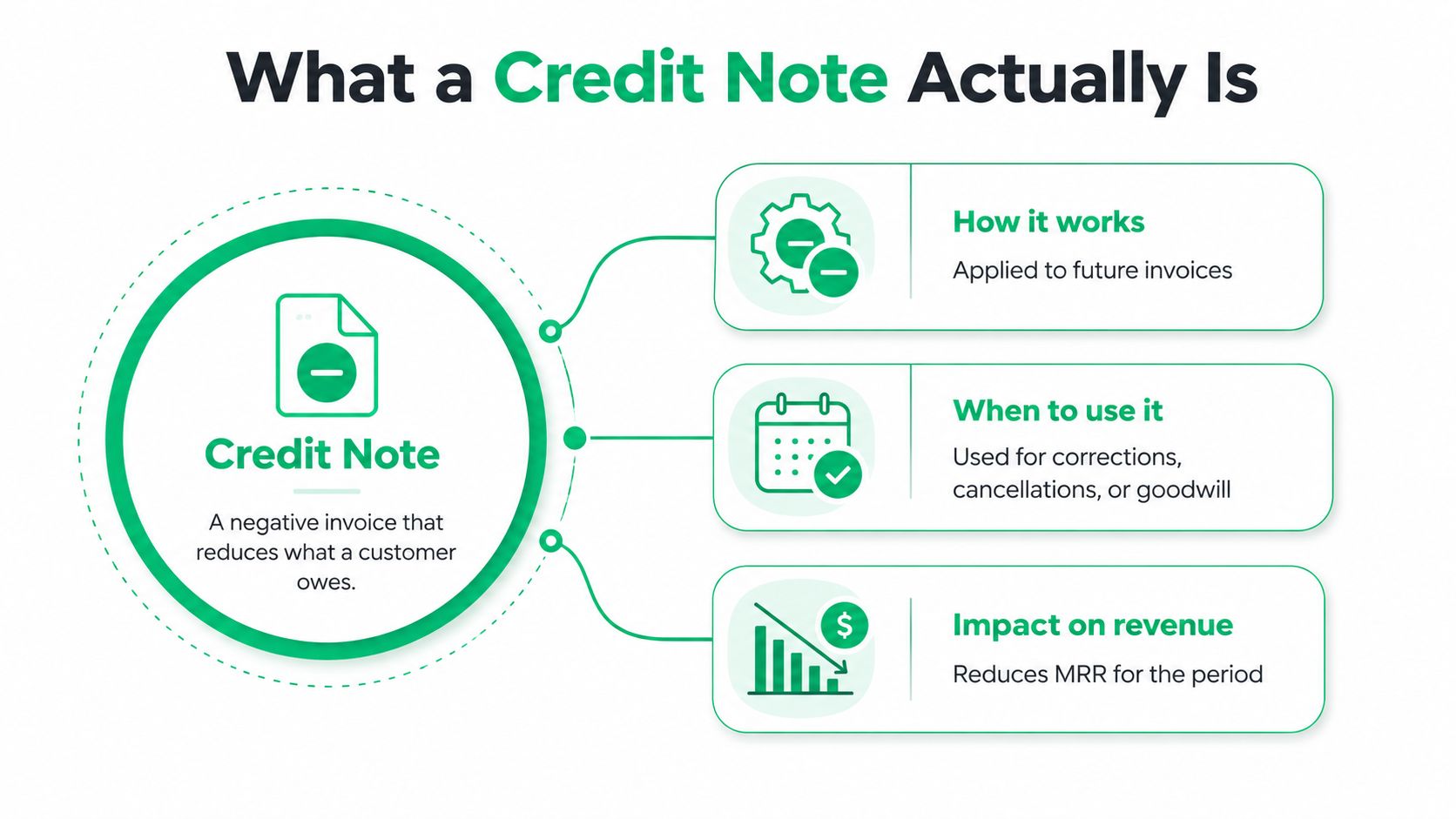
A customer gets billed for a monthly plan, then support notices the invoice included the wrong seat count. Finance cannot erase that invoice and act as if it never existed. A credit note is the formal document that corrects the billing while leaving the original invoice intact, which is why Stripe describes it as a way to offset an invoice and preserve the audit trail rather than replace the invoice itself. A credit note works like a negative invoice that reduces what the buyer owes, and Stripe's explanation of credit notes is a useful reference for that framing.
Why it exists as a separate document
The separate-document part matters more than many founders expect. If you edit or delete an invoice, you lose the historical trail that shows what was billed, what changed, and why. A credit note leaves the original invoice unchanged, then records the correction on top of it, which keeps the sequence traceable for tax, audit, and internal review.
That structure also reduces confusion for finance and operations teams. The original invoice remains the record of the charge that was sent, and the credit note records the amount being removed or reversed. Together, they show the full story without breaking document history.
A credit note often functions like a matching reversal entry that sits beside the invoice and tells the rest of the system to reduce the amount due by a specific amount. In practice, that is what lets accounting teams reconcile a customer's account without corrupting the ledger trail.
Practical rule: if the customer saw the invoice, or your billing system already recorded it, a credit note is usually the safer correction layer.
What it looks like in a SaaS context
In recurring billing, the idea is easiest to grasp through entitlement changes. A plan downgrade, an overbilled seat, or a service credit after a missed SLA all create the same accounting need, reduce what the customer owes without rewriting the past. Stripe and other billing tools treat the credit note as a first-class correction object because it keeps customer communication and ledger integrity aligned.
A useful mental model is simple. The invoice says what you billed, and the credit note says what you are giving back. The two documents travel together, and the net result is the actual amount owed. That is also why a SaaS billing team should never treat a credit note as a casual note in Slack or a one-off email promise.
When SaaS and Subscription Businesses Issue Credit Notes
A SaaS billing team usually issues a credit note when the number on the invoice no longer matches what happened in the subscription. That mismatch can come from an overbilling error, a downgrade that was processed after invoicing, a cancellation dispute, or a goodwill adjustment after an outage. Recurring billing makes these situations common because the invoice is often created automatically, while the exception is handled by a person.
The situations that trigger them
A few patterns show up again and again.
- Overbilling on a plan: A customer is charged for the wrong tier or seat count, then finance corrects the mistake with a credit note.
- Service or scope adjustment: The customer paid for a feature set or work scope that changed after the invoice was issued.
- Invoice error: The line item total, tax treatment, or quantity was wrong, so the billing record needs a formal correction.
- Goodwill credit: Support promises a balance adjustment after a poor experience, usually to keep the account active.
- Cancellation disputes: A subscription ends near renewal and the team decides to offset the charge rather than force a cash refund.
These are finance events, but they are also retention events. In subscription businesses, a credit note gives the company a way to correct the charge without tearing up the commercial relationship. That matters when the customer still plans to renew, or when the amount should stay on account and be applied to a later invoice.
There is also a systems angle here that gets missed often. A credit note is not just a customer service promise, it is a billing record that needs to flow through recurring revenue logic and revenue recognition cleanly. If the note is not recorded properly, the invoice, the subscription schedule, and the books stop telling the same story.
Why credits often beat cash refunds
A refund sends money back to the customer and creates an immediate cash outflow. A credit note can keep that value on the account so it gets applied to a later invoice. That difference matters in subscription businesses because the customer may still have active usage, future billing, or enough trust left to stay engaged if the fix is handled well.
Stripe's billing engine treats this distinction carefully because a credit note can adjust what the customer owes without rewriting the original invoice. That approach keeps the billing history intact while still reducing the amount due. The same logic appears in Booking.com's credit note guidance, which shows how a credit can remain available instead of moving money immediately.
A good credit note reduces friction twice, once for the customer who does not need to wait for a refund cycle, and once for finance, which keeps the original billing record intact.
For SaaS founders, that is the real value. The credit note is not only a correction to the bill. It is a way to correct the bill without disrupting subscription continuity, recurring revenue reporting, or the path to the next renewal. It also gives accounting a cleaner bridge into deferred revenue handling when a charge needs to be reversed or reclassified rather than simply erased.
How Credit Notes Affect Your Accounting and Revenue
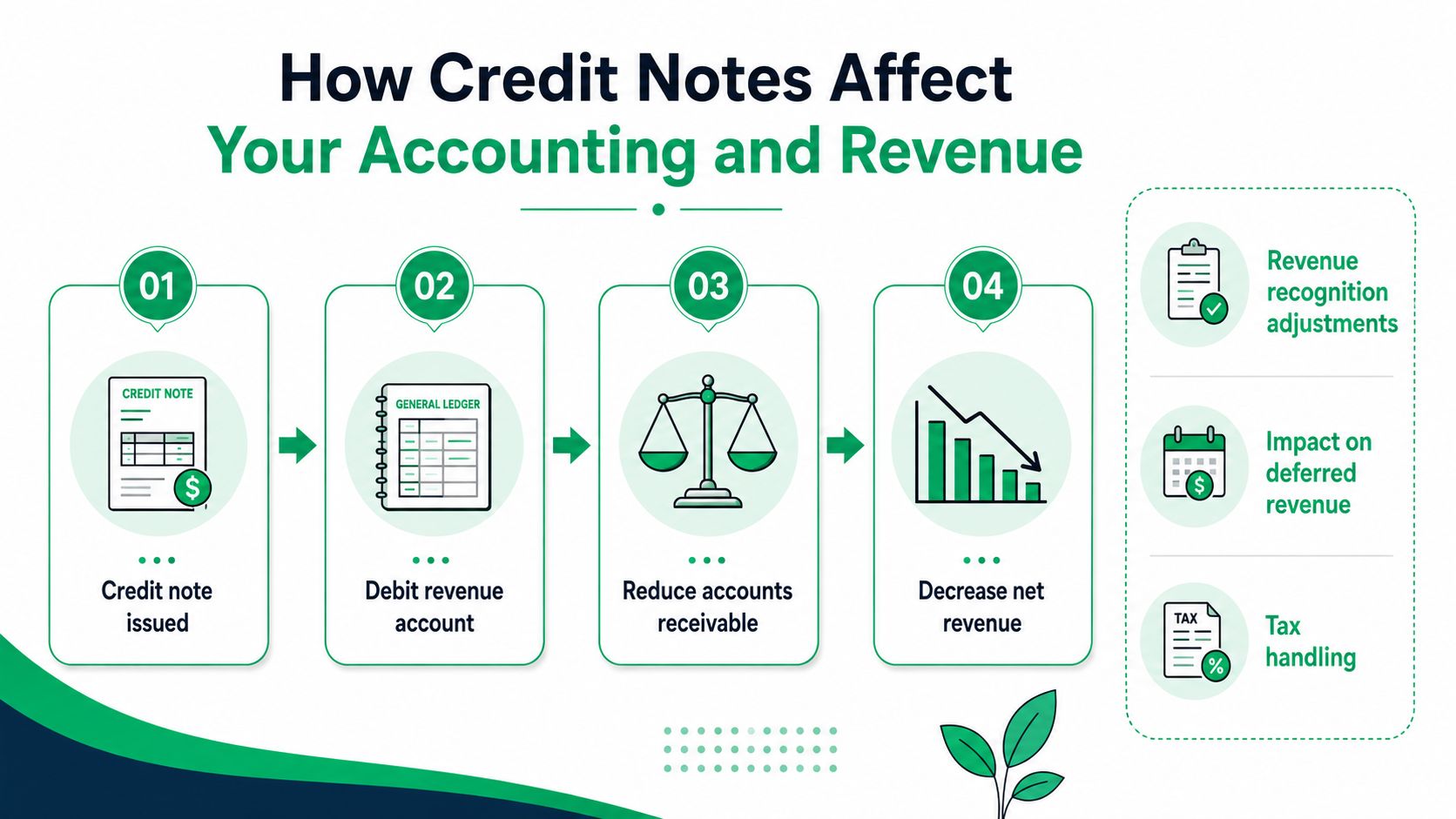
A credit note looks simple on the surface, but in a subscription business it changes more than the amount due. It changes how the original sale stays recorded, how the correction flows through Stripe, and how finance teams explain the difference between billed revenue and earned revenue. The original invoice usually remains in place, then the credit note reduces what the customer owes while preserving the audit trail, which is why billing and accounting can still reconcile cleanly without rewriting history.
What happens in the ledger
Once a credit note is issued, accounts receivable goes down by the credited amount, and the books carry a clear explanation for why the balance changed. That matters because finance teams need to see the original invoice and the offsetting correction side by side when they review month-end close, support adjustments, or audit samples.
Subscription billing adds another layer. A single invoice may cover a service period, a proration, or a bundle of entitlements, so the credit note has to correct the financial outcome without erasing the underlying charge. In practice, that means the ledger keeps both the sale and the correction visible, which is easier to reconcile than trying to rewrite the invoice after the fact.
Why revenue recognition deserves attention
Revenue recognition does not always move in lockstep with the customer-facing correction. If your team recognizes revenue on an accrual basis, a credit note can change the amount reported in the period it is issued, especially when it relates to a cancellation, a service adjustment, or a deferred balance. For a clearer explanation of how those balances sit in the books, see this deferred revenue overview.
The operational mistake is treating the credit note as a support-only fix. It can affect revenue schedules, deferred revenue balances, and the way your monthly reporting ties back to Stripe. When credits are issued without a controlled process, the billing engine, the general ledger, and the board deck can each tell a slightly different version of the same transaction.
Use the credit note as the source of truth for the correction, then let accounting and reporting follow it.
What it means for MRR
Monthly recurring revenue needs clean inputs. A credit note can reduce the revenue that should be treated as earned for that billing period, depending on the reason for the correction and how your books are structured. A small customer issue can therefore have a larger finance impact than it first appears, because support is focused on fairness while revenue teams are focused on timing, classification, and whether the adjustment belongs in current-period MRR or in a deferred revenue correction.
Credit Notes vs Refunds vs Invoice Adjustments
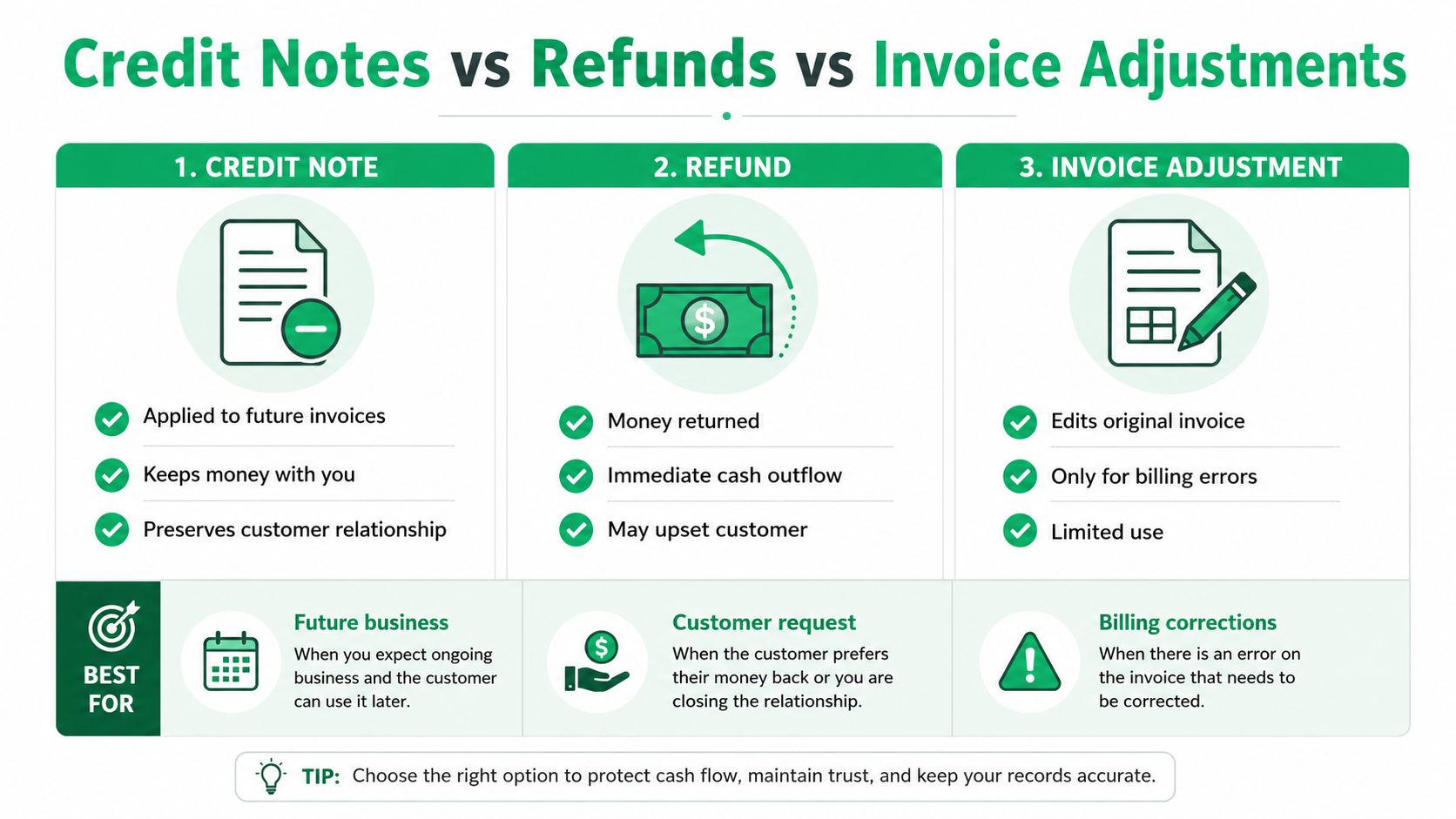
SaaS billing teams often treat these three terms as interchangeable, then run into trouble when the correction has to flow through Stripe, the ledger, and revenue reporting. A credit note, a refund, and an invoice adjustment can all fix a billing problem, but they do it at different points in the process and leave different records behind. The right choice depends on whether you want to keep the original invoice intact, return cash to the customer, or correct the bill before it becomes a settled record.
The practical difference
A credit note lowers what the customer owes and can often be applied to a future invoice. That makes it a good fit when the customer relationship is still active and you want the billing history to stay readable. A refund sends money back after it has already been collected, which fits cases where cash needs to leave the business or the account is closing.
An invoice adjustment is narrower. It usually corrects the invoice itself, and it only works while your billing system still allows the invoice to be changed. Once the invoice is finalized, accepted, or already tied to downstream records, a credit note is usually the cleaner correction because it leaves the original charge visible and adds a separate record for the fix.
A side-by-side decision guide
| Tool | Best fit | Customer outcome | Finance effect |
|---|---|---|---|
| Credit note | Billing correction, goodwill credit, future offset | Customer gets account credit | Original invoice stays visible |
| Refund | Money must leave the business | Customer gets cash back | Immediate cash reduction |
| Invoice adjustment | Early invoice mistake | Invoice itself is corrected | Limited to pre-finalized billing workflows |
The practical pattern shows up clearly in subscription billing. A credit note often stays on the account and is used later against another invoice, while a refund clears the cash movement right away. That distinction matters for recurring revenue teams, because the billing record, the customer balance, and the revenue schedule do not all move in the same way.
If your finance stack relies on a clear comparison of accounting tools for billing teams, this is the point where process discipline matters. The correction has to fit the system you use to track invoices, credits, and the general ledger, or the same change can look different in each place.
Where SaaS teams go wrong
The most common mistake is issuing a refund when the customer really needs a credit, or using a credit note when the team meant to void an invoice that should never have been sent. Those are different fixes. They change how Stripe records the event, how your ledger reflects the correction, and how your customer success team explains the outcome to the customer.
If the invoice was already valid and the correction came later, start with a credit note. If money must leave the company now, use a refund. If the invoice should never have existed, the correction path is usually different.
Issuing and Reconciling Credit Notes in Practice
A clean credit note workflow starts before the document exists. Someone has to confirm the issue, determine the adjustment, and make sure the correction matches the original invoice reference. That's where recurring billing teams either stay organized or create a reconciliation mess.
The workflow that keeps the books clean
- Confirm the billing issue.
Check the invoice, the subscription state, the support thread, and any approval that justified the change. - Match the correction to the original charge.
Make sure the credit note references the right invoice and the right line items so the trail stays readable. - Issue the credit note in your billing system.
In a Stripe-connected stack, the correction should flow through the same system that created the invoice so the record stays consistent. - Apply the credit correctly.
If the customer has a future invoice, the credit can reduce that amount. If the account is closed, finance may need a different settlement path. - Reconcile the outcome in accounting.
Confirm that the ledger, receivables, and revenue reports reflect the correction and that nothing was double-counted. - Store the support evidence.
Keep the email, ticket, or approval note with the invoice and credit note so the audit trail tells the full story.
A simple example from a subscription stack
A customer is billed for ten seats, but only eight were contractually active. Finance identifies the overage after the invoice goes out. Rather than editing the original invoice, the team issues a credit note for the excess charge, references the invoice number, and lets the credit reduce the next renewal invoice. The customer sees a clear correction, support has proof of what changed, and the billing record remains intact.
That workflow is where billing systems, accounting software, and support teams need to stay aligned. If the credit note is created in one place but never reconciled in the ledger, the customer account may look right while the revenue report stays wrong. If you're evaluating how accounting tools handle these corrections, the comparison in this FreshBooks, Xero, and QuickBooks guide can help frame the workflow implications.
What to check before you close the ticket
- Invoice reference is present.
- Credited amount matches the correction.
- Customer knows whether the credit applies now or later.
- Accounting has the supporting evidence.
- Stripe and the general ledger tell the same story.
That list is the difference between a one-off fix and a reliable process. If any one of those pieces is missing, the next month-end close gets harder.
Making Credit Notes Work for Your Revenue Operations
Credit notes become valuable when they're treated as part of revenue operations, not as a cleanup task for finance. In a subscription business, the correction needs to move across the same system boundaries as the original invoice, the renewal schedule, and the customer's account status. If that chain breaks, the business gets noisy books, confused customers, and avoidable reconciliation work.
Build a single source of truth for the correction
The first rule is simple, document why the credit exists in one place. That reason should be understandable by support, finance, and leadership without digging through a chat thread. If the correction came from a cancellation, downgrade, outage, or pricing mistake, the rationale should sit with the credit note record so the business can review patterns later.
Keep Stripe and accounting aligned
Stripe should continue to hold the operational billing record, while your accounting system reflects the financial result. That split only works if the team is disciplined about creating, applying, and reconciling the credit note in a predictable way. Once the systems drift, revenue reporting becomes an exercise in manual explanation instead of clean attribution.
For teams that also manage churn, payment recovery, and save offers, that same discipline helps connect billing corrections to the right outcome metrics. The broader logic is similar to the way revenue attribution models force teams to tie outcomes back to specific actions instead of hand-waving the result.
Turn credit notes into an operating habit
A mature workflow usually includes three habits.
- Track the reason consistently. Support and finance should classify the correction the same way every time.
- Review patterns monthly. Repeated credits often point to a product, pricing, or billing issue.
- Separate customer goodwill from invoice cleanup. Those are related, but they're not the same decision.
That's the RevOps lesson. A credit note isn't just a fix for a mistake, it's a signal about how your subscription engine is behaving. Treat it like operational data, and it starts to improve billing accuracy, revenue clarity, and customer experience at the same time.
If you're tightening how credits, cancellations, and revenue recovery flow through Stripe, Revcover helps subscription teams connect those events to clean billing records and measurable revenue outcomes. It's built for founders and RevOps teams that want fewer gaps between what happened in-product, what got billed, and what the books show.