
Revenue Attribution Model for SaaS Retention

Ayush Soni
Founder, Revcover
On this page
- Why Most Retention Efforts Go Unmeasured
- The reporting gap is usually structural
- Churn reduction needs the same discipline
- What Is a Revenue Attribution Model
- Why retention needs its own attribution logic
- What counts as a revenue event after the sale
- Comparing Common Revenue Attribution Models
- Where simple models break
- Comparison of Revenue Attribution Models
- Why W-shaped often fits complex SaaS journeys
- Applying Attribution to Subscription Recovery
- Voluntary churn intervention
- Involuntary churn recovery
- A workable saved MRR flow
- Key Metrics and Crediting Rules
- Define the window before you report the win
- Crediting rules that prevent bad reporting
- Metrics that operators actually use
- Data Sources and Experiment Design
- The event trail you need
- How to stitch events into one journey
- Experiment design that holds up
- From Data to Decisions
You already know the feeling. A customer clicks cancel, selects “too expensive,” accepts a discount, and stays. Another customer ignores a failed payment email, updates their card after the third reminder, and renews. Finance sees the retained subscription. Support sees the conversation. Product sees the cancellation reason. Marketing sees nothing. RevOps gets asked the hard question anyway: which intervention saved revenue?
Many organizations can describe their retention tactics. Fewer can tie those tactics to saved MRR in a way that stands up in planning, budgeting, and forecasting. They know churn moved. They don't know whether the pause option worked better than the downgrade path, whether dunning emails rescued meaningful revenue, or whether a save offer only delayed cancellation by a billing cycle.
That's where a practical revenue attribution model matters. Not for ad clicks or lead forms. For the middle and bottom of the funnel, where subscription businesses either keep revenue or give it back.
Why Most Retention Efforts Go Unmeasured
Retention work usually grows in layers.
A team adds an exit survey to the cancellation page. Then a downgrade option. Then a pause offer. Then a support handoff for larger accounts. Billing ops adds failed-payment reminders and card update links. Customer success jumps into Slack when a high-value account shows risk signals. Every addition feels sensible.
What's missing is a way to assign revenue credit across those actions. So the business ends up with activity data instead of decision data. You can count canceled subscriptions, accepted offers, reopened invoices, and support touches. You still can't answer the question that matters: which actions preserved recurring revenue, and which only created noise?
The reporting gap is usually structural
In many SaaS stacks, retention data is split across tools:
- Billing data lives in Stripe
- Cancellation reasons live in the app or a form tool
- Support interactions live in Intercom, Zendesk, or HubSpot
- Lifecycle messaging lives in email platforms
- Pipeline context lives in the CRM
- Product usage signals live in the warehouse or analytics tool
Each system sees one slice of the story. None of them, on their own, produce a defensible revenue attribution model for churn reduction.
Practical rule: If your data can't connect a risk event, an intervention, and a subsequent retained payment, you don't have attribution. You have logs.
That's why retention often gets managed on instinct. Teams remember dramatic saves. They over-credit the most visible touchpoint. They under-credit quiet systems like retry logic or a well-timed downgrade path. Then they make roadmap decisions based on anecdotes.
The irony is that attribution maturity is already common at the growth level. Seventy-five percent of companies globally use revenue attribution models to track ROI and measure marketing effectiveness, and the organizations that integrate attribution data into GTM planning and execution see measurable efficiency gains of 15% to 30% according to Fullcast's revenue attribution model overview. The problem isn't belief in attribution. The problem is that many teams stop at acquisition.
Churn reduction needs the same discipline
A cancellation flow is a funnel. A failed payment sequence is a funnel. A save offer is a conversion path. If you treat post-sale recovery with the same rigor used in pipeline reporting, you can tie interventions to saved MRR, compare paths, and stop rewarding tactics that look helpful but don't hold revenue.
That shift changes how retention gets managed. Instead of asking whether customers clicked the offer, you ask whether the account stayed, paid, and remained healthy after the intervention.
What Is a Revenue Attribution Model
A revenue attribution model is the set of rules you use to assign revenue credit to the touchpoints that influenced a revenue event.
The easiest analogy is basketball. The box score shows who made the shot, but anyone who's watched a good offense knows the possession started earlier. The screen mattered. The pass into the lane mattered. The extra pass mattered. Revenue works the same way. The final payment is the score. The touches before it often explain why the score happened.
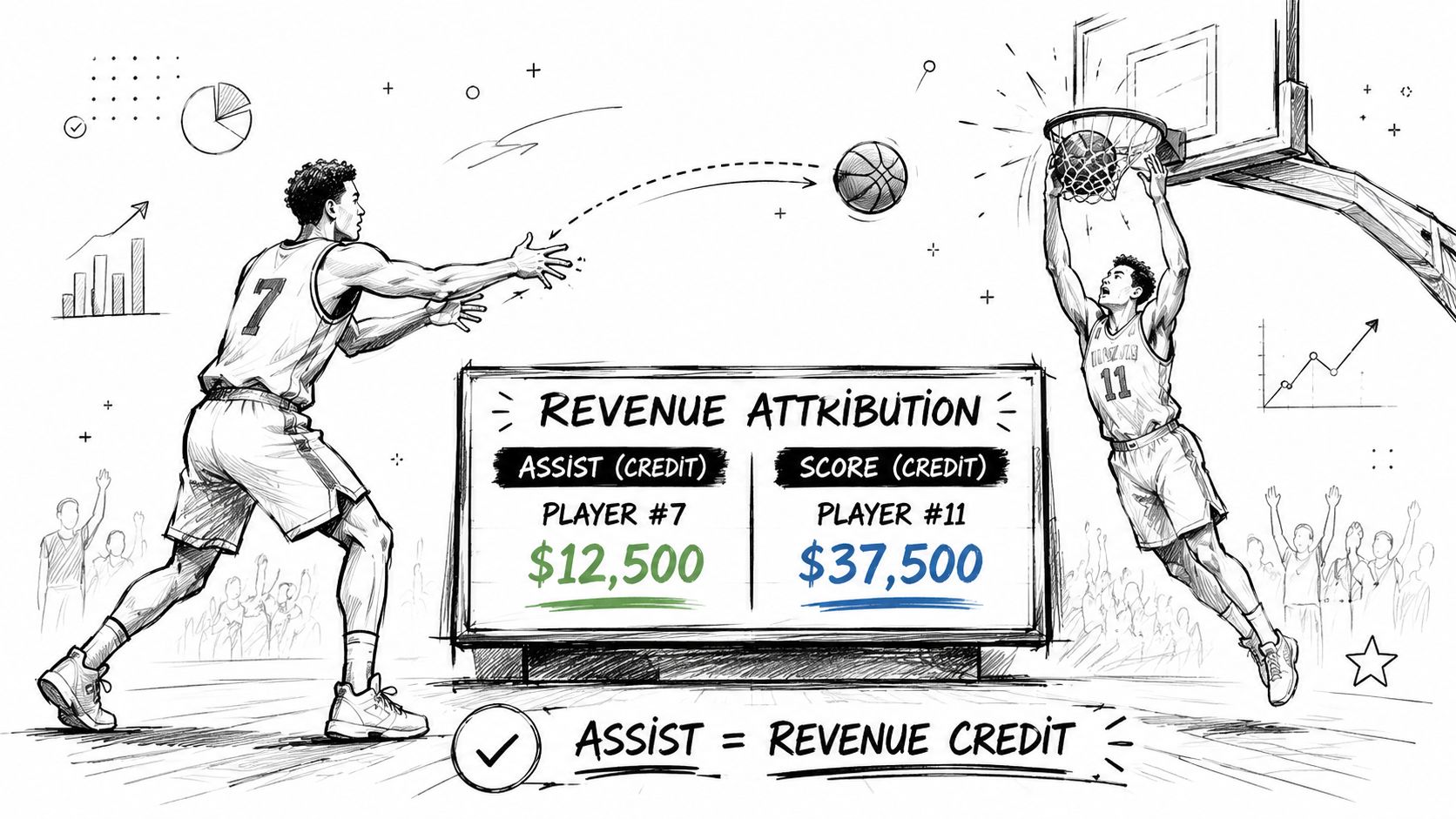
Typically, attribution starts and ends with acquisition. A lead comes from paid search, organic content, partner referrals, or outbound. Revenue gets assigned somewhere in that path. That's useful, but incomplete for a subscription business.
Why retention needs its own attribution logic
In SaaS, revenue doesn't end at the first closed-won event. Customers renew, downgrade, pause, recover from failed payments, threaten to cancel, and sometimes stay because the company intervened at the right time.
That creates a second attribution problem. You're no longer asking, “What created the customer?” You're asking, “What preserved the customer's recurring revenue after risk appeared?”
Those are different systems with different touchpoints.
A top-of-funnel model might credit a webinar, demo request, and sales sequence. A retention model might credit a cancellation reason capture, a save offer, a support chat, a card update prompt, or a retry event. The underlying idea is the same. The objects being credited are different.
What counts as a revenue event after the sale
For churn reduction, a revenue event usually looks like one of these:
- A cancellation is prevented after the user enters a cancel flow
- A payment is recovered after an invoice fails
- A downgrade avoids a full loss of subscription revenue
- A pause converts back to an active paid state
- A high-risk account stays active after a support or success intervention
The key is to define the event in revenue terms, not interaction terms. “Offer accepted” isn't enough. “Retained subscription with subsequent successful billing” is much stronger.
The cleanest retention attribution models don't obsess over who clicked last. They measure which touchpoints changed the revenue outcome.
That's why a practical revenue attribution model has two parts. First, the business maps the touchpoints that can influence retention. Second, it defines the revenue event that those touches can earn credit for. Without both, reports drift toward vanity metrics.
For churn work, this matters because the final action is often misleading. A user may update their card only after seeing multiple reminders. A customer may take a downgrade only after reading help content and speaking with support. If you credit only the final click, you flatten a multi-step recovery process into a single event and lose the signal needed to improve it.
Comparing Common Revenue Attribution Models
No attribution model is objectively perfect. Each one makes a judgment about which moments deserve more credit. The right choice depends on how complicated your customer journey is, how much data you trust, and whether your reporting needs to drive operational changes or just provide directional visibility.
Where simple models break
Single-touch models are attractive because they're easy to explain.
First-touch gives all credit to the first meaningful interaction. That helps if you want to know what introduced the customer to the business, but it's weak for retention. It tells you almost nothing about a cancellation flow or failed-payment recovery sequence.
Last-touch gives all credit to the final interaction before the revenue event. This is common because it mirrors what many tools can report out of the box. It's also where retention teams get fooled. If a recovered subscription gets credited only to the last dunning email, you'll miss the earlier in-app notice, support outreach, or save path that made the customer willing to act.
Linear spreads credit evenly across all tracked touchpoints. That's fair on paper and often unrealistic in practice. In churn reduction, not every touch deserves equal weight. A cancellation reason capture and a personalized downgrade path usually matter more than a generic reminder banner.
Time-decay puts more weight on recent touches. This often works better than linear for bottom-funnel activity because later actions are often closer to the decision. But if you overuse it, you'll under-credit upstream interventions that made the final recovery possible.
U-shaped models emphasize the first and last key interactions, with less weight in the middle. That's useful when the journey has a clear start and finish. It's less useful when the decisive moment happens midstream, such as a cancellation save offer or opportunity milestone.
Comparison of Revenue Attribution Models
| Model | How It Works | Best For | Pros | Cons |
|---|---|---|---|---|
| First-touch | Gives all revenue credit to the first tracked interaction | Understanding discovery sources | Simple, clear, easy to implement | Ignores nurture, recovery, and closing actions |
| Last-touch | Gives all credit to the final interaction before revenue | Short journeys and simple reporting | Easy to explain, often available by default | Over-credits the final step and hides earlier influence |
| Linear | Splits credit evenly across all tracked touchpoints | Teams that need a basic multi-touch view | Recognizes the full path | Assumes every touch mattered equally |
| Time-decay | Gives more credit to touches closer to the revenue event | Longer journeys with stronger late-stage influence | Better reflects decision proximity | Can undervalue foundational earlier touches |
| U-shaped | Emphasizes first and last major interactions | Journeys with a clear start and conversion point | Useful for channel planning | Still simplifies the middle too much |
| W-shaped | Emphasizes three key milestones and shares the rest across middle touches | Complex B2B SaaS funnels with multiple decisive stages | Better maps real conversion structure | Requires clear milestone definitions and cleaner data |
Why W-shaped often fits complex SaaS journeys
For B2B SaaS, W-shaped attribution is often the most practical bridge between simplicity and realism. It assigns 30% to first touch, 30% to lead creation, and 30% to opportunity creation, with the remaining 10% spread across middle touchpoints according to ORM Tech's guide to marketing attribution. The same source notes that companies using W-shaped or multi-touch attribution report 20% to 35% higher accuracy in channel performance than first-touch or last-touch models.
That matters because SaaS journeys usually have more than one decisive moment. Awareness matters. Hand-raise matters. Sales qualification matters. The model reflects that structure instead of pretending one event explains the whole outcome.
For retention, I wouldn't copy that weighting blindly. But I would borrow the principle. Most post-sale recoveries also have milestone events:
- risk appears
- intervention is delivered
- customer engages
- billing or subscription state recovers
That's why retention teams often do better with a position-based or custom multi-touch model than with first-touch or last-touch. The more complex the save path, the more dangerous single-touch attribution becomes.
If your cancellation flow is basic and your recovery motions are minimal, a simpler model may be enough to start. If you route by plan, reason, billing state, and account value, you'll want a model that can reflect multiple meaningful touches without collapsing the journey into one click.
Applying Attribution to Subscription Recovery
Retention attribution gets useful when it stops being abstract and starts following actual subscription paths.
There are two broad recovery motions in most SaaS businesses. The first is voluntary churn intervention, where a customer signals intent to leave. The second is involuntary churn recovery, where the customer still wants the product but billing fails. Each path needs its own logic because the customer intent is different.
Voluntary churn intervention
A customer enters the cancel flow. That's the risk trigger.
From there, the business might capture a reason, route the account based on plan or usage, offer a pause, present a downgrade, provide a temporary discount, or hand the account to support. If the customer stays active and subsequent billing succeeds, some portion of that retained revenue should be credited to the touches that influenced the decision.
The mistake is giving all credit to the final accepted offer.
Suppose the user selected “missing features,” saw an offer to speak with support, opened the help doc linked in the flow, and later accepted a downgrade instead of canceling. In reporting terms, the downgrade might look like the winner. In reality, the account may have stayed because the flow exposed a more suitable plan and support answered the core objection.
That's why the touch sequence matters more than the final form submission.
Don't treat “save accepted” as the outcome. Treat it as one event in a path that only counts if the subscription remains active and bills successfully.
Involuntary churn recovery
This path is different because the customer didn't choose to cancel. The revenue is at risk because billing broke.
The core touchpoints usually include payment failure events, retry attempts, email reminders, in-app alerts, card update sessions, and eventual recovery. If your team sees a lot of issuer declines, understanding the mechanics behind card declined by issuer responses helps separate payment friction from actual customer churn intent.
In this motion, the attribution challenge is sequencing. Was the recovery caused by the retry logic? The reminder email? The in-app paywall? The direct billing portal link? Often the answer is “some combination.”
That's exactly why a revenue attribution model is useful here. It lets you assign credit across the set of recovery touches instead of pretending the last card update click did all the work.
A workable saved MRR flow
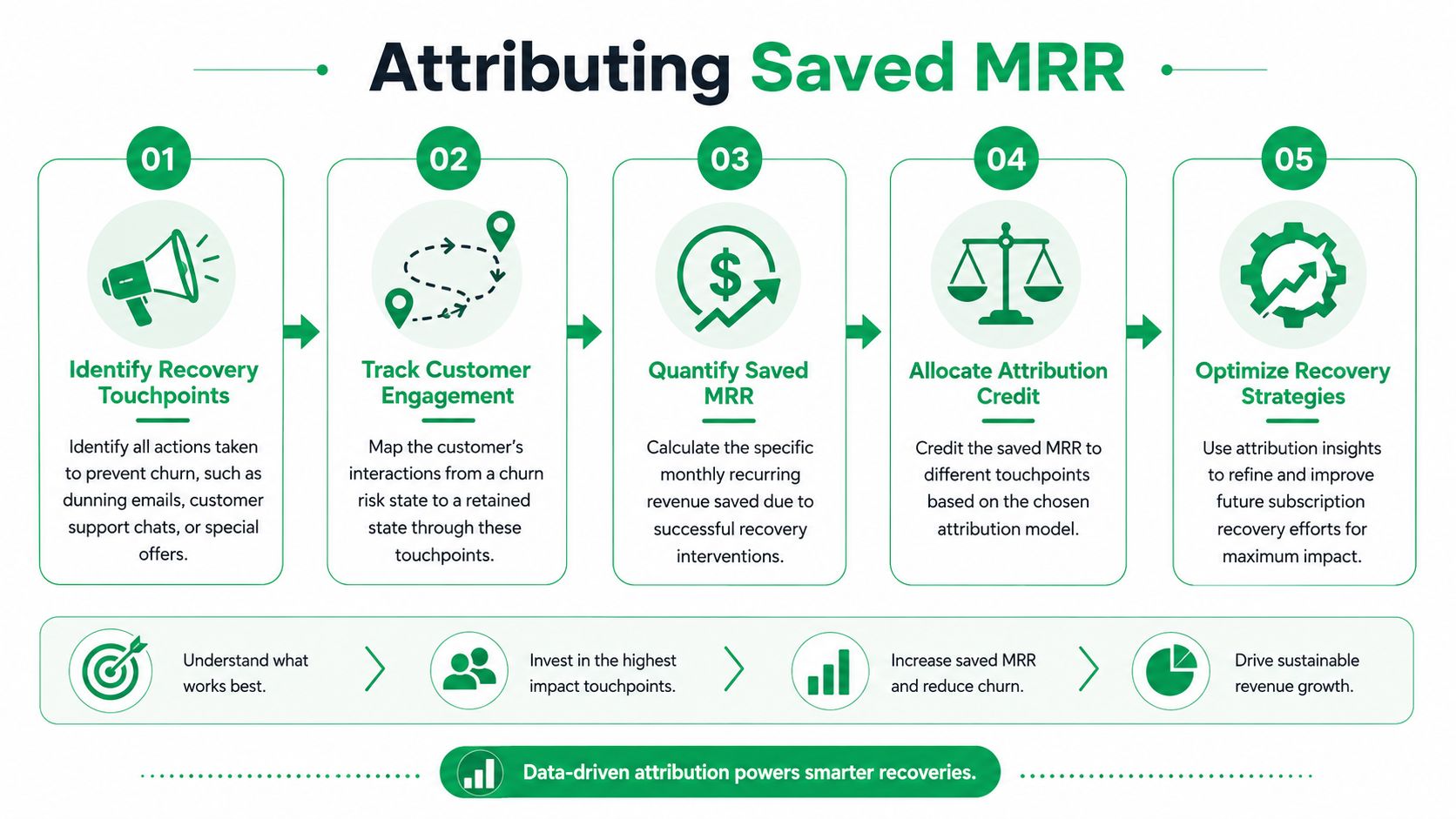
A practical model for subscription recovery usually follows these steps:
- Flag the risk event
Record the moment the account enters cancel intent or the invoice fails. - Log every intervention
Capture emails sent, in-app prompts shown, support touches, offer impressions, offer acceptances, retries, and billing updates. - Define the recovery event
Count recovery only when the subscription returns to a valid retained state and produces subsequent revenue. - Apply attribution credit
Use your chosen model to split saved MRR across the meaningful touches. - Review by path, not just by tactic
The strongest insight often comes from combinations such as “reason capture plus downgrade” or “retry plus reminder plus card update.”
That final point is easy to miss. Teams often compare isolated tactics when they should compare designed flows. A discount alone may underperform. A targeted discount after a specific reason and usage pattern may be the best route for that segment.
Key Metrics and Crediting Rules
Attribution models fail less often because of bad math than because of fuzzy rules. If the team hasn't agreed on what counts as saved revenue, how long credit should persist, or how to handle multiple touches, the dashboard becomes a debate instead of a decision tool.
Define the window before you report the win
The first rule is the attribution window. That's the period after a retention intervention during which revenue can still be credited to that intervention.
In cancellation recovery, a short window reduces over-crediting but can miss delayed decisions. A long window captures more lagged outcomes but risks giving credit to touches that barely mattered. There isn't a universal answer. The right window follows your billing cadence, plan structure, and how customers behave during churn risk.
For failed-payment recovery, the window usually aligns with the retry and reminder cycle. For save offers, it often needs to account for whether the customer stayed only briefly or continued as an active subscriber.
A useful operating principle is simple: set a window that reflects the actual time between intervention and observable recovery, then keep it stable long enough to compare results.
Crediting rules that prevent bad reporting
You also need explicit crediting rules for messy journeys.
- Multiple interventions in one session
If a customer sees a pause offer, ignores it, then accepts a downgrade, decide whether both get partial credit or whether only engaged touches count. - Support plus automation
If a human conversation follows an automated trigger, decide whether human-assisted recoveries live in the same model or in a separate assisted bucket. - Repeated exposure
If the same customer receives several reminders, define whether each message earns credit or whether the sequence is treated as one recovery motion. - Canceled anyway
If a customer accepts an offer but churns soon after, decide whether any revenue gets credited or whether the touch only counts after subsequent successful billing.
A defensible model is stricter than your instincts. It should remove “we think this helped” from the reporting language.
Metrics that operators actually use
The best metrics are operational. They tell you what to change.
A useful retention attribution layer usually tracks:
- Recovered MRR
Revenue retained or recovered after a cancellation or billing risk event. - Save rate by offer
Which paths keep customers active, segmented by reason, plan, value tier, or usage state. - Recovered MRR by touchpoint or path
Which combinations of messages, offers, and support actions preserve subscription revenue. - Offer acceptance versus durable retention
A discount may get accepted often and still produce weak downstream outcomes. - Attribution lift
Compare the outcome of a treatment against a control group rather than celebrating raw saves in isolation.
For teams aligning retention with board-level reporting, it also helps to anchor these metrics against broader revenue health measures such as the distinction between GRR vs NRR in SaaS retention analysis. Attribution tells you which intervention influenced revenue preservation. GRR and NRR tell you how those outcomes affect the business at the portfolio level.
A strong rule set does one more thing. It makes the numbers explainable to finance, growth, and customer success without changing the definition every quarter.
Data Sources and Experiment Design
Retention attribution only works when event data can tell one coherent story. That story usually spans billing, product behavior, customer communication, and account context.
The event trail you need
For most Stripe-based SaaS companies, the foundation starts with billing events such as:
- Payment failure events like
invoice.payment_failed - Subscription state changes such as updates, pauses, cancellations, and resumptions
- Successful payment events that confirm actual recovery
- Invoice status changes that show whether revenue was ultimately collected
That billing layer isn't enough by itself. You also need product-side signals:
- Cancellation intent clicks
- Reason selections and freeform feedback
- Offer views and acceptances
- Plan change events
- Usage markers that explain why a route was shown
Then add communication data:
- Email sends and opens
- In-app reminders
- Support conversations
- Sales or CSM interventions
- Slack escalation logs for high-value accounts
This is the kind of operating view teams aim for when they start tying recovery events back to outcomes.
How to stitch events into one journey
The hard part isn't collecting events. It's joining them.
To ensure accurate attribution, a shared account identifier must survive across Stripe, the app database, CRM records, and messaging tools. Without that, one customer can look like four different records and attribution breaks immediately.
A workable event model usually answers four questions for every account:
- What risk event started the journey?
- Which touches happened after that event, and in what order?
- What subscription or billing state changed next?
- Did the business retain recurring revenue?
If your team is still choosing the core behavioral signals to track, this guide to engagement metrics for subscription businesses is a useful companion because it sharpens which in-app actions belong in the model and which are just background noise.
Experiment design that holds up
Attribution helps explain outcomes. Experiments help prove causality.
The strongest retention programs don't just report which offer was accepted. They test whether one save path outperforms another for a defined segment. That means controlling the route, keeping the measurement rules stable, and resisting the urge to change copy, logic, and pricing all at once.
A few practical standards matter:
- Use a real control condition If everyone sees some intervention, you won't know whether the flow caused the recovery or merely captured customers who would have stayed anyway.
- Test one major variable at a time
If you change the offer type, copy, and routing criteria together, attribution becomes impossible to interpret. - Segment before you generalize
A pause option may work well for seasonal users and poorly for heavy users. Mixed segments blur the result. - Judge durability, not just immediate conversion
The best-looking offer at the point of cancellation may create weak downstream retention.
The cleanest retention experiments are boring by design. They isolate one decision, preserve logging discipline, and wait long enough to observe the revenue outcome.
A data-rich recovery system doesn't need to be complicated. It needs to be consistent. Once the event trail is clean, the attribution model becomes something operators can trust instead of another dashboard they politely ignore.
From Data to Decisions
A good revenue attribution model for SaaS retention changes the conversation.
Instead of debating whether a cancel flow feels better, you can compare which paths preserve more recurring revenue. Instead of assuming the dunning sequence works, you can inspect which messages and recovery actions lead to successful billing. Instead of reporting saves as a vanity count, you can tie interventions to saved MRR and decide where to invest.
That's the practical payoff. Attribution stops being a backward-looking report and becomes a way to choose between pause, downgrade, discount, support handoff, retry logic, and clean cancellation with more confidence.
For teams that want that operating model without stitching everything together manually, Revcover gives subscription SaaS businesses a way to connect Stripe-based cancellation flows, payment recovery, experimentation, and recovered MRR reporting in one system.