
What Does MRR Stand for: Monthly Recurring Revenue

Ayush Soni
Founder, Revcover
On this page
- What Is Monthly Recurring Revenue
- Why normalization matters
- Why MRR Is the North Star Metric for SaaS
- It gives every team the same scoreboard
- It sharpens forecasts and valuation conversations
- How to Calculate MRR Correctly
- Start with normalized subscription revenue
- A simple operating example
- Mistakes that break the number
- The Building Blocks of MRR Growth and Churn
- Think of MRR like a bucket
- What each MRR movement tells you
- MRR vs ARR and Net Revenue Retention
- A quick comparison
- When each metric matters most
- How to Actively Protect and Recover Your MRR
- Where MRR leaks in real products
- What actually works when you want to save revenue
MRR stands for Monthly Recurring Revenue, the predictable income a subscription business receives every month. If you have 500 customers paying an average of $200 per month, your MRR is exactly $100,000.
If you're a new Head of Growth, you've probably already opened a dashboard and seen a mix of Stripe charges, annual invoices, upgrades, refunds, and cancellations, then asked a simple question: what number tells me whether this business is getting healthier? MRR is that number. It gives you a normalized monthly view of subscription revenue so you can make decisions without getting fooled by billing timing, one-off charges, or delayed churn signals.
Most articles stop at the definition. That's not enough in practice. Operators don't just report MRR. They defend it, diagnose why it changes, and build product and billing flows that keep it from leaking out of the business.
What Is Monthly Recurring Revenue
Monthly Recurring Revenue is the normalized, predictable subscription revenue your business expects to earn each month from active subscriptions. That's the practical answer to what does MRR stand for, but the part that matters operationally is normalized.
If you run a SaaS company, billing cycles distort reality unless you normalize them. A customer on a monthly plan is easy to count. A customer who pays for a year upfront can make the month look artificially strong if you treat the full invoice as monthly revenue. That's why MRR exists.
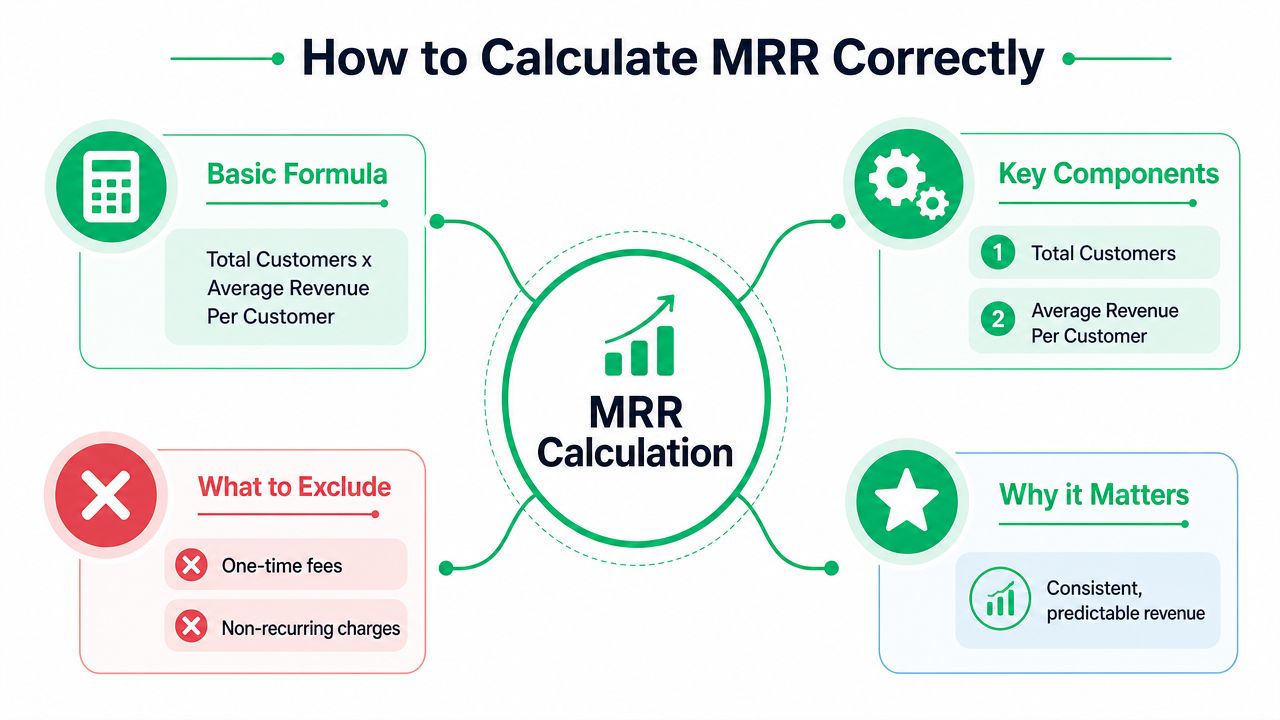
According to Wise's explanation of Monthly Recurring Revenue, the foundational formula is MRR = Number of Customers × Average Revenue Per User (ARPU). The same source gives a useful example: a customer paying $1,200 for a full-year plan contributes $100 to that month's MRR, not the full annual payment.
Why normalization matters
A founder looking only at cash collected can mistake billing timing for growth. One large annual renewal can make a month look great even if customer retention is weakening underneath.
MRR fixes that by turning different contract terms into one comparable monthly view. Once you do that, you can answer the questions that matter:
- Are we growing from new signups
- Are existing customers expanding
- Are cancellations and downgrades erasing progress
- Can we support hiring, marketing spend, or product investment
Practical rule: If a charge won't repeat as subscription revenue, don't include it in MRR.
That means setup fees, implementation fees, and other one-time services stay out. MRR is supposed to show the steady pulse of the business, not every dollar that happened to hit the bank.
Why MRR Is the North Star Metric for SaaS
When operators ask what does MRR stand for, they're usually not asking for vocabulary. They're asking which number should guide decisions every week. In SaaS, MRR is usually that number.

The reason is simple. Revenue in subscription businesses compounds through retention, expansion, contraction, and churn. MRR captures all of that in a way the team can act on. Acquire's overview of MRR in SaaS describes it as the definitive standard for measuring business health and notes that investors often use ARR multiples derived from MRR × 12 when assessing startup value.
It gives every team the same scoreboard
A good north star aligns people who otherwise optimize for different things.
Sales wants new deals. Product wants adoption. Customer success wants retention. Finance wants forecast accuracy. Support wants fewer failure points in the customer journey. MRR creates a shared outcome because each team can see how its work shows up in recurring revenue, not just in activity metrics.
That changes behavior. Teams stop celebrating signups that don't convert into durable revenue. They stop treating cancellations as a support issue alone. They start asking better questions, such as whether a downgrade path is protecting revenue better than a hard cancel, or whether an upgrade flow is producing real expansion.
It sharpens forecasts and valuation conversations
MRR is also the cleanest baseline for planning. If the number is stable and well-understood, budgeting gets easier. Hiring gets easier. Capacity planning gets easier. You can also turn it into annual recurring revenue without creating a second reporting system.
A short explainer helps reinforce that point:
The best growth teams don't treat MRR as a finance-only metric. They use it to decide where product friction is costing real money.
What doesn't work is using total revenue as a substitute. Total revenue mixes recurring and non-recurring income. That can hide whether your core subscription engine is improving or subtly weakening.
How to Calculate MRR Correctly
Getting MRR right isn't hard, but teams often break it by mixing cash collection with recurring revenue accounting. The fix is to be strict.
Start with normalized subscription revenue
The clean formula is straightforward. Wall Street Prep's MRR guide defines MRR as Total Active Accounts × Average Revenue Per Account, while also noting that annual contract value should be amortized across the contract term so you don't inflate monthly performance.
In practice, calculate it in this order:
- List active paying subscriptions only. Ignore free trials unless they are paying accounts.
- Convert each subscription to a monthly value. Monthly plans stay monthly. Annual plans get divided by the number of months in the term.
- Exclude one-time charges. Setup work, implementation, and ad hoc fees don't belong in MRR.
- Sum the monthly values.
If you're cleaning up pricing inputs first, this guide to average revenue calculations for subscription businesses is a useful companion.
A simple operating example
Say your SaaS has:
- 10 customers paying $50 per month
- 6 customers paying $540 per year
The monthly customers contribute $500 in MRR. The annual customers contribute $45 per month each, or $270 total. Your combined MRR is $770.
That example is intentionally plain because it illustrates a common pitfall for teams. Someone sees the annual invoices, books the full amount into the month, and reports a spike that isn't real recurring performance.
If you want MRR to be useful, calculate it the same way every month. Consistency matters as much as precision.
Mistakes that break the number
The most common errors are operational, not mathematical:
- Counting invoiced cash instead of recurring value: This makes annual billing months look stronger than they are.
- Including one-time fees: It inflates MRR and creates a false baseline.
- Mixing trials with paid subscriptions: That turns pipeline into revenue before it exists.
- Ignoring pricing edge cases: Usage-based pricing, discounts, pauses, and downgrades need a clear rule or the number gets noisy.
What works is a documented definition inside finance and growth. One spreadsheet formula isn't enough. The team needs agreement on what counts, when a customer becomes active, how annual plans are normalized, and how discounts affect recurring value.
The Building Blocks of MRR Growth and Churn
Once you've calculated MRR, the next job is understanding why it moved. A flat number can hide improvement. A growing number can hide trouble. You need the components behind the total.
Think of MRR like a bucket
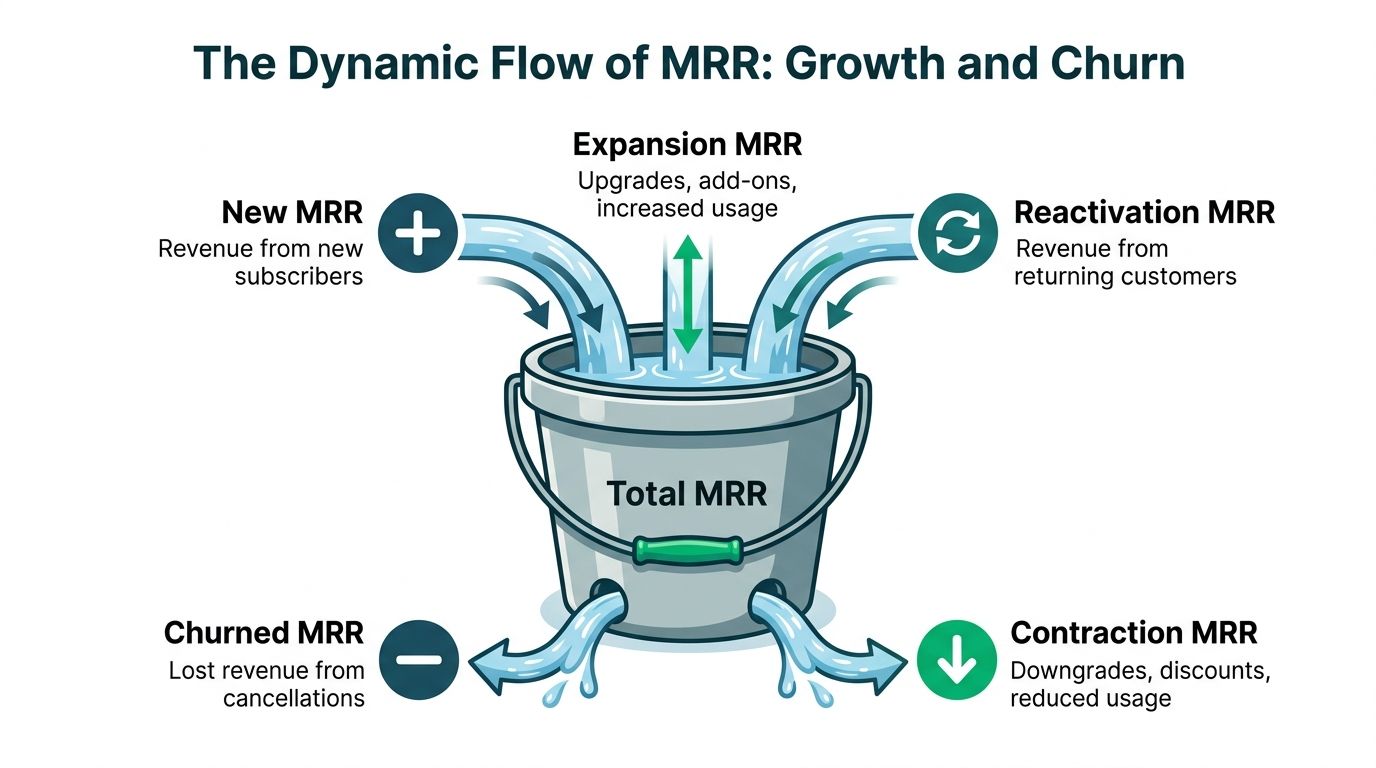
The bucket fills from new customers and expansions. It drains from downgrades and cancellations. Wall Street Prep's breakdown of MRR movements names the four core components:
- New MRR from new sign-ups
- Expansion MRR from upsells
- Churn MRR from cancellations
- Contraction MRR from downgrades
The same source gives the operating formula: Net New MRR = (New + Expansion) – (Churn + Contraction).
That formula matters because it changes how you diagnose growth. If MRR is rising, you still need to know whether growth comes from efficient acquisition, strong expansion inside the base, or brute-force replacement of customers who are leaving.
What each MRR movement tells you
Each component points to a different operating issue.
New MRR tells you whether acquisition is producing paying customers. If signups are up but New MRR is weak, pricing, conversion, or lead quality may be the issue.
Expansion MRR reflects whether customers find enough value to upgrade, add seats, or move to a higher tier. This is often where healthy products show their strength.
Contraction MRR usually points to mismatch. Customers may still want the product, but not at the current price or package. Good downgrade paths can preserve revenue better than forcing an all-or-nothing decision.
Churn MRR is the hardest signal. It tells you customers have left entirely, and it often combines product friction, poor onboarding, weak fit, budget pressure, or avoidable billing problems.
A useful benchmark example comes from ChurnZero's discussion of net MRR growth. A company with $100,000 MRR that loses 2% to churn but gains 3% from expansion ends up with 1% net monthly growth from the existing customer base.
Growth gets cheaper when existing customers expand fast enough to offset what leaks out.
That's why mature growth teams don't obsess over top-of-funnel alone. They look at the composition of MRR movement. If every month depends on replacing lost revenue, acquisition starts carrying a burden retention should be helping shoulder.
MRR vs ARR and Net Revenue Retention
These metrics are related, but they do different jobs. Confusing them creates bad reporting and even worse strategy.
A quick comparison
When explaining what MRR stands for to someone new to SaaS, a common source of confusion emerges. MRR is monthly recurring revenue. ARR is the annualized version. Net Revenue Retention tells you how the existing customer base is holding up over time.
| Metric | What It Measures | Best For |
|---|---|---|
| MRR | Predictable monthly subscription revenue | Weekly and monthly operating management |
| ARR | Annualized recurring revenue | Board reporting, valuation framing, annual planning |
| NRR | Revenue retention and expansion within the existing customer base | Understanding account quality and retention momentum |
If you need the annual lens, this explanation of the calculation of ARR for subscription businesses is the practical counterpart to MRR reporting.
When each metric matters most
ARR is simple in concept. As noted earlier in the article, SaaS teams commonly derive it from monthly recurring revenue multiplied by twelve. That's useful when you want a higher-level view of recurring scale.
NRR asks a different question. Are your current customers worth more, the same, or less over time after upgrades, downgrades, and churn? ChurnZero's MRR benchmark example makes this concrete: a business with $100,000 MRR that loses 2% to churn but gains 3% from expansion produces 1% net monthly growth from its installed base.
That distinction matters in practice. A company can grow MRR while masking weak retention if new sales are covering up churn. The top line looks fine. The engine underneath is less healthy than the dashboard suggests.
So use them together, but don't make them interchangeable:
- Use MRR to run the business now.
- Use ARR to communicate recurring scale in annual terms.
- Use NRR to judge whether the customer base is becoming more valuable or less valuable over time.
How to Actively Protect and Recover Your MRR
A lot of teams treat MRR like a score that updates after the month closes. That's too passive. By the time the number drops, the customer may already be gone.
In practice, MRR is something you can protect inside the product and billing experience.
Where MRR leaks in real products
Two leaks show up over and over.
The first is voluntary churn. A customer clicks cancel, sees a generic confirmation page, and leaves. The product learns almost nothing. The team doesn't test pause offers, downgrades, support handoffs, or plan-specific save paths. Revenue disappears, and the company calls it churn as if nothing could have been done.
The second is involuntary churn. Billing fails, access continues for a while, reminders are weak or poorly timed, and MRR drops later when the subscription finally expires. Paddle's article on Monthly Recurring Revenue says 68% of SaaS companies lose revenue due to involuntary churn from failed payments and that up to 30% of churn is recoverable before the MRR number officially drops.
That changes the operating view of MRR. It's not just a lagging finance metric. It's a signal that can trigger intervention before loss becomes final.
What actually works when you want to save revenue
The strongest retention setups don't rely on one generic cancel page. They use account context and route users differently based on what the business already knows.
That usually means some combination of:
- Reason-aware cancellation flows: Ask why the customer wants to leave, then respond with the next best path instead of a dead-end confirmation.
- Save offers matched to the situation: A pause can make sense for temporary budget pressure. A downgrade can fit lower usage. A support handoff can help when the issue is product confusion or unresolved bugs.
- Payment recovery that starts early: Failed payment flows work better when card update paths, reminders, and retries are coordinated instead of scattered.
- Measurement tied to recovered recurring revenue: If the team can't see which offers preserve revenue and which ones just add friction, it won't improve the flow.
For a broader playbook on retention operations, this guide on how to reduce churn rate in subscription software is a useful next step.
MRR is a number on a dashboard. Retention happens in product decisions, billing logic, and customer-facing flows.
What doesn't work is treating cancellations and failed payments as back-office events. The best operators build these moments into the product itself, because that's where revenue is either kept or lost.
If you're running a subscription product and want more control over cancellation flows, failed payment recovery, and recovered recurring revenue, take a look at Revcover. It helps SaaS teams intercept cancellation intent, recover at-risk subscription revenue, and connect retention actions back to measurable MRR outcomes.