
What Does CAC Mean for SaaS Growth Teams

Ayush Soni
Founder, Revcover
On this page
- What Does CAC Mean in Business and SaaS
- Why SaaS teams track CAC
- How to Calculate CAC Accurately
- Build a repeatable cost boundary
- SaaS CAC Benchmarks by Segment and Motion
- What makes enterprise CAC higher
- Why CAC Alone Does Not Tell the Full Story
- Evaluate the whole unit-economics system
- How Retention and Revenue Recovery Protect CAC ROI
- Turn cancellation intent into a controlled intervention
- Actionable Strategies to Lower Your CAC
- Improve acquisition efficiency
- Protect the revenue you already bought
- Building Your CAC Measurement and Optimization Plan
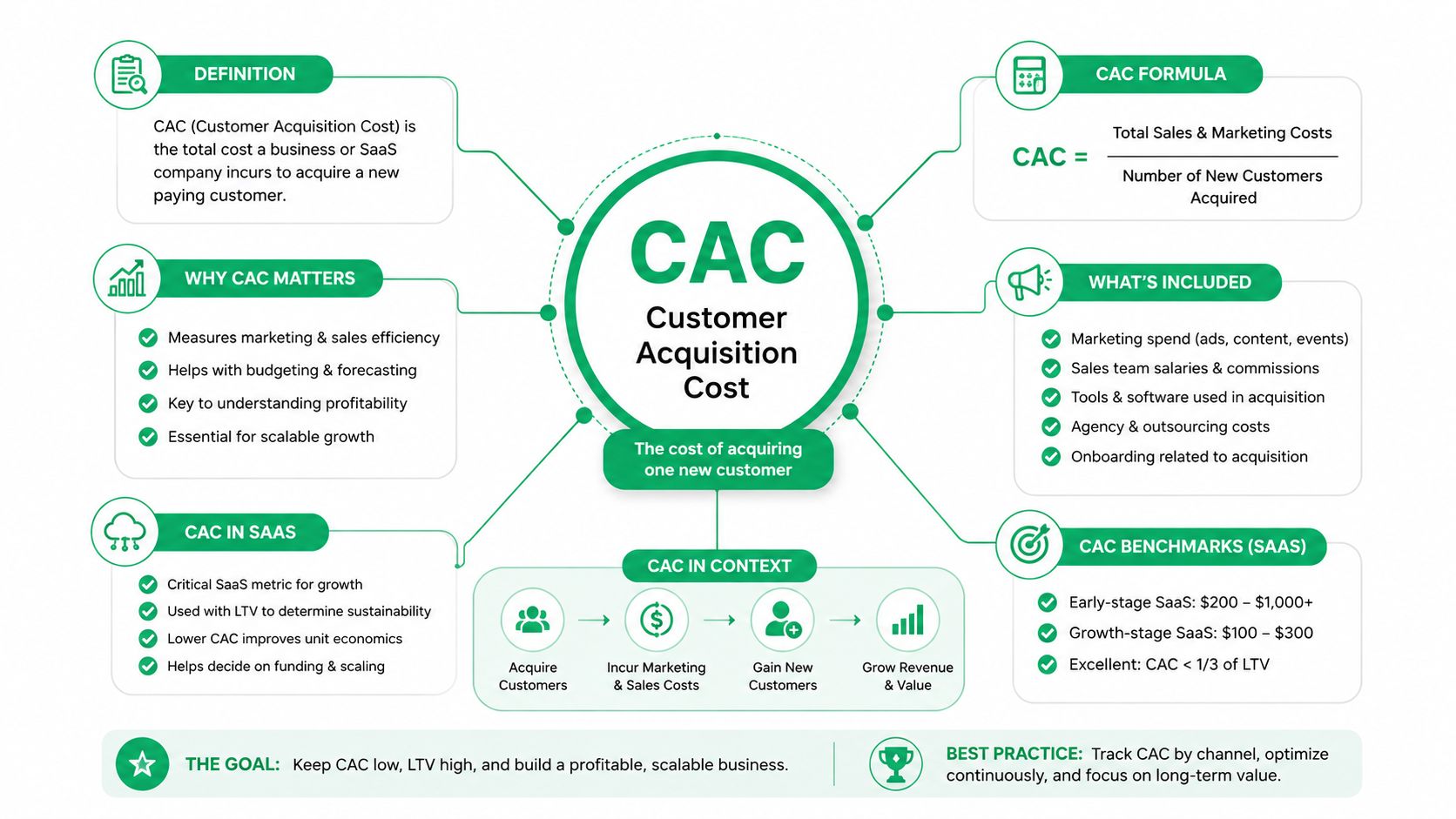
CAC stands for Customer Acquisition Cost, calculated as total sales and marketing spend divided by new customers acquired in the same period. In SaaS, it's the primary unit-economics metric used to judge whether growth spending is efficient.
That definition sounds simple, but the economics behind it aren't. A 2026 SaaS benchmark reports that the median company spends about $2.00 to acquire $1 of new ARR, roughly 14% higher than in 2023 (LTV/CAC Book). CAC has moved beyond a marketing dashboard metric. It now shapes hiring decisions, pricing, channel investment, sales coverage, retention priorities, and board-level discussions about sustainable growth.
The mistake I see most often is treating CAC as a campaign statistic. Paid media spend is only one possible input. A useful CAC model accounts for the people, software, agencies, sales process, and overhead required to turn demand into a paying customer. It also connects acquisition with what happens afterward, because retention and payment recovery determine whether the original investment ever pays back.
What Does CAC Mean in Business and SaaS
Customer Acquisition Cost, or CAC, is the average fully loaded cost of winning one new customer. The standard formula is:
CAC = Total sales and marketing costs ÷ New customers acquired during the same period
The numerator usually includes advertising, sales and marketing personnel, software, agency fees, creative work, and relevant overhead. That's why CAC is more useful than looking at paid-media cost alone. A campaign can appear efficient while the sales team, marketing operations stack, and implementation effort make each new account expensive.
The acronym itself is ambiguous. In SaaS and finance, CAC means Customer Acquisition Cost. In healthcare, it can mean Coronary Artery Calcium, while in U.S. defense contexts it can mean Common Access Card, as shown by the official Common Access Card resource. Search intent matters, so a business article should establish the meaning immediately.
Why SaaS teams track CAC
Subscription software companies need a common way to compare growth spending with customer creation. CAC provides that common denominator. Teams can compare acquisition across periods, channels, segments, and go-to-market motions, provided they use a consistent calculation method.
CAC became a board-level KPI as subscription software scaled because recurring revenue requires upfront investment. A company may spend heavily to acquire an account today while recognizing revenue over time. CAC helps leaders ask whether that investment is reasonable relative to customer revenue, gross margin, retention, and expansion.
That's also why CAC shouldn't stand alone. The SaaS CAC guide from Crescade is useful background for connecting the basic metric to broader subscription economics. For a wider view of how CAC fits into the operating model, see this guide to unit economics.
How to Calculate CAC Accurately
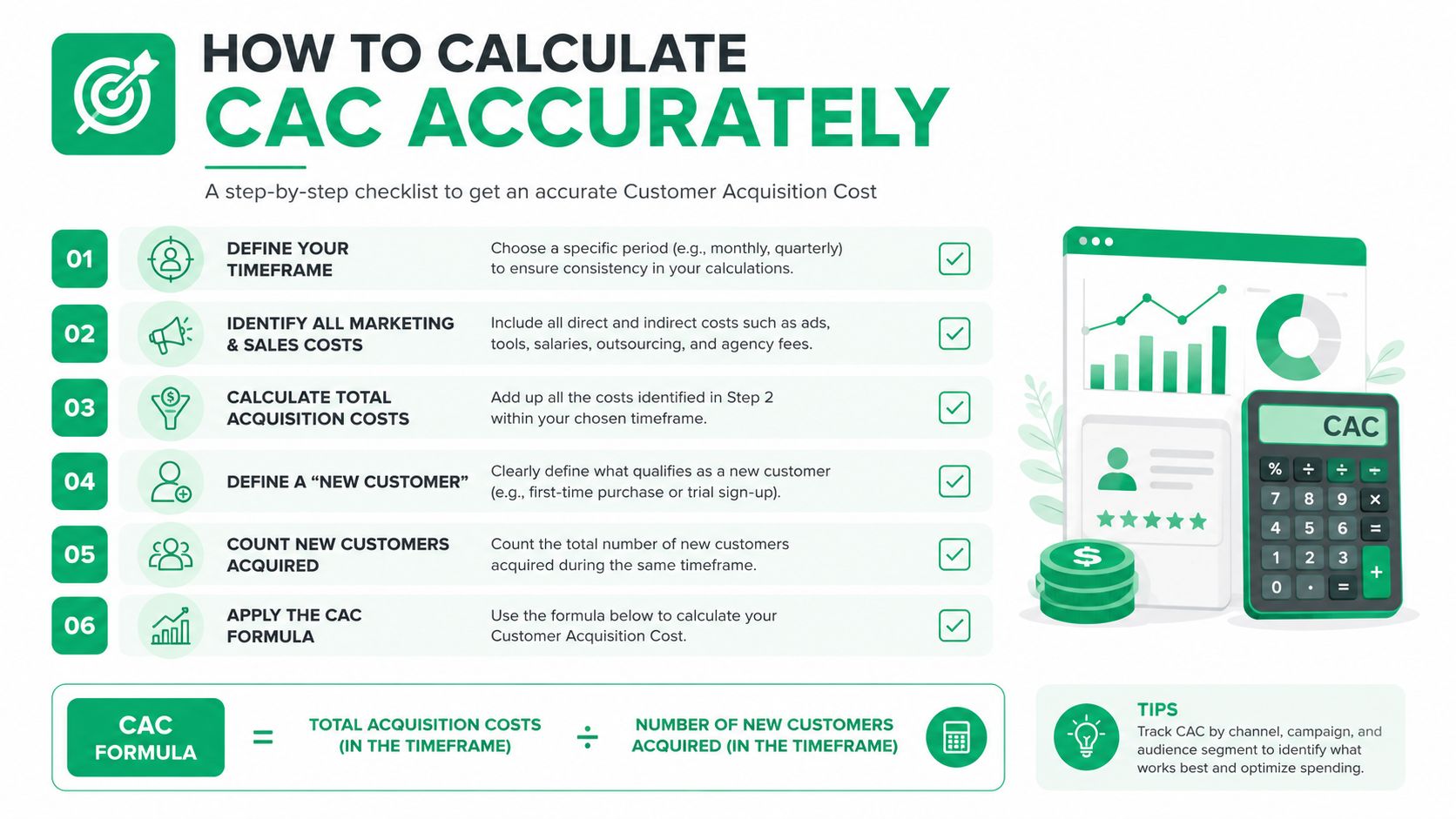
The formula is easy. The difficult part is deciding what belongs in it.
A blended CAC includes the sales and marketing cost required to acquire all new customers. That typically means paid acquisition, content and creative, salaries, commissions, sales tools, marketing automation, agencies, events, and relevant overhead. A paid CAC isolates paid-media investment, which can be useful for campaign management but shouldn't be presented as the company's complete acquisition cost.
Two SaaS companies can report different CAC figures and both be correct if their definitions differ. One might include the full compensation of a sales team. Another might allocate only the portion associated with new business. The problem isn't choosing one method. The problem is changing the method whenever the result becomes uncomfortable.
Build a repeatable cost boundary
Use a written policy before you calculate the metric. At minimum, document these decisions:
- People: Decide whether to include sales, marketing, growth, partnerships, and acquisition-focused customer success salaries.
- Tools: Include software that supports demand generation, attribution, prospecting, sales execution, and conversion.
- External support: Account for agencies, contractors, creative production, and outsourced appointment setting where applicable.
- Period matching: Compare costs and newly acquired customers from the same reporting period, while recognizing that long sales cycles can create timing distortion.
- Customer definition: Decide whether a new customer means a signed account, a paid account, or an activated subscription.
Consider two contrasting motions. A self-serve company may use a product-led funnel, paid search, lifecycle email, and in-product conversion. Its cost base may be concentrated in marketing, product, and software. An enterprise sales-led company may rely on account executives, solutions consultants, sales engineers, legal review, procurement support, and longer implementation coordination. Applying the same unexamined allocation to both motions hides the actual economics.
Practical rule: Keep the calculation stable, then create separate views for channel, segment, plan, and acquisition motion.
Don't let a blended average conceal an unhealthy channel. Review CAC by cohort and source, then pair the analysis with the broader subscription business metrics framework. A channel-level CAC can rise while total CAC stays flat, or total CAC can look acceptable because a strong segment masks weak acquisition elsewhere.
SaaS CAC Benchmarks by Segment and Motion
SaaS acquisition cost varies sharply by segment and sales motion. Current benchmark coverage reports approximately $702 for self-serve B2B SaaS, $3,840 for mid-market sales-led SaaS, and $11,400 for enterprise sales-led acquisition, a roughly 16x spread between product-led and enterprise selling (Digital Applied).
A separate range in the same benchmark coverage places self-serve or PLG SaaS at $50 to $200, SMB SaaS at $200 to $600, mid-market B2B SaaS at $600 to $1,200, and enterprise SaaS at $1,200 to $5,000 or more. These ranges and point estimates should not be blended into one target.
| SaaS Segment | Typical CAC Range | Key Characteristics |
|---|---|---|
| Self-serve or PLG SaaS | $50 to $200, with a reported benchmark around $702 for some B2B self-serve motions | Product-led discovery, low-touch conversion, limited sales involvement |
| SMB SaaS | $200 to $600 | Smaller accounts, shorter evaluation, comparatively lower sales complexity |
| Mid-market B2B SaaS | $600 to $1,200, with a reported benchmark around $3,840 for some sales-led motions | Sales assistance, multiple stakeholders, more onboarding support |
| Enterprise SaaS | $1,200 to $5,000+, with a reported benchmark around $11,400 for some enterprise motions | High ACV potential, complex procurement, longer sales cycles, heavier labor intensity |
Methodology explains much of the apparent gap. A benchmark may define the segment differently, include different acquisition costs, or measure a different customer or revenue event. Use these figures as directional context, then compare them with your own cohorts, margins, and payback results.
What makes enterprise CAC higher
B2B acquisition generally costs more than B2C because the process includes longer sales cycles, more handoffs, and greater labor intensity, as explained by Stripe's SaaS CAC overview. Enterprise buyers may require security reviews, demonstrations, technical validation, legal negotiation, and procurement approval. Every added stage can increase the labor and time required to win the account.
A higher CAC can still be efficient when ACV, gross margin, retention, and expansion support an acceptable payback period. The useful question is whether the acquisition cost matches the value and recovery profile of the customers that motion attracts. Retention and payment recovery matter here: reducing cancellations or failed-payment losses helps preserve the return on the original acquisition spend, even when the headline CAC stays unchanged.
Why CAC Alone Does Not Tell the Full Story
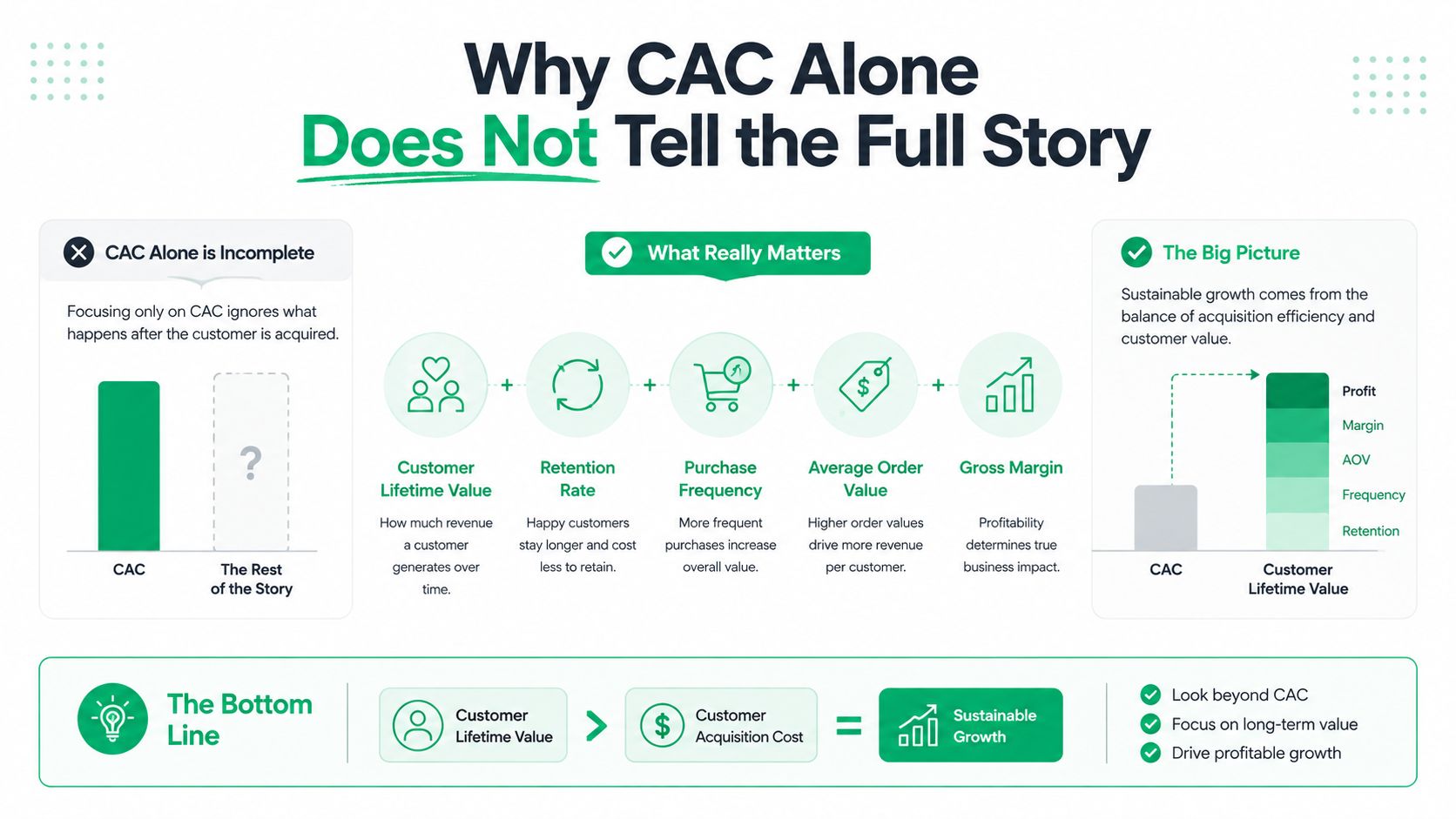
A low CAC can hide a weak business. If customers cancel before the company recovers the acquisition investment, efficient top-of-funnel performance doesn't create durable economics.
Two companion metrics matter most: LTV:CAC and CAC payback period. LTV:CAC compares customer lifetime value with acquisition cost. A commonly cited SaaS guideline is 3:1, meaning lifetime value is three times CAC, while a commonly used payback objective is under 12 months (Cube's LTV:CAC analysis, For Entrepreneurs SaaS metrics definitions).
CAC payback asks how long it takes to recover acquisition cost through gross-margin contribution, not just booked revenue. Gross margin matters because revenue has delivery costs. A customer generating revenue without enough margin may take longer to repay the original acquisition investment than a topline calculation suggests.
Evaluate the whole unit-economics system
Suppose one segment has a lower CAC but weak onboarding, frequent cancellation, and limited expansion. Another segment costs more to acquire but retains accounts longer and supports broader usage. The second segment may produce healthier economics even though its raw CAC looks worse.
That's why I review CAC alongside:
- Gross-margin payback: How quickly gross-profit contribution recovers acquisition cost.
- Retention: Whether acquired customers remain active long enough to repay the investment.
- Expansion: Whether account growth improves lifetime value after the initial sale.
- Cohort performance: Whether recent customers behave differently from earlier cohorts.
- Channel quality: Whether a low-cost source attracts customers who activate and retain.
A blended LTV:CAC ratio can also hide variation. Segmenting by plan, source, sales motion, and customer profile shows which customers create durable value and which ones consume acquisition resources without adequate recovery.
The operating principle is straightforward: CAC measures the investment, but retention determines whether the investment pays back.
How Retention and Revenue Recovery Protect CAC ROI
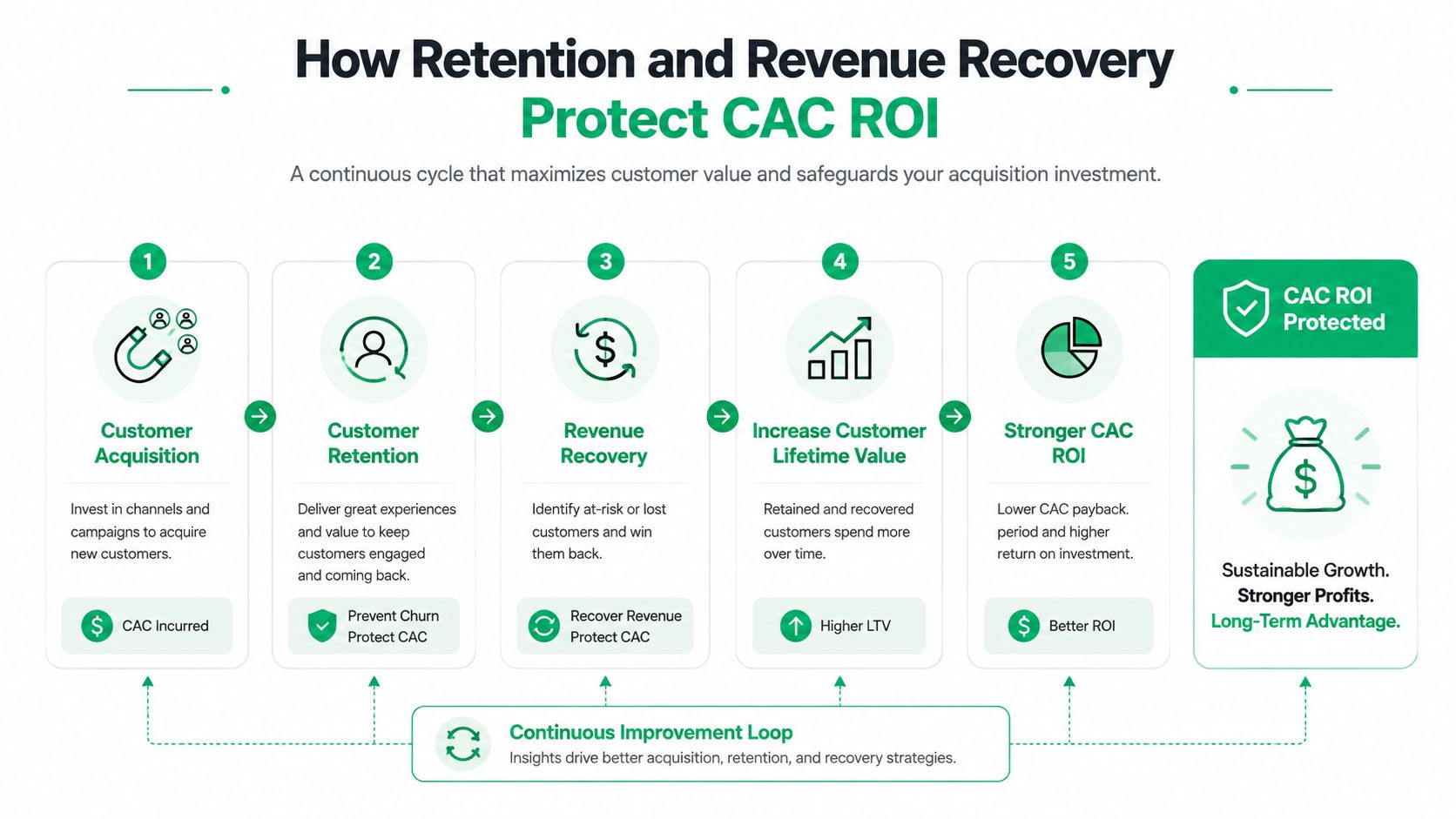
Most CAC programs stop when the customer converts. That's a serious measurement error. Acquisition creates an economic obligation, and the business has to retain revenue long enough to recover the cost of winning the account.
Cancellation intent is one of the clearest moments to act. A customer who clicks cancel has already identified a problem, whether it's price, missing functionality, low usage, a temporary budget issue, or a poor experience. A generic survey records the reason and ends the interaction. A well-designed cancellation flow uses the reason to route the customer toward an appropriate next step.
Turn cancellation intent into a controlled intervention
Useful save paths can include a pause, a downgrade, a targeted offer, a support handoff, or a sales conversation. The route should reflect account context, plan, usage, stated reason, value, and billing state. A customer citing temporary budget pressure shouldn't receive the same response as a customer reporting a missing product capability.
The experience also needs an honest exit. Obstructive cancellation patterns may delay churn while damaging trust and creating support burden. The right goal is not to trap every customer. It's to save appropriate accounts, capture reliable reasons, and make the outcome measurable. For broader context on the discipline, see this explanation of customer retention management meaning in 2026.
Payment failure creates a separate form of leakage. Involuntary churn can occur even when the customer still wants the product. Coordinated retries, email and in-app reminders, a direct card-update path, and carefully timed feature restrictions give the customer a practical way to restore billing.
The acquisition dollar earns its return after conversion, not at conversion.
A platform such as Revcover can connect with Stripe to intercept cancellation intent, route customers through context-specific save paths, coordinate payment recovery, and attribute outcomes to recovered MRR. Teams evaluating the operational side should also understand dunning management, especially when failed-payment handling is split between billing, support, and lifecycle marketing.
The broader lesson is important. Reducing effective CAC doesn't always mean spending less to acquire customers. It can also mean preserving more of the revenue those acquisition dollars already generated.
Actionable Strategies to Lower Your CAC
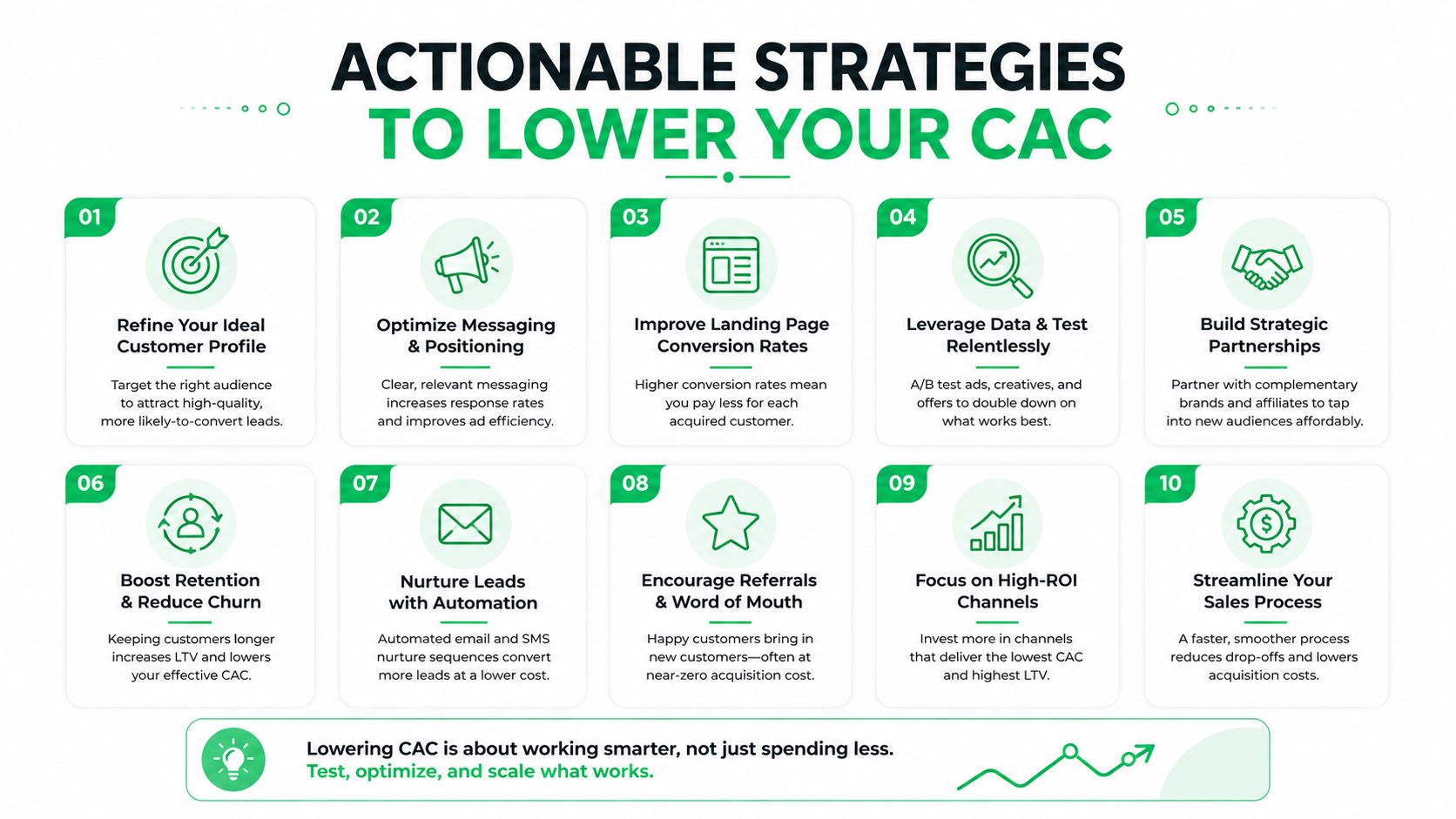
Lowering CAC requires work on both sides of the customer lifecycle. Acquisition teams improve the cost of creating customers. Product, success, and billing teams improve the percentage of acquired revenue that survives and expands.
Start with channel analysis. Separate CAC by source, segment, plan, and motion instead of optimizing toward one blended number. A channel with cheap leads may produce expensive customers if activation and retention are poor. A more expensive channel may deserve additional investment when it consistently attracts accounts with stronger payback.
Improve acquisition efficiency
- Raise conversion quality: Review landing pages, signup friction, qualification, onboarding, and sales handoffs together. A conversion improvement matters only when the resulting customers activate and pay.
- Shorten unnecessary sales work: Remove duplicate discovery, unclear qualification, and avoidable approval steps. Sales complexity is a direct cost driver, particularly in B2B acquisition.
- Test product-led entry points: Self-serve trials, guided onboarding, templates, and in-product education can reduce dependence on high-touch selling when the product supports that motion.
- Reallocate by cohort quality: Shift attention toward channels that produce retained customers, not the lowest reported paid CAC.
Protect the revenue you already bought
Retention improvements often have attractive benefits because they work on customers already acquired. Build cancellation flows that capture reasons and offer relevant options. Cluster feedback into product themes, then connect those themes to affected plans and revenue so product teams can prioritize issues with commercial context.
Payment recovery deserves the same operating discipline. Coordinate retry schedules, reminders, card updates, and account-state changes rather than sending disconnected messages from multiple systems. The implementation may involve billing, lifecycle marketing, support, and engineering, but the outcome should be visible in the same revenue model.
Finally, run controlled experiments. Track the reason presented, route shown, accepted offer, subsequent subscription state, and recovered revenue. Don't count a click or accepted offer as success if the customer cancels immediately afterward.
Building Your CAC Measurement and Optimization Plan
Start by writing the CAC policy your finance, marketing, sales, and RevOps teams will all use. Define included costs, customer-count rules, reporting periods, attribution, and segment views. Then benchmark your result against the motion that drives your growth, not against an unrelated SaaS model.
Review CAC, LTV:CAC, payback, retention, expansion, and recovered revenue together on a regular quarterly cadence. When CAC worsens, ask whether costs increased, conversion weakened, sales cycles lengthened, customer mix changed, or churn and failed payments reduced recovery.
On Monday morning, export acquisition costs and new customers by channel, split the view by segment, and identify the cohort with the weakest payback. Then inspect cancellation reasons and failed-payment recovery beside it. CAC isn't just a number to report. It's a system spanning demand, sales productivity, product value, billing reliability, and customer retention.
If your SaaS team wants to protect the revenue behind every acquisition dollar, visit Revcover to explore Stripe-connected cancellation flows, save paths, payment recovery, and recovered-MRR reporting. Use the data from cancellation intent and failed payments to make CAC optimization a full-funnel operating process.