
Dunning Management for SaaS: A Guide to Recovering Revenue

Ayush Soni
Founder, Revcover
On this page
- Beyond Failed Payments Why Dunning Is Your Secret Retention Tool
- Dunning is a customer experience workflow
- What works and what usually fails
- The Core Components of a Modern Dunning Strategy
- Why point solutions fail
- The five components that work together
- Designing Your Dunning Cadence Schedule and Messaging
- A practical cadence for subscription revenue recovery
- Message templates that sound helpful not desperate
- How to adjust the playbook by segment
- Best Practices and Frameworks for Experimentation
- Build measure learn for dunning management
- What to test first
- Key Dunning Metrics Every SaaS Leader Should Track
- The dashboard that matters
- How to read the story behind the numbers
- Integrating Dunning into Your Growth and RevOps Stack
- Keep billing as the source of truth
- Turn payment failures into account intelligence
You're probably looking at a subscription business that seems healthy on the surface. New bookings are landing. Expansion is happening. Pipeline reviews feel productive. Then finance flags a quieter problem: customers who didn't mean to churn are slipping out through failed payments, expired cards, issuer declines, and update flows that ask too much work at exactly the wrong moment.
That's why dunning management deserves more respect than it usually gets. In SaaS, it isn't a back-office reminder sequence. It's a retention system, a customer communication system, and a source of operational truth about where your buying experience, billing setup, and product value story break down under stress.
The teams that build this well don't treat a failed payment as just a collections event. They treat it as a moment to preserve MRR, protect the relationship, and learn something useful about the account.
Beyond Failed Payments Why Dunning Is Your Secret Retention Tool
Dunning management is often still framed as a billing cleanup task. That framing is expensive.
When a customer hits a failed renewal, you're not only dealing with a charge attempt. You're dealing with a moment of friction in the relationship. If the response is clumsy, the customer reads it as indifference. If the response is clear and respectful, the customer often sees it as useful service. That difference shapes retention.
The hidden cost of poor dunning is that it blurs the line between billing failure and product churn. Finance sees a decline. Customer success sees a silent downgrade in account health. Growth sees MRR disappear without a clear reason code. Product loses the chance to understand whether the issue was value, payment friction, or account confusion. That's why the distinction between voluntary and involuntary churn in SaaS matters operationally, not just analytically.
Dunning is a customer experience workflow
The best systems do three jobs at once:
- Recover revenue: They give the customer a fast path to fix the payment problem.
- Protect trust: They use language that assumes good intent, not delinquency.
- Capture signal: They tell your team whether the underlying issue was card expiry, procurement delay, internal ownership changes, or weakening product value.
That last point gets missed. Failed payment workflows often reveal who owns the billing, which accounts are unmanaged, and where handoffs between sales, support, and finance are messy.
Practical rule: If your dunning process only sends emails, you don't have a retention system. You have an automated reminder tool.
What works and what usually fails
What works is simple. Clear notification. Easy card update path. Reason-aware retries. Human escalation for accounts that matter. Grace before restriction.
What doesn't work is equally predictable. Generic “payment failed” copy with no context. A broken login-to-billing maze. Hard lockouts on first failure. The same tone for a trial user and a strategic account.
Strong dunning management feels less like collections and more like guided recovery. That's why the teams that take it seriously usually end up with better retention discipline across the whole business.
The Core Components of a Modern Dunning Strategy
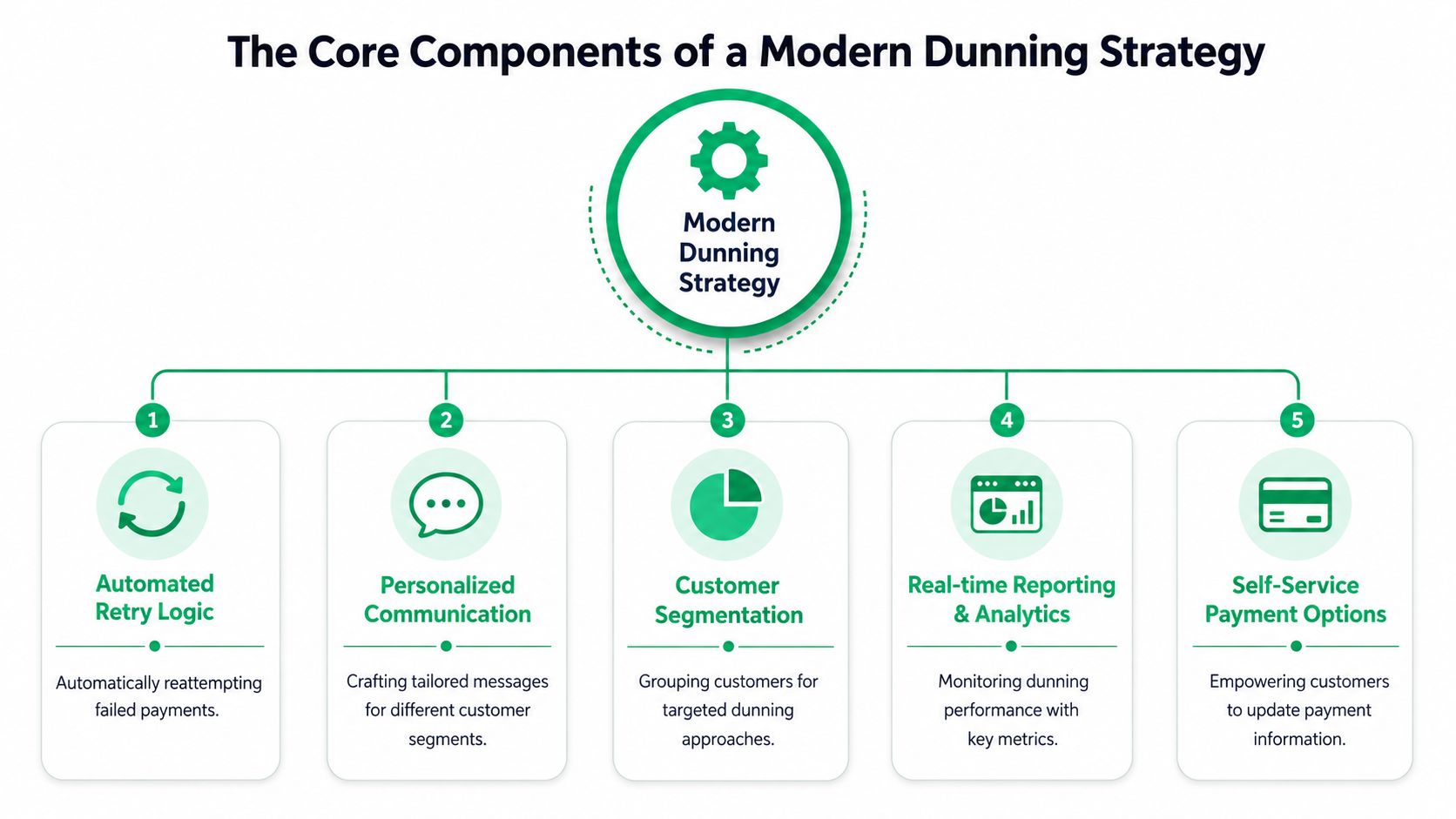
A modern dunning system works like a pit crew. The goal isn't to admire any single motion. The goal is to get the car back on the track quickly, safely, and with as little disruption as possible. One person changing a tire while nobody checks the engine doesn't win races. Dunning works the same way.
Why point solutions fail
A lot of SaaS teams bolt together a retry rule inside Stripe, a few email templates in a lifecycle tool, and a support macro for edge cases. That can work at low volume. It usually breaks once account segments, payment failure reasons, and ownership rules get more complex.
The weak spot is almost never effort. It's coordination. Retry timing doesn't match message timing. Customer success gets notified too late. Billing pages create friction. Nobody knows when to gate access and when to wait.
The five components that work together
Here are the five pillars that matter most.
- Smart retry logic
Not every decline should be treated the same. Some failures can succeed on another attempt. Others need updated payment details before any retry makes sense. SaaS companies that implement intelligent retry logic based on specific decline codes can recover up to 15% more revenue than those using a generic fixed-interval retry schedule, according to Revcover's data insights on decline-code-based retry logic.
That's the difference between a system that listens to the payment signal and one that just keeps knocking on a locked door.
- Multi-channel communication
Email matters, but email alone is fragile. In-app notices reach active users. SMS can work for time-sensitive reminders when appropriate. Internal alerts help teams intervene on higher-value accounts. Use channels based on urgency, customer profile, and the kind of product relationship you have.
- Frictionless card update paths
If your message says “update billing details” and the customer has to click through a login wall, hunt for the billing tab, and guess which card failed, recovery rates will suffer. Every dunning motion should remove effort. Deep-link to the billing update page. Keep the path obvious. Confirm success immediately.
A surprising amount of failed-payment churn has nothing to do with willingness to pay. It comes from forcing a busy customer to do too many small steps.
- Graceful feature gating
Immediate account shutdown is a blunt instrument. It may protect policy consistency, but it often damages trust and creates unnecessary support volume. Better systems apply temporary, visible limits that preserve enough access for the user to fix the issue without feeling trapped.
Examples include limiting exports, pausing new seat additions, or showing billing banners before cutting off core access. The exact gate depends on your product and customer expectations.
- Customer segmentation
Dunning management should reflect account value and account context. A self-serve monthly customer can stay mostly automated. A strategic annual account with a failed installment probably needs a human alert, CRM context, and a customer success touchpoint.
A practical segmentation model often includes:
- Plan tier: Enterprise accounts need more judgment than trial or low-ACV accounts.
- Lifecycle stage: New customers may need educational copy. Mature accounts may need shorter, direct reminders.
- Usage pattern: Active usage is often a strong sign that recovery is worth urgency.
- Payment history: A one-time failure is different from repeated decline behavior.
The system is only as strong as the handoff between these parts. Great dunning management doesn't rely on one heroic tactic. It coordinates several small, well-timed decisions.
Designing Your Dunning Cadence Schedule and Messaging
Most dunning programs fail in the middle. Teams either under-communicate and let recoverable revenue sit untouched, or they over-communicate and sound like a collections agency. The right cadence creates momentum without turning a fixable billing issue into a trust problem.
A practical cadence for subscription revenue recovery
Use this as a starting point, not doctrine. Your exact schedule should reflect billing model, average contract value, product dependency, and how quickly customers feel pain from restricted access.
| Day | System Action | Customer Communication | Notes |
|---|---|---|---|
| Day 0 | Detect failure and classify decline type | Send immediate email and in-app notice | Keep the tone calm. Tell the customer what happened and what to do next. |
| Day 1 | Retry only if the decline type suggests a retry is appropriate | No new message unless the account is high value | Avoid piling on before the customer has a chance to act. |
| Day 2 | Check account segment and usage | Send reminder with direct payment update link | Focus on convenience, not pressure. |
| Day 4 | Trigger second retry when logic supports it | In-app banner for active users | Match contact to product activity. |
| Day 6 | Flag high-value accounts for human review | Customer success or sales outreach for selected accounts | Use CRM context before reaching out. |
| Day 8 | Attempt another recovery action based on billing state | Send firmer reminder | Clarify service impact if unresolved. |
| Day 10 | Prepare access limitation workflow | No mass message if a personal outreach is already active | Don't let automation collide with a live conversation. |
| Day 12 | Apply graceful feature gating where appropriate | Notify customer of temporary limitation and exact fix path | The message should explain the consequence and the resolution path. |
| Day 14 | Final automated recovery attempt if appropriate | Final notice | Be direct, respectful, and specific about what happens next. |
| Day 15+ | Escalate to cancellation or account suspension policy | Confirmation of account status and reactivation path | Make reactivation easy if the customer returns promptly. |
The most important design choice isn't the exact day count. It's the logic behind each step. For example, an issuer decline may call for a different sequence than an expired card. If you want a clearer view of the underlying causes, this breakdown of why a card gets declined by the issuer is useful because it maps payment failures to the kinds of fixes customers can complete.
Message templates that sound helpful not desperate
The tone should evolve. Start with assistance. End with clarity.
Initial notice
Subject: We couldn't process your renewal
Hi [First Name], We had trouble processing your latest subscription payment. This is usually resolved by updating the payment method or retrying with your bank.
You can fix it here: [Update payment details]
Your account is still active for now, and we'll keep trying to help you get this resolved.
Reminder message
Subject: Quick action needed to keep your account active
Hi [First Name], Your renewal still needs attention. To avoid any interruption, please update your payment details using the secure link below.
[Update billing]
If someone else handles billing on your team, please forward this message to them.
Final notice before gating or cancellation
Subject: Action required to avoid service interruption
Hi [First Name], We still haven't been able to complete your payment. If this isn't resolved soon, your account will move into a limited access state.
To keep your subscription active, update your payment details here: [Fix payment]
If you need help, reply to this email and our team will point you to the fastest path.
How to adjust the playbook by segment
One sequence should not serve every customer equally.
For self-serve accounts, optimize for automation and low friction. Keep messaging short. Use product-language they already understand. Avoid human outreach unless behavior suggests unusual value or risk.
For high-value accounts, layer context into every step:
- Check ownership: Confirm who manages procurement or billing before sending repeated reminders.
- Coordinate outreach: Pause automated messages if a CSM or AE is already in motion.
- Use account activity: An active account with broad usage deserves quicker intervention than a dormant one.
- Preserve goodwill: If the payment failure is administrative, don't create product pain too early.
For new customers, billing issues can feel like onboarding failures. Your message should reassure them that the product is still available to them while they sort out the admin side, at least within your policy window.
For chronic late-payers, remove ambiguity. Fewer pleasantries. Clear deadlines. Tighter internal review.
The best dunning copy never sounds like it was written to “collect.” It sounds like it was written to help the customer keep getting value.
That's the difference between a payment workflow and a retention workflow.
Best Practices and Frameworks for Experimentation
A static dunning process leaves money on the table. Most SaaS teams would never accept a set-and-forget onboarding flow, pricing page, or lifecycle campaign. Then they let failed-payment recovery run untouched for quarters. That's a mistake.
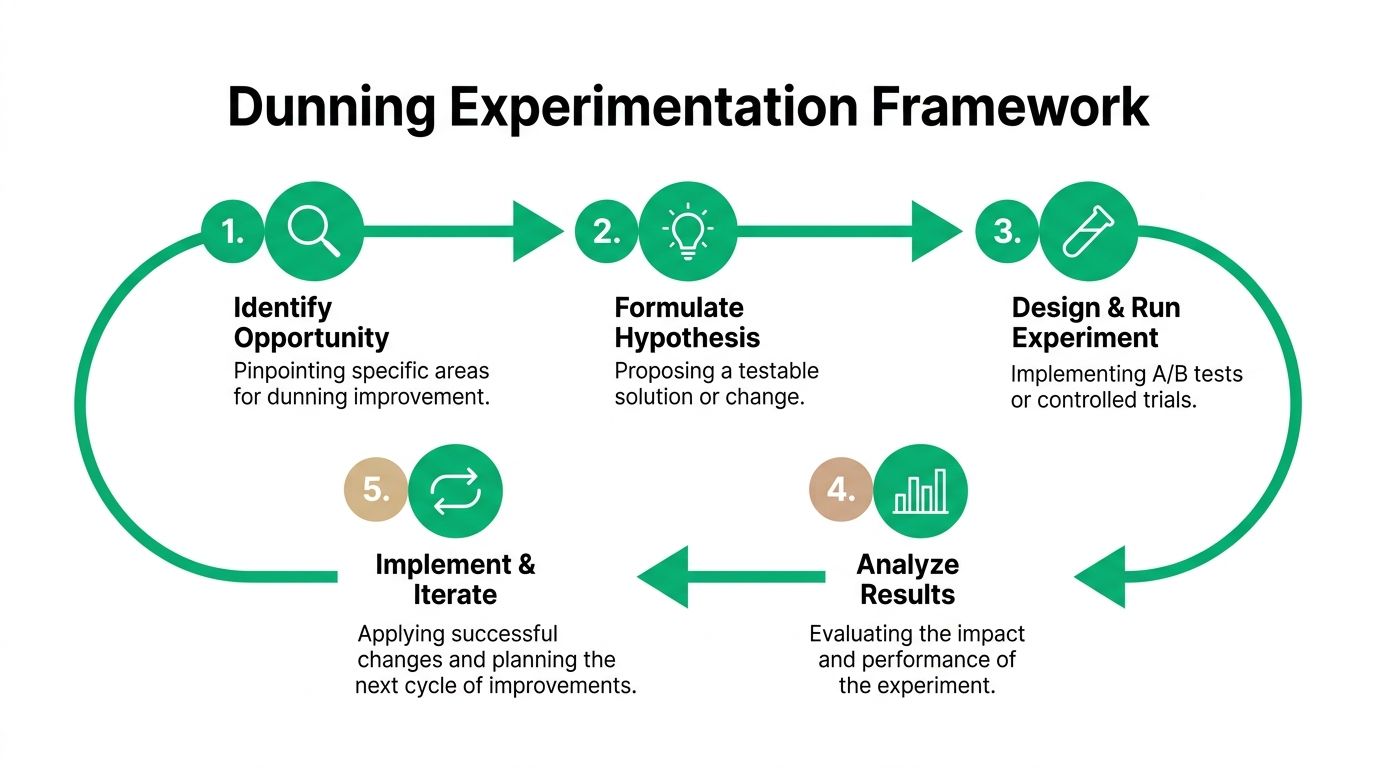
Dunning management should be treated like a recoverable revenue funnel. You build a hypothesis, measure the output in recovered MRR, and learn where friction lives.
Build measure learn for dunning management
A useful operating loop looks like this:
- Build: Pick one part of the flow to improve. Don't test everything at once.
- Measure: Track what changed in recovery outcome, account experience, and internal workload.
- Learn: Keep the winner if it improves MRR recovery without creating downstream damage.
This discipline matters because local improvements can create global problems. A more aggressive final notice might increase short-term payment fixes while creating more support tickets or unnecessary churn among customers who needed one more day.
What to test first
Start where there's the least ambiguity.
Retry timing is often the most impactful operational test. If your current system retries on a rigid interval, compare that against a more reason-aware pattern.
Subject lines and opening copy are another practical starting point. “Payment failed” may be clear, but “Update your payment method to keep your account active” might create a stronger action path for some segments. Test clarity against urgency, not cleverness against cleverness.
Billing page friction often hides in plain sight. Ask simple questions:
- Can the customer reach the update screen in one click?
- Do they know which payment method failed?
- Do they understand what happens after they update it?
- Does the confirmation make it obvious that the account is safe?
Escalation rules also deserve testing. Some teams gate access too soon and create resentment. Others wait too long and train customers that failed payment has no consequence.
Key takeaway: Don't optimize for opens, clicks, or retries in isolation. Optimize for recovered MRR with acceptable customer experience.
A practical experiment backlog often includes:
| Test area | Hypothesis | Risk to watch |
|---|---|---|
| Retry logic | Decline-aware retries will recover more payments than fixed retries | Too many attempts can create customer confusion |
| Email copy | Clearer action language will increase card updates | Overly urgent tone can feel punitive |
| Channel mix | In-app prompts will help active users resolve faster | Too many prompts can feel noisy |
| Gating timing | A later gate will preserve goodwill without hurting recovery | Waiting too long may reduce urgency |
| Human intervention | High-value account outreach will save strategic revenue | Poor ownership can create duplicate outreach |
Good experimentation in dunning management is restrained. One variable at a time. A clean measurement window. A clear owner. If your team can't say what changed and why, you're not running experiments. You're making edits.
Key Dunning Metrics Every SaaS Leader Should Track
You need a simple dashboard that helps finance, growth, customer success, and product interpret the same failed-payment system from different angles.
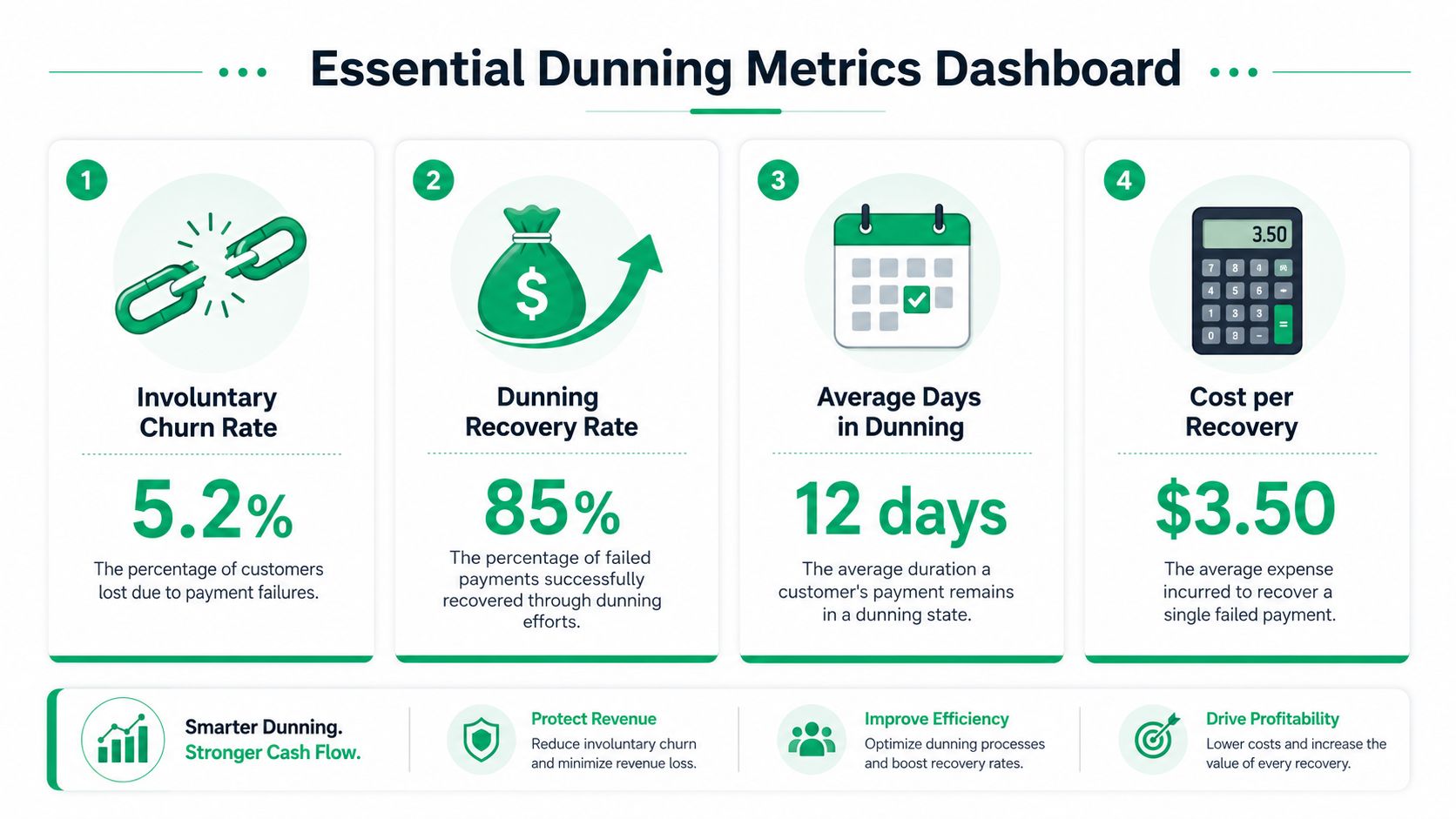
Start with the visual summary below.
The dashboard that matters
These are the core metrics worth tracking consistently:
- Involuntary churn rate: The share of customers or revenue lost due to payment failures rather than intentional cancellation.
- Dunning recovery rate: The portion of failed payments that are recovered during the dunning window.
- Average days in dunning: How long accounts stay unresolved between failure and recovery or cancellation.
- Cost per recovery: The operational cost required to recover a failed payment, including tooling and human time where relevant.
- Recovery by segment: Performance broken out by plan, account value, geography, payment method, or lifecycle stage.
- Failure reason mix: A categorized view of the root causes driving failed payments.
If your finance team already works from receivables aging views, it also helps to align dunning reporting with the logic behind an aging report in finance operations, especially for teams that manage both subscription recovery and broader billing follow-up.
Here's a useful primer on the topic before you formalize your dashboard:
How to read the story behind the numbers
Metrics only matter if they lead to action.
A high recovery rate with long days in dunning usually means the system eventually works, but too slowly. That can create awkward customer experiences, delayed cash collection, and extra support work. Shorten the path. Reduce page friction. Improve internal routing.
A low involuntary churn rate with high manual intervention can look healthy until you inspect scalability. If the process only works because a few people catch edge cases by hand, it isn't durable.
A rising failure reason concentration in one category often points to a specific systems problem. Maybe your renewal timing clashes with customer procurement patterns. Maybe your billing owner field is unreliable. Maybe your product reaches casual users well but loses administrative accountability inside larger accounts.
What's a “good” number? There isn't a universal benchmark you should trust blindly. A bootstrapped self-serve SaaS business, a vertical SaaS company with invoice-heavy accounts, and a product-led B2B platform will all have different baselines. Good means the trend is improving, segment variance is understood, and recovered MRR can be tied back to specific levers.
Integrating Dunning into Your Growth and RevOps Stack
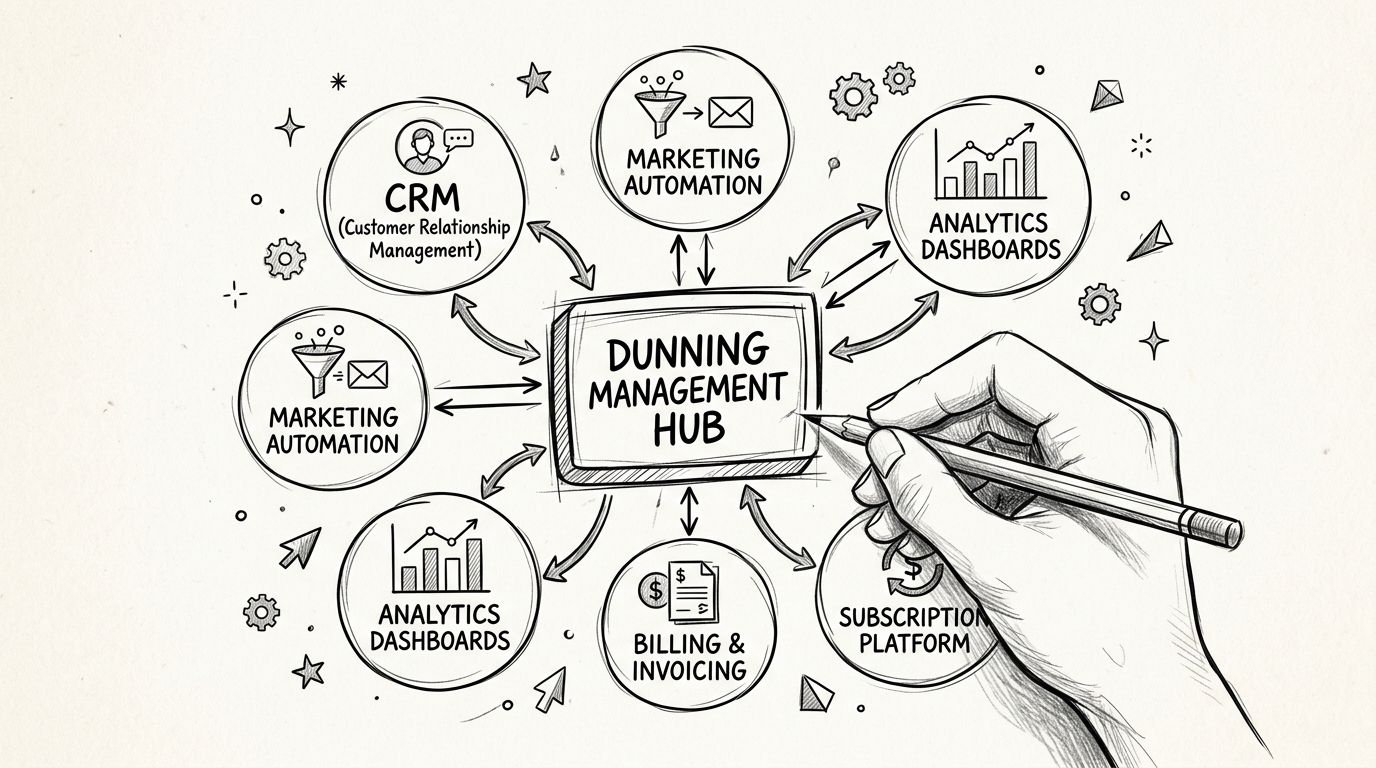
Dunning becomes far more valuable when it stops living inside billing alone. The strongest systems treat payment failure as a revenue event and an account signal at the same time.
Keep billing as the source of truth
For most subscription SaaS teams, Stripe should remain the billing source of truth. That means subscription status, invoice state, and payment outcomes originate there. Your dunning layer should listen and orchestrate, not fork the billing record into a separate reality.
In practice, that usually means reacting to billing events such as failed payment webhooks, then triggering downstream workflows:
- CRM updates: Add a payment-risk status on the account or subscription record in Salesforce or HubSpot.
- Team alerts: Post a Slack notification for accounts that meet high-value or high-risk rules.
- Customer messaging: Trigger email or in-app recovery flows without requiring a support agent to notice first.
- Usage-aware routing: Change the treatment for active accounts versus dormant ones.
That operating model keeps your systems aligned. Finance trusts the billing platform. Growth trusts the measurement. Customer success trusts the alerting.
Turn payment failures into account intelligence
Organizations often underuse dunning management. A failed payment isn't only a collections problem. It's also one of the cleanest account-risk signals you can get because it combines timing, customer behavior, and billing friction in a single moment.
Teams that integrate payment failure alerts into their CRM and communication tools like Slack see a 30% faster response time for high-value accounts, according to Revcover's analysis of integrated payment failure workflows. The operational lesson is straightforward. When the right owner sees the risk early, they can step in before the account drifts toward avoidable churn.
A practical RevOps setup usually includes:
- Stripe to CRM sync: Mark account status, owner, and billing risk in the record your team already works from.
- Slack escalation rules: Send alerts only for the accounts that justify attention, not every routine failure.
- Customer success playbooks: Give CSMs a script for procurement delays, card expiry, and account-owner confusion.
- Product instrumentation: Track whether active users in dunning continue to log in, hit billing banners, or abandon the update flow.
- Feedback capture: When a customer chooses not to update payment, capture why. Budget freeze, vendor consolidation, missing feature, internal offboarding, and billing admin turnover are very different signals.
A world-class dunning system doesn't just recover money. It teaches the business where revenue is fragile.
That's why dunning belongs in the growth loop. It informs lifecycle strategy, product prioritization, account health scoring, and win-back targeting. Once connected properly, it stops being a billing afterthought and becomes part of how you protect and grow MRR.
If you want a system that connects failed-payment recovery, cancellation intent, account context, and recovered MRR in one place, Revcover is built for that job. It works alongside Stripe, helps teams run coordinated recovery flows, and turns payment failures into measurable retention outcomes instead of scattered operational noise.