
What Are Acquisition Costs? a SaaS Founder's Guide

Ayush Soni
Founder, Revcover
On this page
- The Most Important Question in Growth
- Deconstructing Customer Acquisition Cost
- What usually belongs in the numerator
- What to leave out
- How to Calculate CAC for Your SaaS Business
- Move from blended to channel-level CAC
- Add fully loaded CAC when you need a truer benchmark
- Don't ignore labor time
- Bring churn and revenue recovery into the model
- A simple reporting stack
- The Golden Trio CAC LTV and Payback Period
- Why the ratio matters more than the standalone number
- Why churn is the quiet destroyer of CAC economics
- Recovery is part of the unit economics model
- Actionable Levers to Optimize Your CAC
- Tighten the front end
- Treat retention like acquisition leverage
- Use feedback as a product signal
- Measuring and Reporting CAC Effectively
- The metrics that belong on one page
- Cadence matters
- Keep the story connected
You're looking at a dashboard that should feel simple. New MRR is climbing, ad spend is climbing with it, and yet the question hangs there every week: is this growth profitable, or are you buying revenue too expensively? That's the core problem acquisition costs are meant to answer.
For SaaS founders, what are acquisition costs isn't an academic question. It's the price tag on growth, and if you don't measure it correctly, you can make a healthy pipeline look broken or a broken funnel look healthy. The practical version is simple, CAC tells you what it costs to win a new paying customer, and the harder version is knowing what to include, what to exclude, and how retention changes the economics after the sale.
The Most Important Question in Growth
A founder I've seen more than once opens Stripe, looks at the recurring revenue graph, then opens the marketing tab and winces. MRR is up, but so is spend, and the first instinct is usually to ask whether the channel is working. The better question is tighter and more useful, how much did it cost to get each customer, and did they stay long enough to be worth it?
That's where Customer Acquisition Cost, or CAC, becomes the anchor metric. In SaaS, it's the cleanest way to connect sales and marketing activity to revenue generation, as long as you define the cost bucket correctly and use the same time period for costs and new customers, as Stripe's CAC guidance lays out in its SaaS explainer. Stripe's SaaS CAC guidance also makes the operational point that only acquisition-tied costs belong in the numerator, because support, infrastructure, and R&D distort the picture.
The practical payoff is straightforward. If CAC is too high, you either need to acquire more efficiently or make each customer worth more over time. If CAC is understated, you'll approve campaigns that look efficient on paper but drain cash in the business.
Practical rule: treat CAC as a control system, not a vanity report. It should tell you when to slow down, when to double down, and when the product, pricing, or retention layer is the real problem.
The subtle part is that acquisition doesn't end at the signup or the closed-won deal. If customers churn early, fail to pay, or cancel before the economics work, your acquisition engine is leaking value after the sale. That's why revenue recovery and churn reduction matter, and why metrics like GRR and NRR are worth tracking alongside CAC, as discussed in this GRR vs NRR guide.
Deconstructing Customer Acquisition Cost
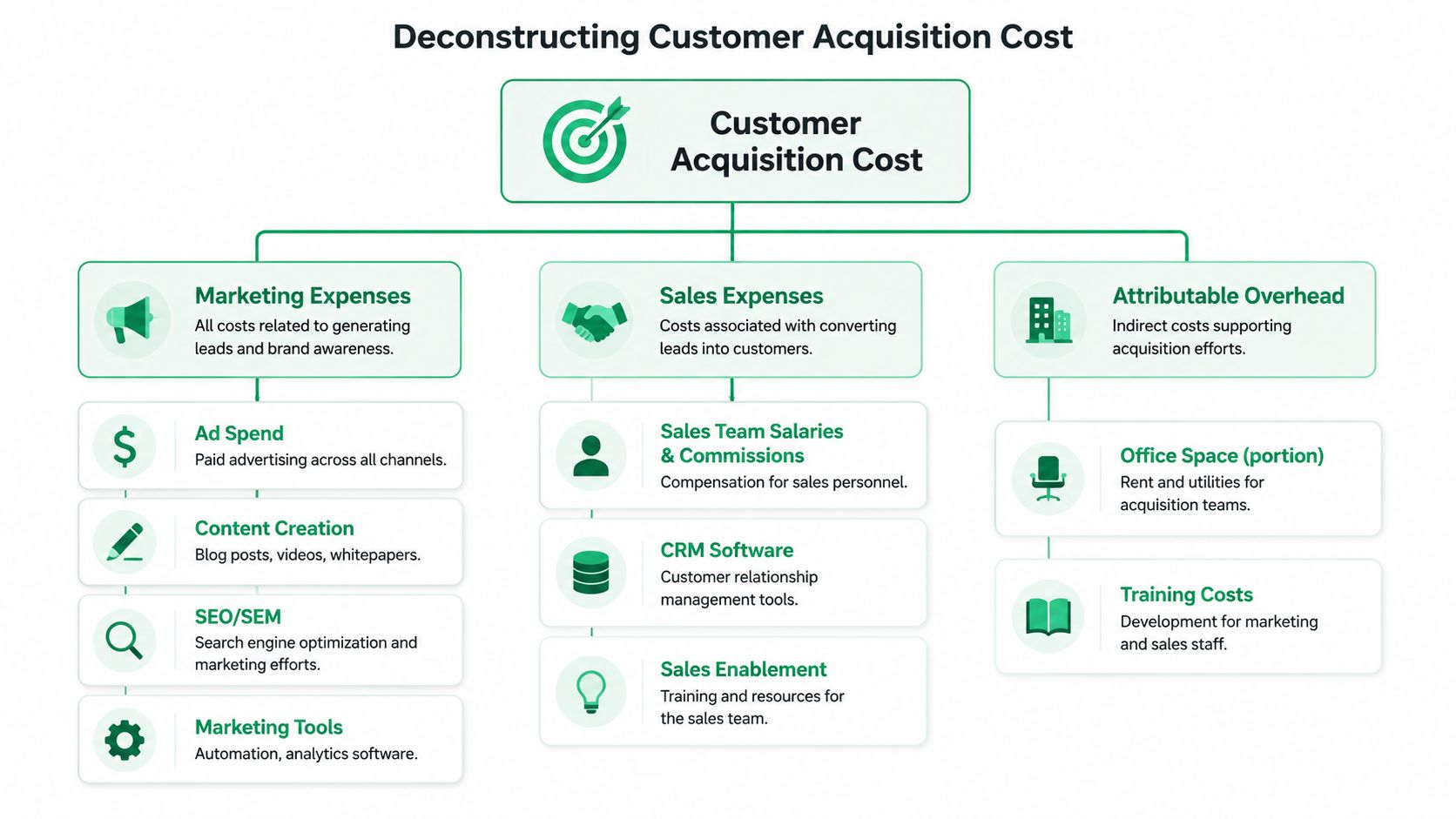
CAC is the price tag on a new customer. Not the price of one ad click, not the price of one demo, and not the price of one outbound email. It's the total cost of winning a new paying account over a defined period, divided by the number of new paying customers gained in that same period.
What usually belongs in the numerator
The most common mistake is thinking CAC means ad spend only. In practice, acquisition spend can include the cost of the campaigns that created demand, the people who converted it, and the software and overhead required to support that work. That often means marketing salaries, sales salaries, commissions, bonuses, CRM subscriptions, automation tools, analytics tools, and acquisition-related overhead.
A useful way to think about it is this, if the expense exists because the company is trying to win a customer, it probably belongs in CAC. If the expense exists because the company is serving an existing customer, it usually doesn't.
This distinction matters because the wrong numerator changes every decision downstream. If you stuff support, infrastructure, or R&D into CAC, you'll make channels look less efficient than they really are. If you strip out acquisition labor, you'll flatter the business and delay needed fixes.
What to leave out
Stripe's SaaS guidance is explicit that support, infrastructure, and R&D should be excluded from the CAC numerator when you're measuring acquisition efficiency. That keeps the metric focused on the cost of acquiring a customer, not the broader cost of running the company. Stripe's explanation of CAC in SaaS is a good reference point for that boundary.
The easiest way to keep the line clean is to ask a simple question about every expense, did this cost help win the customer, or did it help keep and serve the customer? If the answer is the second one, it belongs in a different model.
A messy CAC model usually isn't a math problem, it's a category problem. The more clearly you separate acquisition from servicing, the more useful the metric becomes.
For a broader operating model, teams often cross-check this with their revenue attribution logic, since the channel that starts the journey is not always the one that closes it. That's why attribution discipline matters as much as the formula itself, and why revenue attribution model design should sit alongside CAC reporting.
How to Calculate CAC for Your SaaS Business
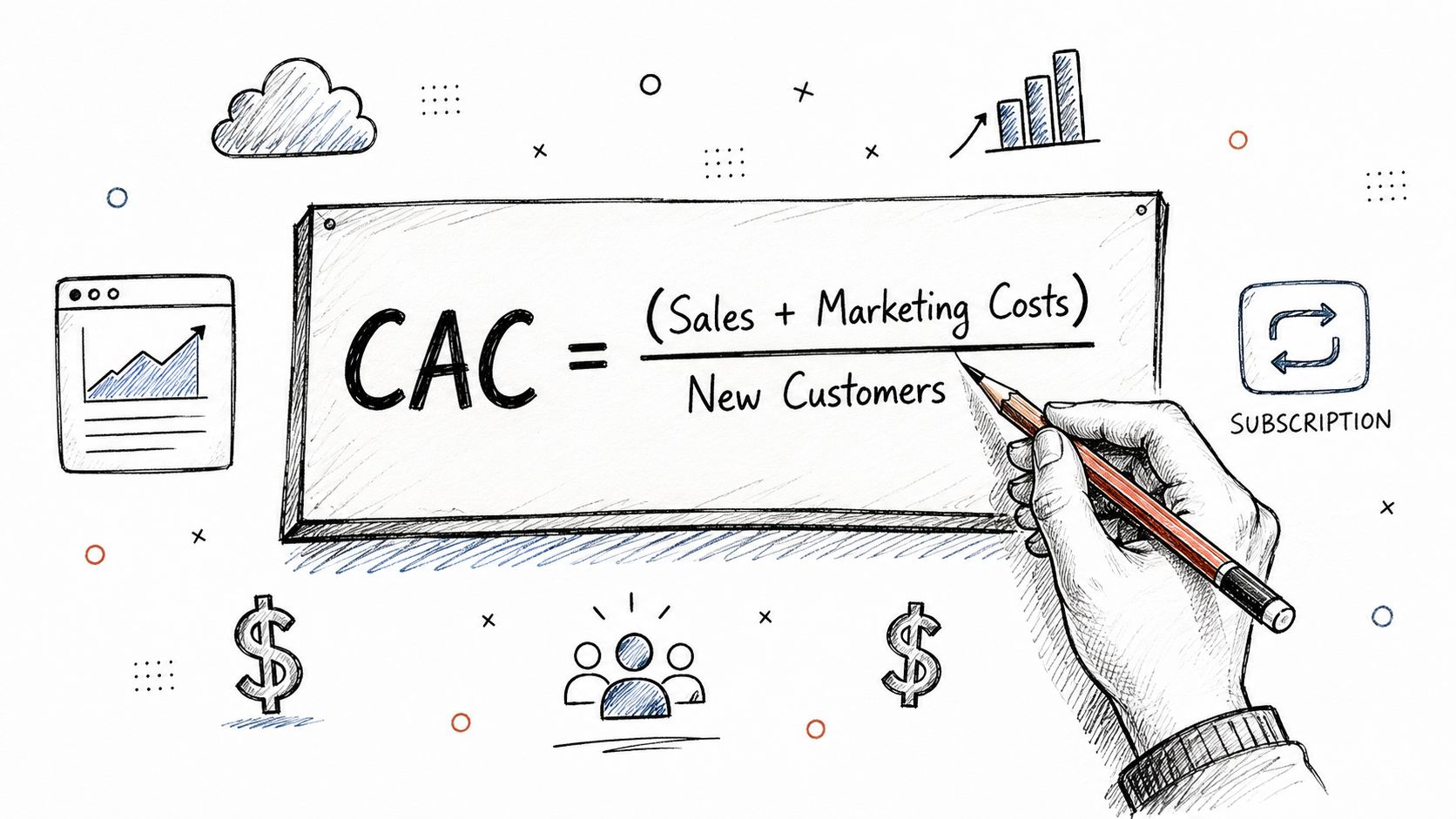
A founder can look at CAC and still miss the complete picture. The number is only useful if you tie it to the exact period, the right cost bucket, and the revenue outcome that follows. CAC = total acquisition cost over a period divided by new paying customers acquired in that same period. That formula still gives subscription businesses the cleanest starting point, as long as the numerator only includes direct acquisition costs.
The timing has to line up. If you count one quarter's spend and another quarter's customers, the result stops describing what happened. Teams then debate whether efficiency improved when the comparison was never valid in the first place.
Move from blended to channel-level CAC
A blended CAC shows the average cost of growth across the business. That works for a board deck or a quick health check, but it masks the true trade-offs between channels. If paid search is efficient and outbound is expensive, one blended number can blur the decision.
Channel-level CAC gives you a better operating view. You isolate the spend for one channel and divide it by the new customers that channel produced in the same window. That makes it easier to decide where to keep investing and where to pull back.
Add fully loaded CAC when you need a truer benchmark
Blended CAC still leaves out part of the story. Fully loaded CAC adds product cost of sales, support, infrastructure, and G&A allocated to the revenue you acquired. MTLC's B2B SaaS CFO guide treats that as a better benchmark for capital-efficiency analysis because it captures the broader cost of acquiring and servicing revenue. MTLC's CAC guide makes that boundary clear.
Use blended CAC when speed matters. Use fully loaded CAC when you need to judge how much growth really costs the business.
Don't ignore labor time
Another place teams undercount is founder and management time. Netsuite's CAC guidance notes that acquisition cost should include direct acquisition labor, such as discovery calls, proposal writing, networking, and other acquisition-only activities. Netsuite's CAC overview is a useful reminder that founder-led selling can look cheap only because the labor is hidden.
If you spend half your week in demos, proposal edits, and follow-up emails, that time has a cost. It may not appear in the same line item as paid media, but it still changes CAC for the business.
Bring churn and revenue recovery into the model
A CAC number can look acceptable while the business leaks revenue after the sale. Reducing churn improves the unit model on the back end, and recovered revenue does the same when you win back accounts that were drifting away. Both effects change how much acquisition spend you can afford, because they improve the revenue side of the equation rather than only the spend side.
That is why teams serious about subscription economics track CAC alongside average revenue and retention behavior. If you want a clean way to estimate that revenue layer, see how to calculate average revenue. A tool like Revcover matters here because it does not just help with lost deals or reactivation, it improves the economics around the original acquisition spend by protecting more of the revenue you already paid to earn.
A simple reporting stack
A practical SaaS team can track CAC in three views:
- Blended CAC: for quick business health checks.
- Channel CAC: for budget decisions.
- Fully loaded CAC: for capital-efficiency and board-level analysis.
The point is not to maintain six versions of the same metric. It is to choose the version that matches the decision you are making. The wrong level of detail slows teams down, but the wrong level of aggregation leads them to spend blindly.
The Golden Trio CAC LTV and Payback Period
CAC by itself can trick you. A company can have a high acquisition cost and still be healthy if customers stay long enough and generate enough revenue. That's why CAC, LTV, and payback period need to be read together, not in isolation.
Why the ratio matters more than the standalone number
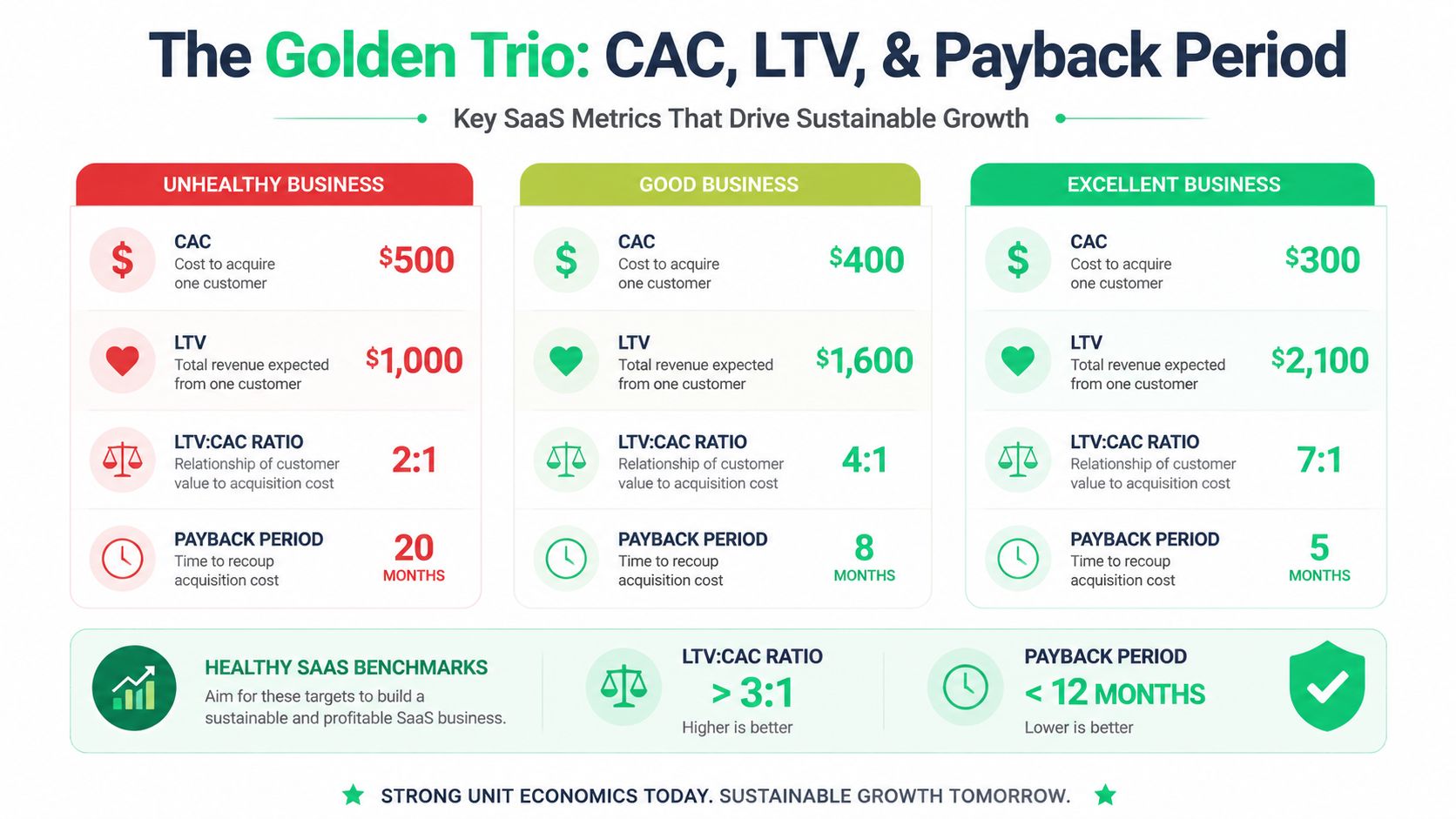
LTV, or lifetime value, is the revenue a customer is expected to generate over the relationship. Once you put that next to CAC, you get the LTV:CAC ratio, which is a key indicator of whether growth is scalable. A common benchmark in SaaS is 3:1, meaning the customer should return roughly three times what it cost to acquire them.
The reason this matters is operational, not academic. If you spend too much to acquire a customer who leaves quickly, you never get the revenue back. If you recover the acquisition cost too slowly, the company can still run into cash strain even if the ratio looks acceptable on paper.
The visual above shows why teams treat payback period as a separate constraint. A business can have a decent ratio and still suffer if it takes too long to recover the acquisition outlay. That is especially important for subscription companies, where cash timing matters as much as lifetime economics.
Why churn is the quiet destroyer of CAC economics
Churn doesn't change what you paid to acquire a customer, but it changes how much value you obtain from that acquisition. Every cancellation shortens the revenue stream, which lowers LTV and weakens the ratio. The same CAC starts looking worse because the denominator in the recovery equation shrank.
That's why retention work is not a side project. Cancellation flows, payment retries, and save offers can all protect value that would otherwise leak out of the business. When that recovered revenue extends customer lifetime or saves a renewal, it directly improves the economics of the original acquisition.
Recovery is part of the unit economics model
Revenue recovery tools matter because they touch the LTV side of the equation, not just the churn dashboard. A better cancellation flow can surface why people leave, while payment recovery can rescue customers who were never unhappy in the first place. That means the acquisition spend you already made has a better chance of paying back.
The fastest way to make CAC more tolerable is often not cheaper acquisition. It's a longer, healthier revenue life after the sale.
For founders, that shift in thinking is important. You're not only trying to buy customers efficiently, you're trying to keep the revenue stream alive long enough for the acquisition to make sense. The second half of the model is where a lot of SaaS companies leave money on the table.
Actionable Levers to Optimize Your CAC
The instinct to “lower CAC” usually leads teams to cut ad spend. That can help in the short term, but it's often the weakest lever available. A better move is to increase the value and lifespan of each customer, because that improves the economics of every dollar you already spent to acquire them.
Tighten the front end
The acquisition side still matters, of course. Better targeting means fewer wasted impressions and fewer bad-fit demos. Cleaner landing pages, stronger offer positioning, and better qualification in sales all reduce the cost of turning interest into revenue.
A few practical moves work especially well:
- Narrow your target profile: Stop paying to reach accounts that were never likely to buy.
- Improve conversion points: Fix landing pages, demo booking flows, and trial-to-paid handoffs.
- Use channel-level CAC weekly: It shows you where spend is buying customers efficiently and where it's just generating activity.
- Invest in organic channels that compound: SEO, referrals, and product-led acquisition usually get more attractive once the motion is stable.
Treat retention like acquisition leverage
The more overlooked lever is everything that happens after the first purchase. If a customer stays longer, pays more reliably, or expands faster, the original CAC becomes easier to justify. That's why cancellation UX and payment recovery belong in a CAC conversation even though they happen after acquisition.
Three practical retention moves matter:
- Design cancellation flows that accurately capture intent: You want the reason, the plan context, and the chance to save the account without making the process feel hostile.
- Recover failed payments quickly: A coordinated retry and reminder process can rescue customers who meant to stay.
- Route high-value accounts differently: Not every cancellation deserves the same offer, and not every account should see the same save path.
Use feedback as a product signal
Cancellation reasons and failed-payment outcomes are not just support artifacts. They tell you whether pricing is off, onboarding is weak, the product missed a promise, or the billing experience is too fragile. That feedback should flow into product, success, and revops decisions fast.
If you want CAC to improve structurally, build a loop where the losses inform the next acquisition cycle. That's how you stop paying for the same mistake twice.
Measuring and Reporting CAC Effectively
A good CAC dashboard doesn't try to impress people. It helps leadership answer a small set of questions quickly: are we acquiring efficiently, are customers worth enough to support that spend, and is revenue sticking after the sale?
The metrics that belong on one page
A practical unit economics dashboard should include:
- CAC
- LTV
- LTV:CAC ratio
- Payback period
- Gross MRR churn
- Net MRR churn
- Recovered MRR
Those metrics together tell a more complete story than CAC alone. Acquisition spend tells you what it costs to buy demand, while churn and recovery tell you how much of that demand survives long enough to create value.
Cadence matters
Fast-moving SaaS teams usually benefit from a monthly view for finance and a weekly operational check for channel movement and retention signals. That mix keeps the business from drifting too long before anyone notices a problem. It also helps separate true trend changes from one-off noise.
The dashboard should be built for decisions, not just reporting. If CAC rises while recovery improves, the business might still be getting healthier. If CAC falls but churn worsens, the top of the funnel may be hiding a deeper retention issue.
Keep the story connected
The best teams don't look at acquisition, churn, and recovery as separate departments. They treat them as one unit economics system. That's the only way to know whether growth is creating durable revenue or just churning through budget.
If you're building or revisiting your SaaS metrics stack, start with CAC, then put LTV, payback period, churn, and recovered revenue in the same weekly or monthly review. That's the clearest way to see whether growth is getting more efficient or just more expensive.
If you want a cleaner way to connect acquisition spend, churn reduction, and payment recovery into one operating loop, take a look at Revcover.