
Value Based Segmentation: Drive SaaS Retention & Revenue

Ayush Soni
Founder, Revcover
On this page
- Introduction to Segmentation Challenges
- Understanding the Core Concept
- Why static tiers fall short
- What "value" means in practice
- Where churn reasons change the segment's job
- Advanced Frameworks for Implementation
- Start with predicted value, not past spend alone
- Add real time intent to the routing layer
- Mapping Segments to Retention and Recovery Actions
- Route by segment and reason
- A simple segment action playbook
- Handle failed payments differently from voluntary churn
- Key Metrics for Monitoring Impact
- Measure segment performance by revenue weight
- Build attribution into the dashboard
- Common Pitfalls and Testing Guidance
- Three mistakes that weaken segmentation
- How to test without breaking your billing flow
- Integration Notes for Stripe and Revcover
- Connect billing events to segmentation logic
- Roll out in stages
- Conclusion and Next Steps
Your churn dashboard looks worse than it did last month. A customer clicks cancel, lands on the same generic page everyone sees, chooses “too expensive,” and disappears. Another account with a failed payment gets the same reminder email as a barely active low-value user. Your team is collecting signals, but not acting on them in a way that matches the revenue at risk.
That's the trap many SaaS teams fall into. They know segmentation matters, but their segmentation lives in a slide deck, a dashboard, or a CRM field that never changes fast enough to influence the moment a customer decides to leave. Value based segmentation becomes useful only when it changes what happens next.
Introduction to Segmentation Challenges
A Head of Growth usually doesn't discover a segmentation problem in a data warehouse. They discover it in lost revenue.
One week, the customer success team says enterprise accounts are canceling for “budget reasons.” The next week, product hears that smaller customers are leaving because of missing features. Finance notices recoveries are inconsistent. Yet the cancellation flow still treats every account the same. That creates a strange outcome. Your team knows customers are different, but your offboarding experience pretends they aren't.
The issue isn't only churn. It's misrouted churn. A high-value account with strong usage and a short-term pricing objection shouldn't get the same path as a low-engagement account that hasn't logged in for weeks. When both receive identical offers, the business either over-discounts the wrong customers or under-serves the right ones.
Practical rule: If your cancellation flow doesn't change based on account value and stated reason, you're not running a retention system. You're running a form.
Many teams already segment for marketing, pricing, or customer success coverage. The missing piece is using those segments at the exact point of cancellation intent. That's where value based segmentation stops being a planning exercise and starts shaping revenue outcomes.
Understanding the Core Concept
A useful way to define value based segmentation is to separate customers by the business value they are likely to create, then use that value at the moment a retention decision needs to happen. In SaaS, that value usually comes from a mix of revenue, margin, product usage, renewal behavior, and expansion potential. HubSpot's guide to customer segmentation gives a solid foundation for grouping customers by meaningful differences rather than treating the whole base as one audience.
The key shift is operational. Value based segmentation is not only a planning model for quarterly strategy. It becomes far more useful when you combine the segment with live cancellation intent.
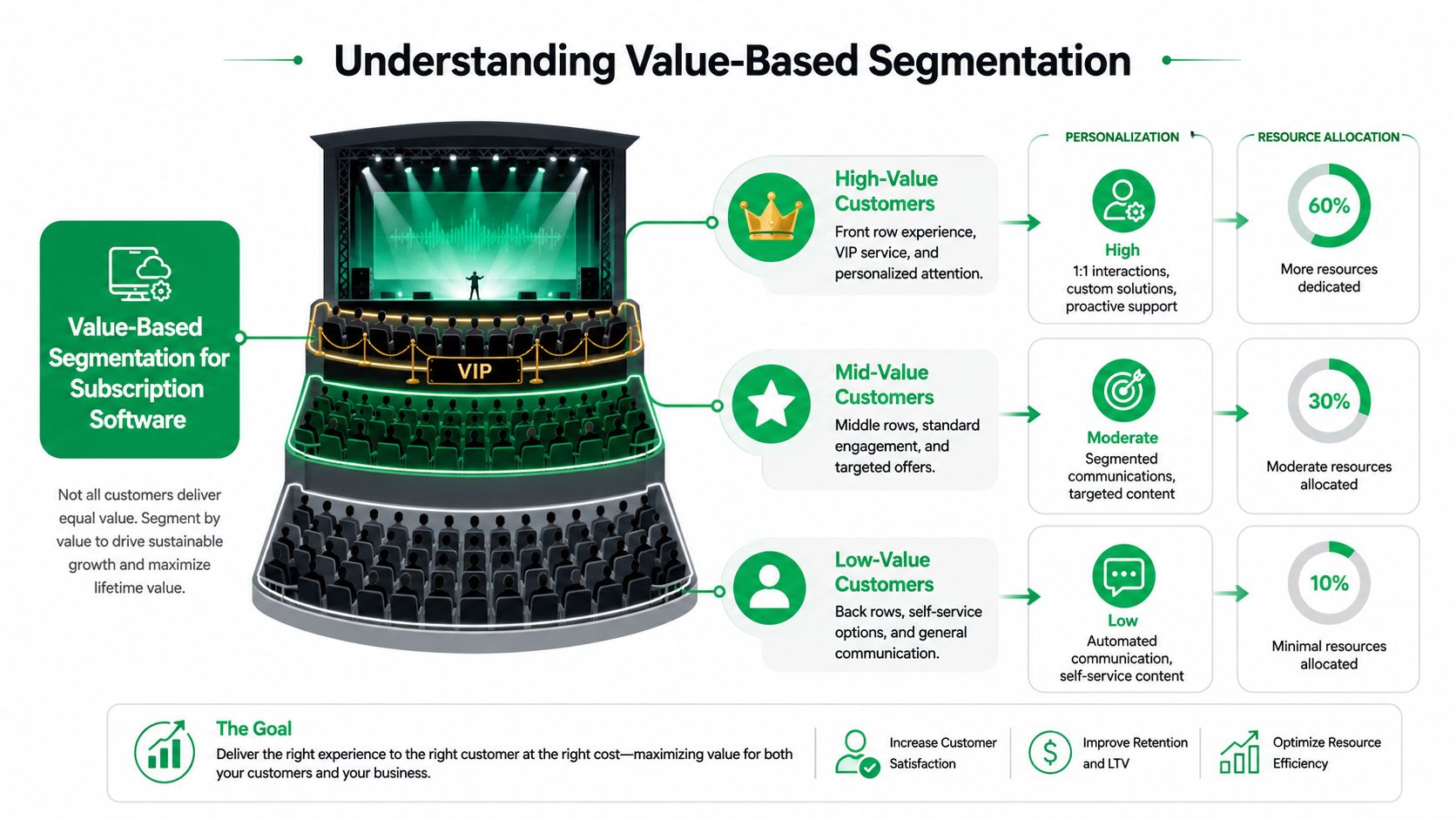
A theater comparison helps here. Some seats generate more revenue, some guests return every season, and some are likely to buy add-ons at intermission. If a loyal front-row guest suddenly asks for a refund because tonight's audio failed, the venue would not respond the same way it would to a one-time visitor who never planned to come back. SaaS retention works the same way. Account value tells you how much the relationship matters. The cancellation reason tells you how to respond.
Why static tiers fall short
Many growth teams start with three buckets. High value, mid value, low value. That structure is useful, but only up to a point.
The problem shows up when a customer enters a cancellation flow. A high-value account can cancel because procurement froze spending for one quarter. Another high-value account can cancel because the product lacks a required workflow. Those are not the same retention problem, even if both accounts sit in the same tier. A static model groups them together because it looks at stored account attributes. A live retention model separates them because it also listens to what the customer is saying right now.
That difference matters in practice. The first customer may respond to a downgrade, a short pause, or revised billing terms. The second may need product-team outreach, roadmap communication, or a faster handoff to customer success. If both customers see the same generic offer, your team wastes incentives on the wrong cases and misses saves that needed a different intervention.
What "value" means in practice
Teams often reduce value to contract size. That shortcut causes confusion.
A better definition asks two questions:
- What has this account contributed so far? Revenue, gross margin, retention history, payment reliability, and expansion patterns belong here.
- What is this account likely to contribute next? Product adoption, seat growth, feature depth, support burden, and churn signals matter here.
That second question is where many segmentation programs become more useful. A smaller account with strong adoption and clean expansion signals may deserve more attention than a larger account with weak usage and heavy service cost. Value is closer to future economic fit than simple account size.
If your team already tracks attribution, this gets easier to explain internally. A customer segment should connect to the same revenue logic you use elsewhere. Our guide to revenue attribution models for subscription growth teams can help align segment decisions with how your business measures impact.
Where churn reasons change the segment's job
The most important idea in this article is simple. A value segment should guide priority. A churn reason should guide action.
That distinction closes the gap between theory and execution. Traditional segmentation models are good at sorting accounts into strategic groups. They are weaker at handling real-time cancellation moments, because cancellation intent is situational. A customer who selects "too expensive" needs a different path from one who selects "missing integrations," even if both have the same LTV profile.
For that reason, the segment should act like a routing layer, not a final answer. It tells your system how much retention effort the account deserves, what level of incentive is appropriate, and whether human intervention makes financial sense. The stated churn reason then adjusts the next step immediately.
The segment explains the account's economic importance. The churn reason explains the intervention that fits the moment.
Used together, those two inputs turn value based segmentation from a reporting label into a decision system.
Advanced Frameworks for Implementation
A strong implementation framework has to answer two questions at once. Which accounts are worth intervention, and what should happen the moment cancellation intent appears. Historical revenue helps with the first question, but it is too slow for the second.
Start with predicted value, not past spend alone
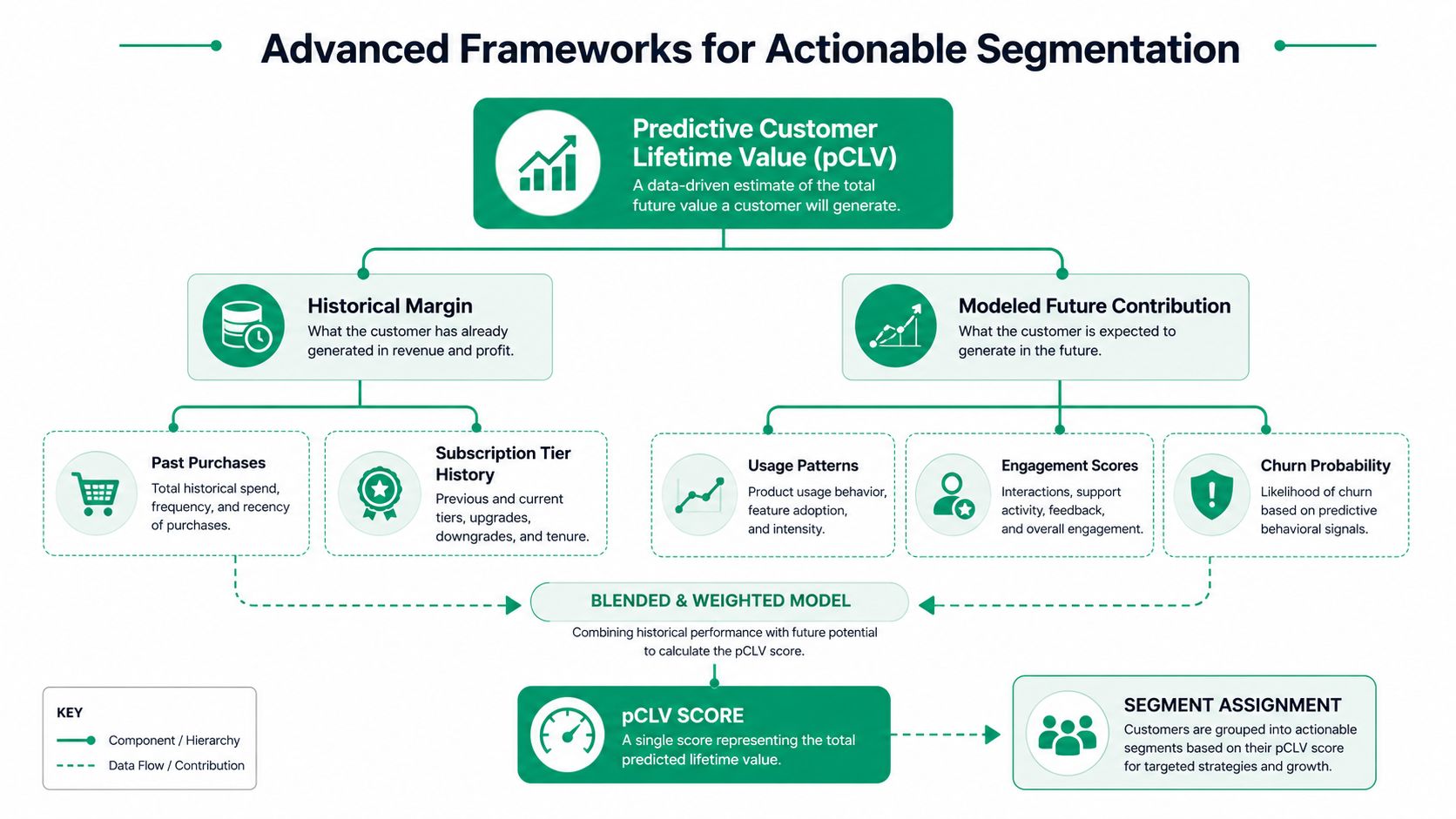
A useful model begins with predicted customer lifetime value, or pCLV. Historical account value shows what an account has contributed so far. pCLV adds a forward view of likely retention, expansion, and margin, which makes it more useful for retention decisions.
The framework described in this pCLV segmentation reference uses a blended score that combines past contribution with modeled future value. That approach fits SaaS well because account value shifts before revenue lines make the change obvious. Usage can soften. Seats can grow. Product fit can weaken. A model built only on ACV often misses those signals until the account is already halfway out the door.
A practical setup usually includes three controls:
- A limited number of tiers so customer success, lifecycle, and recovery teams can act without overcomplicating routing.
- Stability rules so one noisy signal does not move an account in and out of priority status during an active save attempt.
- Tenure adjustments so newer customers are not misclassified just because their history is thin.
Analysts using this kind of framework often find that pCLV improves attribution logic for saved revenue because it reflects likely future contribution, not only current contract size. For teams refining measurement, that connects directly to how a revenue attribution model for subscription growth teams should assign credit across segments, interventions, and recovered MRR.
A simple analogy helps here. ACV is a rearview mirror. pCLV is a route forecast. You need the mirror, but you would not drive a retention program by looking backward alone.
Add real time intent to the routing layer
Value tiers set priority. Real-time intent decides the response.
That second layer is where many segmentation models fall short. Traditional segmentation was built for analysis and planning. Cancellation flows require a system that reacts in the moment, using current signals that explain why the customer wants to leave right now.
That usually means combining inputs such as:
- Billing state, such as failed payment, delinquency, or involuntary churn risk
- Behavioral decline, such as lower usage, feature drop-off, or reduced seat activity
- Cancellation reasons captured inside the exit flow
- Plan and firmographic context, such as company size, pricing tier, or contract structure
Older segmentation methods grouped customers by broad patterns like recency, frequency, and monetary value. As customer data became richer, teams moved toward clustering and predictive scoring that could account for multiple variables at once. IBM's overview of customer segmentation methods outlines that progression from simple rule-based grouping to more advanced analytic models.
That evolution matters because churn intent is rarely one-dimensional. Two accounts can sit in the same value tier and need completely different treatment. A high-value customer who selects “too expensive” may need a downgrade path or a targeted offer. Another high-value customer who selects “missing integrations” may need a specialist follow-up or product education. The segment stays stable. The action changes with the reason.
Clustering can help when these patterns overlap. It can reveal groups like “high-usage but price-sensitive” or “healthy account with billing friction” that a single revenue field would hide. The goal is not to replace value-based segmentation. The goal is to make it operational by layering immediate cancellation context onto a stable economic tier.
Used this way, the framework works like triage in an emergency room. Value tells you who needs attention fastest. Churn reason tells you which treatment fits the case.
Mapping Segments to Retention and Recovery Actions
Segmentation only matters if it changes the next screen, the next message, or the next handoff. Once a customer shows churn intent, your system should decide which path fits that account instead of sending everyone through the same exit tunnel.
A useful benchmark comes from this value-based pricing framework. It reports that when cancellation routing is personalized by account value and stated reason, recovered MRR per intervention rises from $42 to $89 on average, with high-value segments showing 2.3x higher save-path conversion. That doesn't mean every customer should see a discount. It means the path should match the reason and the value at risk.
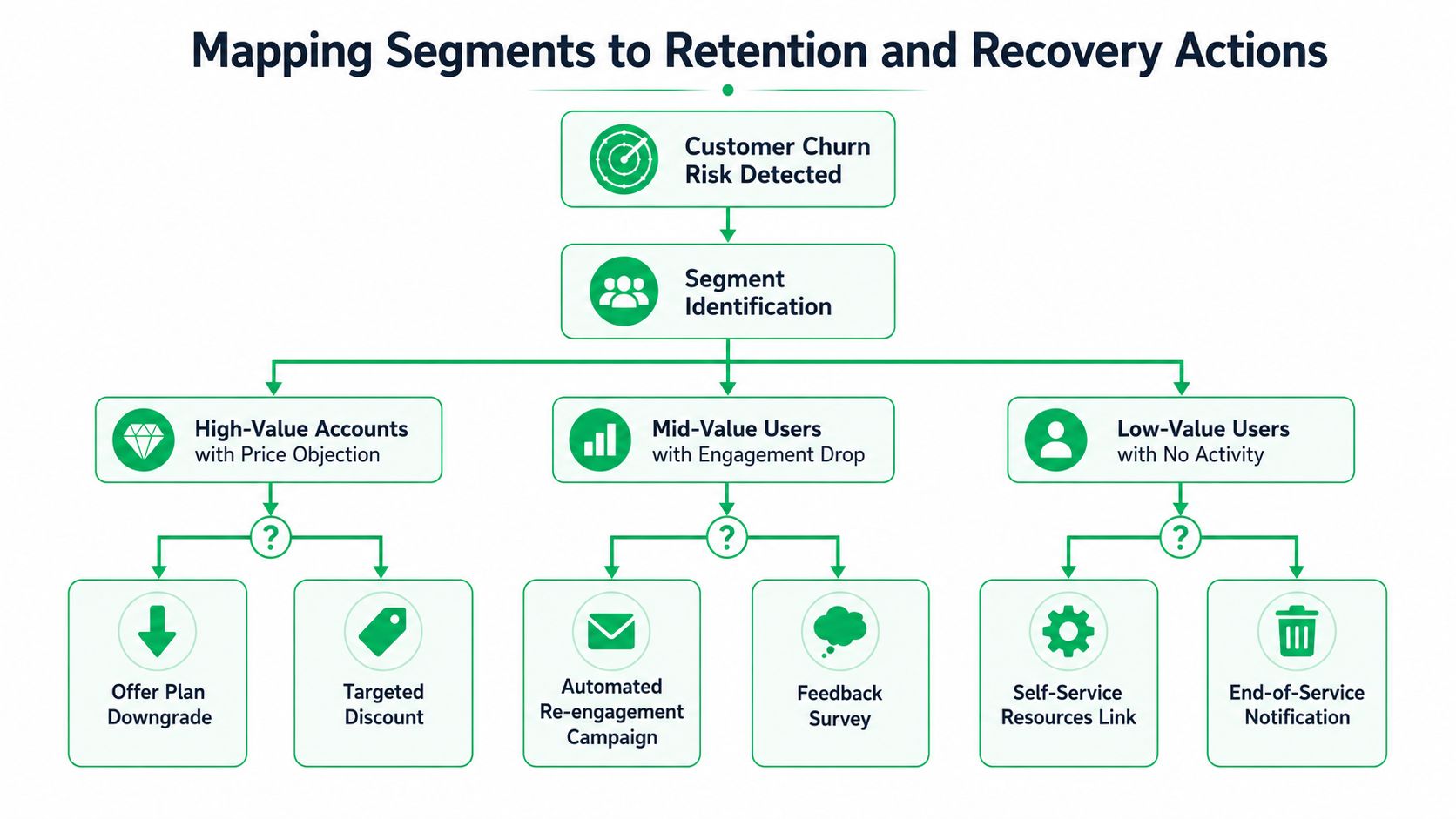
The flow below shows the idea at a glance.
Route by segment and reason
Consider three customers who all click cancel on the same day.
The first is a high-value account with steady usage. They choose “too expensive.” That account may respond well to a plan downgrade, a targeted discount, or a short pause that protects the relationship without forcing a full cancellation.
The second is a mid-value account with declining activity. They choose “not using it enough.” That usually calls for a lighter path. A pause option, onboarding refresh, or automated re-engagement sequence can work better than a price concession.
The third is a low-value user with weak engagement and no clear path to expansion. A clean self-serve cancellation is often the right choice. Forcing unnecessary friction wastes support effort and can create a poor brand impression.
This short demo gives a practical view of how a cancellation flow can adapt in real time.
A simple segment action playbook
Here's a practical table you can adapt for your own routing rules.
| Segment | Save Offer | Recovery Action | Routing Criteria |
|---|---|---|---|
| High-value account with price objection | Plan downgrade or targeted discount | Human review if the account shows strong usage | High value tier, active usage, cancellation reason tied to price |
| High-value account with product gap | No automatic discount | Sales or success handoff with context | High value tier, important feature objection, recent product engagement |
| Mid-value account with lower engagement | Pause option or onboarding refresh | Automated follow-up sequence | Mid value tier, usage drop, cancellation reason tied to low adoption |
| Mid-value account with billing issue | Limited-time grace flow | Card update prompt and reminder sequence | Mid tier, delinquent billing state, prior product activity |
| Low-value account with low activity | Clean cancellation or self-serve help | Minimal follow-up | Low value tier, weak usage, low expansion potential |
| Any segment with payment failure and continued product intent | No save offer during voluntary exit flow | Retry cadence and direct payment update path | Failed payment, open account, recent login or product use |
A well-designed payment path also needs specific handling for billing friction. Teams dealing with issuer declines often need a more targeted response than a generic dunning email. This guide on card declined by issuer scenarios is useful for thinking through those recovery triggers.
Handle failed payments differently from voluntary churn
Voluntary churn and involuntary churn look similar in revenue reports, but they require different actions.
For a customer who actively clicks cancel, you want to understand motive. For a customer whose card fails, you want to reduce friction and restore access cleanly. Mixing those workflows leads to awkward experiences, like asking a customer why they want to leave when they were trying to pay.
Use separate logic for:
- Explicit cancellation intent where the customer states a reason
- Billing failure where payment state is the primary issue
- Hybrid cases where a customer complains about price after repeated payment trouble
In practice, that means your system should consider plan, usage, churn reason, and billing state together. A high-value customer with a failed renewal and recent product activity deserves faster intervention than a dormant low-value user with the same billing error.
Key Metrics for Monitoring Impact
Once routing goes live, teams often make a second mistake. They track total cancels and total recoveries, but they don't measure whether the segmentation logic itself is working.
Measure segment performance by revenue weight
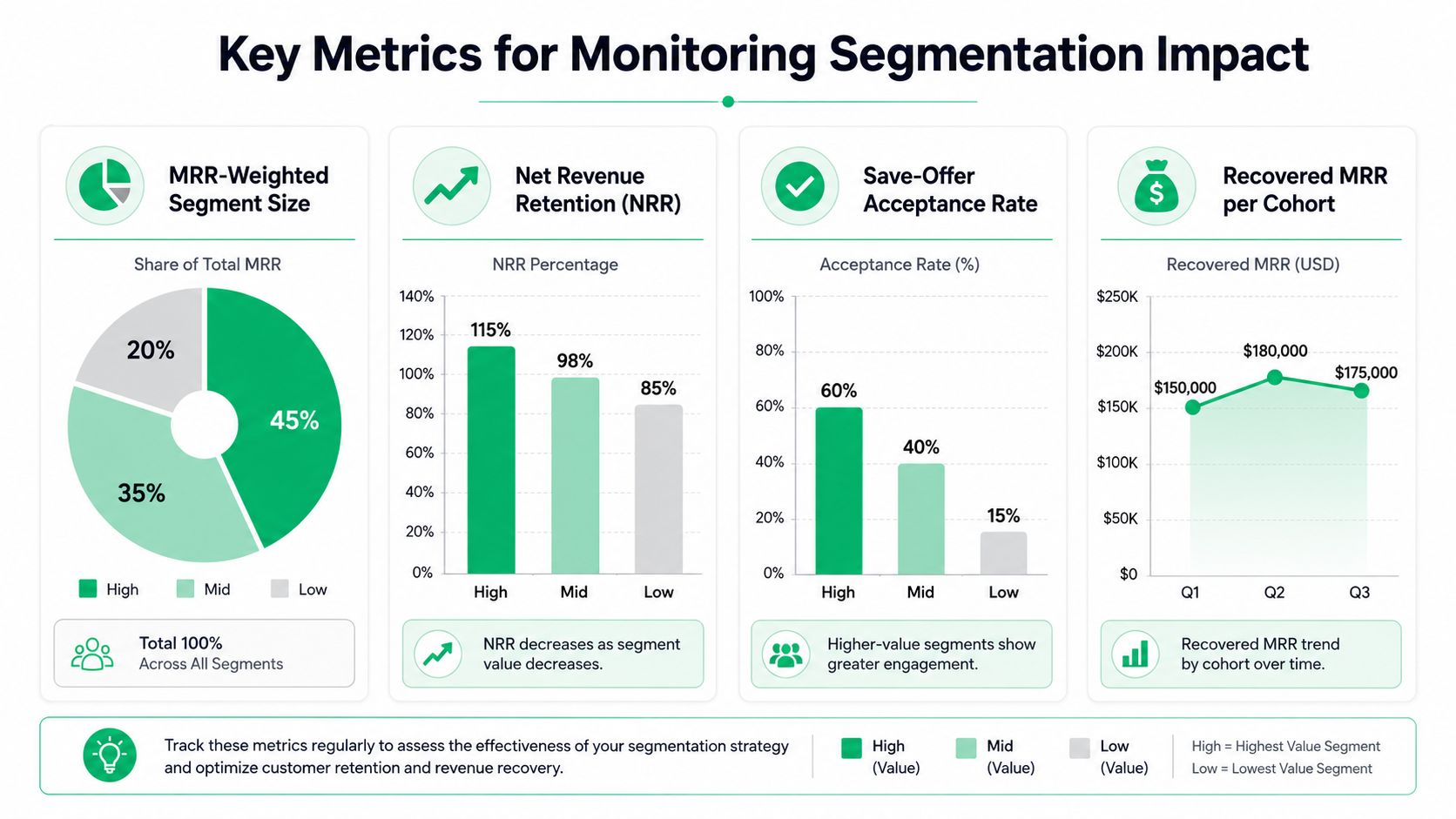
Start with MRR-weighted segment size. A segment that contains fewer accounts may still deserve more attention if it represents more recurring revenue. Counting logos without weighting revenue can push teams toward noisy tests on the wrong population.
Then track net revenue retention by segment. If your highest-value segment is shrinking despite strong save rates, you may be offering the wrong intervention or reacting too late.
A practical dashboard usually includes:
- MRR-weighted segment size so teams know where the revenue concentration sits
- Save-offer acceptance rate by route and reason
- Recovered MRR per cohort to show which interventions preserve revenue over time
- NRR or GRR context to connect saves to broader retention health
If your team needs a cleaner way to distinguish revenue preservation metrics, this overview of GRR vs NRR can help frame the reporting model.
Build attribution into the dashboard
Attribution matters more than many expect. If a customer accepts a downgrade, updates a card, and later expands, which action gets credit? Without clear rules, every team claims success and no one learns what was effective.
Your dashboard should tie each outcome to:
| Metric | What it should answer |
|---|---|
| Segment membership | Which value tier was this customer in at the moment of intervention? |
| Trigger event | Was the action caused by cancellation intent, billing failure, or usage decline? |
| Presented offer | What exact path did the customer see? |
| Outcome | Did the customer save, recover payment, downgrade, pause, or leave? |
Good segmentation reporting doesn't just show saved accounts. It shows which rule, offer, and trigger produced the save.
That level of attribution helps growth, product, finance, and success teams work from the same evidence instead of interpreting the same churn event in different ways.
Common Pitfalls and Testing Guidance
Many articles describe value as if it were a permanent label. That's one reason teams struggle to make segmentation useful at the moment of churn. Merkle's discussion of value-based customer segmentation points to the same gap. Most existing content treats value as a static metric and doesn't explain how to weight real-time cancellation intent and churn reasons for immediate retention actions.
Three mistakes that weaken segmentation
The first mistake is using only historical revenue. Past spend tells you who was valuable. It doesn't tell you what intervention fits now.
The second is over-segmenting. Teams create too many micro-groups, then can't gather enough signal to make routing decisions confidently. If the playbook becomes hard to explain, it usually becomes hard to operate too.
The third is ignoring cost-to-serve. Not every high-revenue account is high-value in margin terms. Some customers require so much support, onboarding, or custom handling that a “save at all costs” approach doesn't make business sense.
A healthier pattern is to ask three questions before you add a rule:
- Can a team act on it immediately? If not, it belongs in analysis, not routing.
- Does it change the offer or path? If not, it may not need to be a segment.
- Can you measure the result clearly? If not, the rule will create noise.
How to test without breaking your billing flow
Testing should be disciplined but simple. Start with one variable that can plausibly change behavior, such as a downgrade offer for price objections or a revised retry schedule for failed payments.
Use a few guardrails:
- Keep the control path intact so you always know what “business as usual” would have produced.
- Test one intervention inside one segment first instead of changing every route at once.
- Define the revenue window up front so teams agree on when a recovery counts.
- Prepare a rollback rule for any path that creates support load or billing confusion.
Don't chase complexity too early. A smaller set of clear experiments usually teaches more than a tangled matrix of overlapping offers.
Integration Notes for Stripe and Revcover
A common failure looks like this. A customer clicks cancel in Stripe, chooses "too expensive," and disappears into the same offboarding flow as someone who left because their card failed. The billing system recorded an event, but the retention system missed the intent behind it. Value based segmentation breaks down at that point because the team can still see customer value, but cannot act on the reason for leaving while the window to intervene is open.
Stripe should supply the live account and billing signals. Revcover or a similar retention layer should decide what to do with them in the moment. The important integration detail is timing. You want the cancellation reason and billing state captured before the subscription reaches its final end state, so the system can route a high-value customer with a price objection very differently from a low-usage customer who wants to leave cleanly.
Connect billing events to segmentation logic
The setup works like an airport control tower. Stripe reports what just happened. Your retention layer decides which runway the customer should move to next. If the signal arrives too late or without context, every customer gets treated like the same plane.
In practice, that means listening for cancellation and payment events, pulling in plan and account details, and attaching churn feedback while the customer is still in session. Stripe documents the subscription lifecycle and webhook events that teams use to trigger those decisions in real time: Stripe subscription webhooks and event handling.
At a minimum, the integration should pass through:
- Plan data so the flow knows what the customer is paying for now
- Usage context so low-adoption and high-adoption accounts can follow different paths
- Billing state so involuntary churn and voluntary cancellation do not get mixed together
- Reason capture so structured or freeform feedback can change the next step immediately
That last input is the piece teams often miss. Traditional segmentation sorts customers into stable value tiers, which is useful for reporting and planning. Cancellation intent adds a live layer on top. A high-value account is still high-value, but "missing features," "budget cut," and "no longer using the product" should not trigger the same save offer.
Roll out in stages
Start with two routes that are easy to validate. One route can cover voluntary cancellations for a clearly defined high-value segment. The other can cover failed payments, where dunning and card update prompts matter more than save offers. This keeps the first version small enough to audit without creating billing confusion.
Then expand based on what your team can support. Add reason-based branches inside each value tier. For example, a high-value account citing price might see a downgrade path, while a similar account citing low usage might see a pause plus reactivation guidance. The segment is the starting point. The churn reason is the switch that changes the action.
Operational visibility matters too. Send urgent cancellation alerts to Slack, update the CRM when an account is saved or downgraded, and log the intervention tied to the final outcome. That gives growth, support, and finance the same view of what happened.
Use sandbox testing before widening traffic. Confirm that discounts, pauses, plan changes, retries, and clean cancellations all resolve correctly in Stripe, and confirm that Revcover receives the same account context your team expects to use for routing.
Conclusion and Next Steps
Value based segmentation works when it changes decisions in the moment a customer is about to leave. The core shift is simple. Stop treating segmentation as a static reporting exercise, and start using it to route live cancellation and billing events.
A strong first rollout doesn't need to be massive. Audit your current cancel flow. Define a small set of value tiers. Capture clear churn reasons. Map each major reason to a matching action. Then track which routes protect recurring revenue.
A practical checklist looks like this:
- Collect the right inputs from billing, plan, usage, and churn feedback
- Define stable tiers based on business value
- Add routing logic that reacts to stated reason and billing state
- Set up attribution so each saved dollar ties back to a specific intervention
- Run controlled tests and keep only the paths that perform
If you want to operationalize this without rebuilding your billing stack, Revcover helps SaaS teams connect Stripe cancellation intent, payment recovery, and revenue attribution into one retention workflow. It's built for teams that want personalized save paths, cleaner churn feedback, and measurable recovered MRR tied to the exact interventions that worked.