
Real Time Notification: Real-Time Notifications

Ayush Soni
Founder, Revcover
On this page
- Why Batch Processing Fails at Revenue Recovery
- The actionability gap is the real problem
- Not every event deserves an alert
- The Five Real Time Notification Patterns
- How each pattern behaves in practice
- Real-Time Notification Patterns Compared
- How to choose without overbuilding
- Designing for Reliability and Delivery Guarantees
- Delivery guarantees matter most on billing events
- The reliability components that actually matter
- Real Time Notifications for Subscription Revenue Recovery
- Cancellation intent is a live event
- Failed payments need immediate orchestration
- Scaling and Securing Your Notification System
- Build for burst traffic, not average traffic
- Security mistakes usually start in payload design
- Best Practices for Team Routing and Alerting
- Route by business consequence
- Write alerts that people can act on
- Your Path to Real Time Recovery
A customer clicks cancel subscription. Another customer's card fails on renewal. Your system records both events, but nobody can act on them until tomorrow's report lands in a dashboard.
That's the operational gap most subscription teams live with. The data exists, but it arrives too late to change the outcome. By the time product, support, or RevOps sees the signal, the customer has already left, the payment reminder has gone cold, and the recovery window is narrower than it needed to be.
A good real time notification system closes that gap. It doesn't just move messages faster. It turns account events into actions while the customer still has context, while your team still has a chance to intervene, and while the business still has a realistic path to recover revenue.
Why Batch Processing Fails at Revenue Recovery
Batch processing works fine for reporting. It fails when timing changes the result.
If a finance lead reviews a failed-payment list every morning, they can measure revenue leakage. They can't prevent much of it. If a product team reviews cancellation reasons at the end of the week, they can identify patterns. They can't save the customer who clicked away on Tuesday.
The actionability gap is the real problem
The problem isn't only latency in a technical sense. It's the actionability gap between a meaningful event and the first useful response.
A high-value account starts a cancellation flow. A user hits a billing settings page after a failed charge. Someone retries a card update and gets blocked again. These are moments when context is fresh and the customer is still engaged. A real time notification system gives your team or automation a chance to respond while that context still exists.
Batch systems erase that timing advantage. They flatten urgent events into historical records.
That's why teams that depend on spreadsheet reviews, daily sync jobs, or end-of-day summaries often feel like they're always reacting one step late. The operational artifact looks tidy, but the customer journey is already over. If your retention workflow still starts with a report, it's worth revisiting how those signals differ from lagging indicators like an aging report for overdue accounts.
Batch data explains what happened. Real time notification systems help teams change what happens next.
Not every event deserves an alert
There's another failure mode. Some teams try to fix slow visibility by alerting on everything.
That approach usually creates noise faster than value. Research highlighted in a real-time notifications review in PMC notes that the dominant gap is guidance on distinguishing intent signals from noise to prevent churn fatigue, even though 95%+ of systems achieve high delivery success. In practice, that means the technical pipeline may work while the business workflow still fails.
A cancellation button click is a strong intent signal. So is a payment failure webhook. A random tab switch, hover event, or shallow settings-page visit usually isn't.
A workable filter looks more like this:
- High-intent events should trigger immediate routing. Think cancellation starts, failed renewals, or repeated billing update attempts.
- Context events should enrich the alert, not trigger one alone. Plan tier, account value, recent support activity, and product usage fit here.
- Low-value events should stay in logs or analytics. They help analysis later, but they shouldn't interrupt a human or launch a save flow.
Teams get the most value when they treat real time notification design as a business decision first and a transport problem second.
The Five Real Time Notification Patterns
Instead of "the best" notification architecture, teams require the right one for the event, the audience, and the action that should follow.
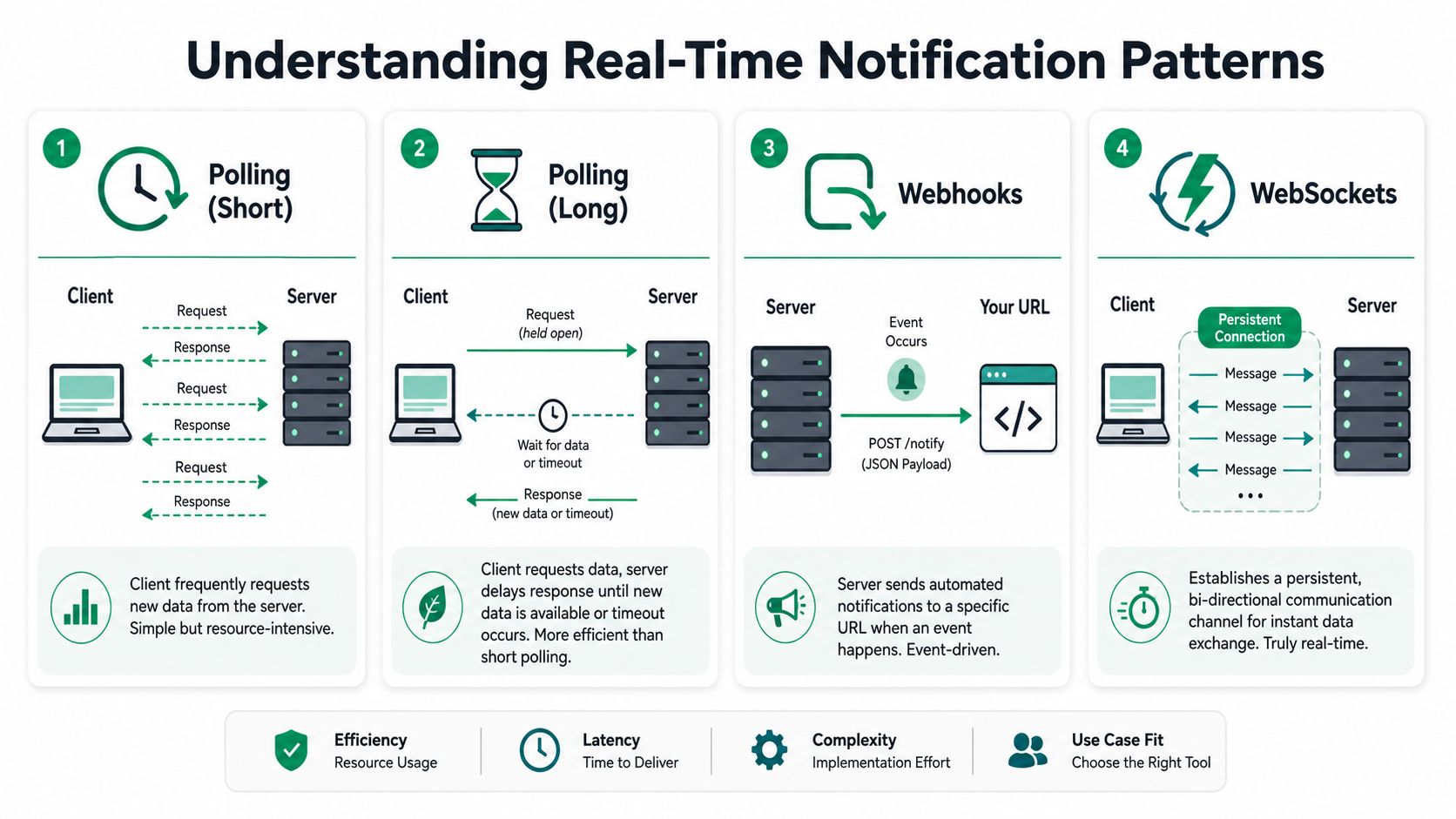
The five common patterns are polling, long polling, webhooks, WebSockets, server-sent events, and push notifications. Each solves a different part of the problem.
How each pattern behaves in practice
Short polling is the simplest model. The client keeps asking, “Anything new?” every few seconds. It's easy to ship and easy to reason about. It also wastes work when nothing changed, which is exactly what happens most of the time in SaaS billing flows.
Long polling improves that by keeping the request open until the server has something new or the request times out. It reduces needless traffic, but it still behaves like repeated check-ins rather than a true live connection.
Webhooks are server-to-server callbacks. Stripe sends your system an event when a payment fails, a subscription changes, or an invoice updates. This is the backbone for most revenue-recovery workflows because the event originates in the billing system and needs to reach your application immediately.
WebSockets keep an open, two-way channel between client and server. That's useful when the product UI itself should update in real time, such as showing a live cancellation handoff, an in-app billing reminder, or an instant agent response.
Server-sent events, or SSE, sit between simpler HTTP patterns and full WebSockets. They stream updates from server to browser in one direction. If the UI only needs live updates and the browser doesn't need to send frequent messages back on the same channel, SSE can be a cleaner fit.
Push notifications are best for reaching users outside your app. They don't replace your internal event pipeline. They sit at the edge of it.
Real-Time Notification Patterns Compared
| Pattern | Directionality | Latency | Complexity | Best Use Case |
|---|---|---|---|---|
| Polling | Client to server | Moderate to high | Low | Admin dashboards that can tolerate delay |
| Long polling | Client to server with delayed response | Lower than short polling | Low to moderate | Basic live status updates without persistent sockets |
| Webhooks | Server to server | Low | Moderate | Stripe events, payment failures, subscription changes |
| WebSockets | Bi-directional | Low | High | In-app live notifications and interactive workflows |
| SSE | Server to client | Low | Moderate | Browser feeds, activity streams, live status banners |
| Push notifications | Server to device | Variable | Moderate | Re-engagement outside the product |
How to choose without overbuilding
The mistake I see most often is using one pattern everywhere because the team already understands it.
If the event begins in Stripe, start with a webhook. If the message must appear inside an open app session, consider WebSockets or SSE. If the user isn't active in the app, push may be appropriate. Polling is still acceptable for low-stakes internal tooling, but it's a poor fit for recovery moments where delay undermines the outcome.
Practical rule: Use the cheapest pattern that still preserves the business moment you're trying to save.
For subscription businesses, a common stack is straightforward:
- Webhooks ingest billing events from Stripe.
- Queues buffer and route them internally.
- WebSockets or SSE update the product UI for live sessions.
- Push or email handles off-session follow-up when needed.
That mix keeps the architecture aligned with the customer journey instead of forcing every notification through the same channel.
Designing for Reliability and Delivery Guarantees
A notification system that drops billing events is worse than a slower system that handles them predictably. At least with visible delay, teams know they have a problem. Silent loss creates false confidence.
Delivery guarantees matter most on billing events
For customer messaging, “best effort” might be acceptable in some cases. For failed renewals, cancellation workflows, and account state changes, it usually isn't.
A strong baseline is at-least-once delivery. That means the system is allowed to deliver the same event more than once, but it should never lose a critical message. The duplicate risk is handled elsewhere.
A system design guide focused on real-time notifications makes this explicit for involuntary churn recovery: reliable delivery requires an at-least-once model combined with idempotent de-duplication using unique UUIDs and idempotency keys. That design prevents double-sending during transient network failures or replayed events.
That trade-off matters for Stripe-connected workflows. If your payment-failure event is retried upstream or replayed from a queue, you want the downstream handler to recognize, “I've already processed this reminder,” rather than sending duplicates or mutating billing state twice. The same principle shows up in payment operations more broadly, especially when teams expand into accepting ACH payments alongside cards.
The reliability components that actually matter
Reliable systems tend to share the same core parts.
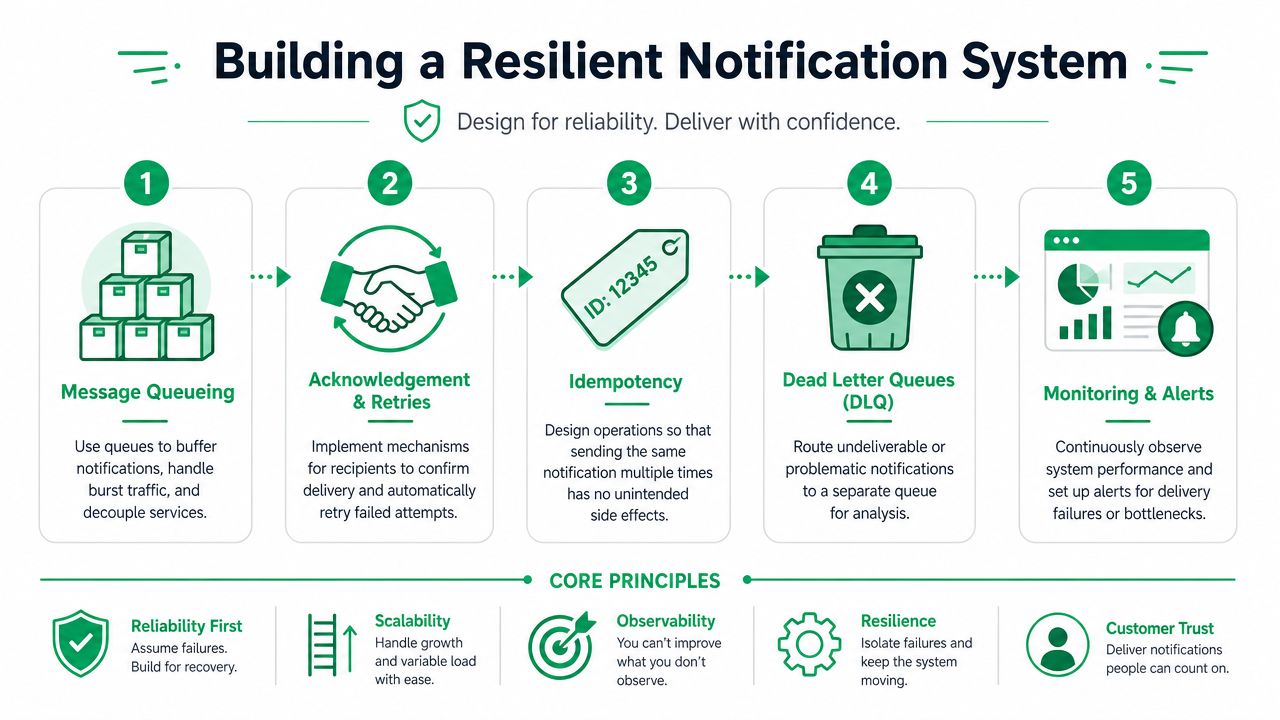
- A durable queue or log
Producers should publish events and move on. Don't make upstream systems wait on every notification side effect. - Idempotency keys at the handler layer At this layer, duplicate events stop becoming duplicate user experiences.
- Retries with exponential backoff
Some failures are temporary. Your worker should assume that and retry intelligently rather than hammering a provider. - A dead-letter queue
Permanent failures shouldn't vanish. Route them somewhere inspectable so operators can replay or investigate them. - Acknowledgement and monitoring
You need to know whether the event was accepted, processed, and delivered to the target channel.
A simple mental model is package delivery. “At least once” means the courier may ring twice, but the package won't be lost. Idempotency means the recipient only signs for it once. The dead-letter queue is the holding area for packages with unreadable addresses.
Missing a failed-payment alert is usually more expensive than deduplicating an extra one.
Another detail that matters in live session delivery is connection ownership. When a user has an active browser session, the notification should go to the gateway that currently holds that connection rather than broadcasting blindly across all nodes. That keeps throughput sane and reduces accidental duplication.
The reliable architecture is rarely flashy. It's just disciplined. For revenue recovery, that discipline is essential.
Real Time Notifications for Subscription Revenue Recovery
Here, architecture stops being abstract.
In subscription software, two events usually matter more than the rest: a customer trying to cancel and a renewal payment failing. Both are recoverable, but only if the system responds while the moment is still live.
Cancellation intent is a live event
When a user clicks “cancel,” teams commonly still treat that like form submission. They log the reason, maybe show a short survey, and let the subscription end cleanly.
That's operationally simple, but strategically weak. The click itself is a high-intent event with enough context to make a better decision. You know the plan, account history, support status, product usage, and likely reason cluster. You can route based on that information in real time.
A low-usage self-serve account might get a pause option. A customer blocked on budget may see a downgrade path. A strategic account with recent support friction might trigger a human handoff. The important point is that the routing decision happens immediately, not after a CS manager reads a report.
This is also where “real time notification” should be interpreted broadly. It isn't only a bell icon or Slack ping. It includes the internal event that tells your system to switch from default cancellation to an intervention path.
The best save flows don't feel like alerts. They feel like the product understood what happened and responded appropriately.
Failed payments need immediate orchestration
Payment failure recovery is even more sensitive to timing because the customer didn't necessarily choose to churn. The card may be expired, the bank may decline the charge, or the payment method may need re-authentication. If you react while the failure is still fresh, users are more likely to understand what happened and fix it.
A MagicBell article on real-time notifications identifies a key gap for Stripe-connected businesses: delayed payment failure alerts beyond 2–4 hours can reduce recovery rates by up to 30%. That's the clearest business argument for real time notification design in billing systems. Delay doesn't just slow response. It lowers the odds that the customer takes action at all.
If you've ever seen users write in saying they were “randomly canceled,” the delay problem is usually part of the story. The system knew the payment failed. The customer just didn't hear about it in a way that preserved trust. Teams dealing with card failures should also understand the issuer side of the problem, especially common patterns behind a card declined by issuer response.
Here's the operational sequence that tends to work best:
- Stripe emits the billing event and your webhook ingests it immediately.
- Internal routing classifies the account by value, plan, lifecycle stage, and recent activity.
- Customer-facing channels fire quickly through in-app messaging, email, or push, depending on session state.
- The resolution path is direct. No generic “contact support” dead end. Send the user straight to update payment details.
- Team alerts stay selective. Humans should only get involved when the account value or context justifies it.
A short walkthrough helps make the pattern concrete:
The business takeaway is simple. Recovery systems work best when event transport, decision logic, and customer messaging are tightly connected. If any layer waits for the next batch cycle, the whole loop weakens.
Scaling and Securing Your Notification System
A notification pipeline that works at normal traffic can still fail during the only moments that matter. Failed renewals often cluster. Cancellation intent spikes during pricing changes, outages, or product mistakes. Systems need to survive the ugly days, not just the average days.
Build for burst traffic, not average traffic
High-scale notification systems should be built with room for sharp surges. A Conf42 engineering presentation on scalable real-time systems recommends capacity for 5–10x anticipated peak loads, along with distributed architectures and autonomous scaling.
That guidance maps directly to subscription recovery. If a billing issue triggers a wave of failed payments, you don't want the notification layer to back up right when customers need a path to fix their account.
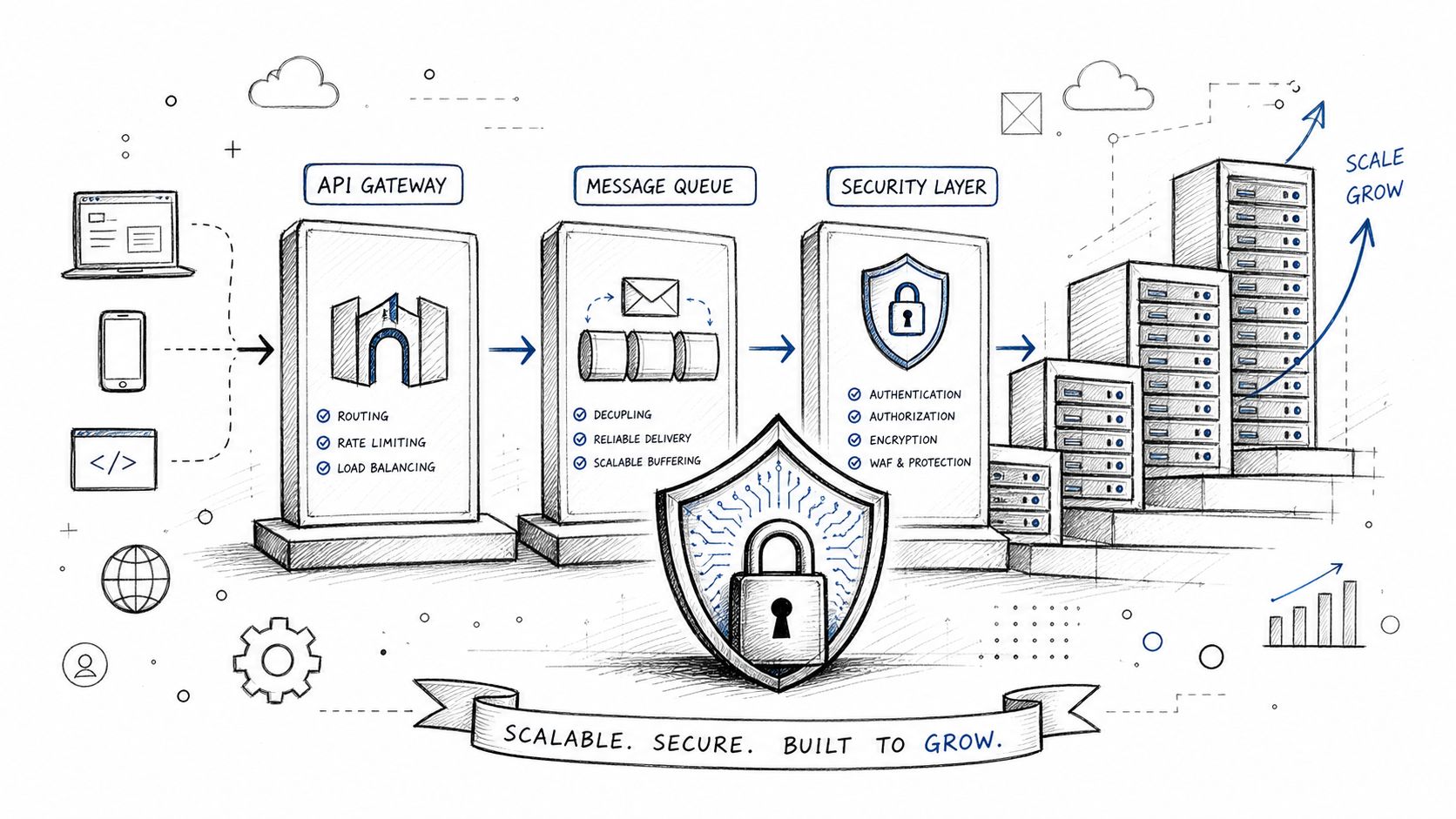
The practical architecture usually includes:
- A buffer between producers and consumers so Stripe webhooks, app events, and internal services don't depend on immediate downstream success.
- Sharded processing paths when one stream gets hot.
- Caching for routing decisions so common lookups don't hit the primary database every time.
- Circuit breakers and bulkheads so one failing dependency doesn't drag down the whole system.
The same Conf42 material also emphasizes sub-15ms notification delivery times for high-scale real-time systems. That's an engineering target, not a universal product requirement, but the principle is sound: keep the internal path fast enough that business rules can execute while the user is still in the moment.
Security mistakes usually start in payload design
Security problems in notification systems rarely begin with the channel itself. They start with over-sharing.
A billing alert payload doesn't need every account field. A Slack notification about a cancellation attempt doesn't need raw payment details. Webhook receivers should verify signatures, reject malformed requests, and limit which systems are allowed to publish events into the pipeline.
A compact checklist helps:
- Verify origin for every inbound webhook before processing.
- Minimize payloads so downstream consumers only see the fields they need.
- Apply rate limits to public-facing endpoints and admin actions.
- Respect user preferences such as quiet hours and channel opt-outs.
- Separate operational alerts from customer data where possible.
Secure systems are easier to scale because they carry less unnecessary state and expose fewer dangerous surfaces. That matters when multiple teams, tools, and channels sit on the same event spine.
Best Practices for Team Routing and Alerting
A notification is only useful if it reaches the person or system that can do something with it.
That sounds obvious, but many teams still route by source application instead of business consequence. The result is familiar: support gets technical alerts they can't resolve, engineers get billing notifications they shouldn't own, and customer success misses the handful of churn events that required a call.
Route by business consequence
The cleanest routing model starts with the question, “Who can act on this event fastest and best?”
A failed payment for a low-touch account may need no human at all. An automated billing recovery path is enough. A cancellation attempt from a strategic customer may belong in a Slack channel watched by customer success and sales leadership. A queue processing failure belongs with the on-call engineer, not the account team.
A good routing matrix usually considers:
- Account value to distinguish automation from white-glove follow-up
- Event type such as cancellation intent, payment failure, or infrastructure failure
- Customer state including trial, active subscription, past-due, or recently reactivated
- Ownership so the same account doesn't bounce between teams
Routing should follow accountability, not org chart convenience.
Write alerts that people can act on
Even perfect routing fails if the message itself is bloated. For user-facing push, brevity matters a lot. A OneSignal analysis cited by Amra & Elma found that in 2026, across 4.7 billion push notifications and 50,000 apps, messages with 7 words or fewer produced a 94% engagement lift over messages longer than 15 words, and 5 words was the highest-performing length across Android and iOS.
That doesn't mean every internal alert should be five words. It does mean the actionable core should be immediately visible.
Compare these two approaches:
| Weak alert | Strong alert |
|---|---|
| “There has been an issue with a customer billing event that may require attention.” | “Enterprise renewal failed. Update card now.” |
| “A user may be considering cancellation based on recent activity.” | “Annual account clicked cancel. CS follow-up needed.” |
For team alerts, include just enough context to decide the next move:
- What happened
- Which account it affects
- Why it matters
- What action should happen next
If teams need to read a paragraph before they know whether to respond, the alert is too long.
Your Path to Real Time Recovery
Real time notification systems aren't a side feature for subscription software. They're the operational layer that connects account events to revenue outcomes.
Batch processing still has a place in analytics, finance review, and trend reporting. It doesn't belong at the front of a recovery workflow. The important work starts earlier, when a cancellation click, payment failure, or account-state change can still trigger the right response.
The pattern is consistent across the stack. Pick the right transport for the event. Make delivery reliable. Filter intent from noise. Route by consequence. Keep customer-facing messages short and direct. Build enough scale and safety that the system holds up when your team needs it most.
The fastest improvement usually doesn't come from adding more alerts. It comes from auditing where important events lose time, context, or ownership.
Start there. Trace the path from Stripe or product event to customer action. Look for delays, duplicate handlers, dead ends, and alerts nobody owns. Every one of those gaps is a place where recoverable revenue slips away.
If you want a simpler way to turn cancellation intent and failed payments into recoverable MRR, Revcover helps subscription teams connect Stripe events to save offers, payment recovery flows, and team alerts without rebuilding the full orchestration layer from scratch.