
NMI Payment Gateway Guide for Subscription SaaS in 2026

Ayush Soni
Founder, Revcover
On this page
- Why Subscription SaaS Teams Start Looking at NMI
- How a Gateway Differs from a Processor
- NMI sits in the routing layer, and that is the part SaaS teams care about
- The merchant-account split changes how you build recurring billing
- Core Features That Matter for Recurring Billing
- Smart routing is the feature subscription teams care about most
- Omnichannel support matters if your SaaS spans more than one checkout surface
- Tokenization keeps raw card data out of your app
- Security, PCI Scope, and Tokenization
- The browser collects, the server forwards
- Wallet support is useful, sandbox behavior is exactly what you want
- How NMI Compares to Stripe for SaaS Billing
- Convenience versus control
- NMI vs Stripe for Subscription SaaS
- Pricing, Fit, and When NMI Is the Wrong Choice
- Who gets value from NMI
- Who should pass
- Integrating NMI Into an Existing Subscription Stack
- A sane migration path starts in sandbox
- Common integration mistakes are predictable
- Frequently Asked Questions About the NMI Payment Gateway
- Does NMI handle recurring billing natively?
- How does NMI handle card-on-file updates and dunning?
- Can a Stripe-first team move to NMI without rebuilding everything?
- Do you need an ISO or partner-led onboarding model?
You know the moment. The subscription team says checkout is “fine” until finance starts asking why certain regions keep underperforming, why one processor change would mean rewriting the billing stack, and why you're still trapped in a gateway you can't route around. That's usually when NMI payment gateway enters the conversation, not because it's trendy, but because it solves a very specific problem: it gives SaaS teams a flexible gateway layer without forcing them to rebuild their merchant account strategy from scratch.
For recurring billing, that distinction matters. NMI is not the thing that moves money directly. It's the transaction layer that routes payment data between your business and your merchant bank or processor, and one independent guide says it connects to more than 200 global processors (NMI payment gateway operating model guide). For a subscription company, that means the gateway can become a control point for routing, processor flexibility, and checkout consistency, while the actual settlement relationship stays separate.
Why Subscription SaaS Teams Start Looking at NMI
The trigger is usually operational, not theoretical. Finance gets boxed in by a processor that limits approval tuning, product wants one billing layer across web and mobile, or leadership needs to keep a specific merchant account in place without rebuilding checkout. For subscription SaaS, that is the point where payments stops being a generic checkout problem and becomes a routing control problem.
A second trigger is inherited complexity. A SaaS business acquires another company, expands into a new region, or inherits a merchant setup that does not fit the current billing stack. NMI gets attention because it sits in the gateway layer, so it can route transaction data while settlement still runs through a separate merchant account.
That split matters in real subscription operations. If your billing team wants to change processor relationships, test a different acquirer for a market, or separate traffic by risk profile, a gateway gives you that control without forcing a full rebuild of the customer-facing flow. NMI is built for that kind of flexibility, and its processor coverage is one reason it shows up in shortlists for SaaS teams with mixed markets and multiple acquiring relationships (NMI guide).
If you want a broader view of how B2B payments platforms are framed in SaaS, this Revcover overview of B2B payments platforms gives useful context.
Practical rule: If your main pain is processor rigidity or inherited acquiring complexity, NMI belongs on the list. If you only need recurring billing fast, it is more infrastructure than you need.
Subscription teams also start looking at NMI when they need to preserve payment logic while changing the rails underneath it. That happens when a company wants to keep the same checkout, the same customer workflow, and the same tokenized billing profile, while moving settlement or routing to a different processor setup. NMI is useful because it separates the front-end payment layer from the back-end financial relationship instead of forcing those pieces into one vendor.
That is why the platform keeps coming up in SaaS billing conversations. It is not just about accepting cards. It is about keeping control of merchant-account relationships, choosing where transactions go, and avoiding a hard dependency on a single processor path. NMI's omnichannel positioning, online, in-store, and mobile, reinforces that it is built as a routing and integration layer, not just a checkout form (NMI product strategy guide).
For subscription leaders, the takeaway is simple. NMI fits teams that need gateway flexibility and merchant-account control, not teams looking for a lightweight card acceptance tool.
How a Gateway Differs from a Processor
A subscription billing stack breaks in very predictable ways when teams blur gateway and processor. The gateway is the control layer. It accepts the payment request, secures the data, and decides where that transaction goes. The processor is the money-moving layer behind it.
NMI sits in the routing layer, and that is the part SaaS teams care about
Your billing app sends the transaction to the gateway first. NMI then packages the request, applies routing rules, and passes it to the processor or merchant bank you have connected. That separation matters because it lets you keep checkout logic stable while changing the back-end payment relationship when your processing strategy changes.
For subscription teams, the practical value is control. A gateway that can work across multiple processors gives you room to route by brand, geography, risk profile, or customer segment without rebuilding the payment flow every time you change acquirers. That is the primary reason NMI shows up in SaaS billing discussions. It gives you an orchestration layer, not just a place to accept card data.
The merchant-account split changes how you build recurring billing
NMI does not remove the merchant account. It makes the merchant-account relationship part of the architecture instead of hiding it inside one closed payment stack. That is useful if you want cleaner separation between the customer experience and the financial rails underneath it.
The trade-off is straightforward. If you want a single vendor to own the whole stack end to end, NMI is the wrong model. If you need to preserve payment logic while changing processors, or if you want the option to direct different traffic to different paths, NMI fits that job much better.
This is also where teams running mixed payment types should pay attention. A SaaS business that accepts card payments and ACH payments usually needs more than a basic checkout tool. It needs routing, token handling, and merchant-account coordination that can support recurring operations without forcing a rebuild later.
A gateway choice is a routing choice. If your team wants control over how transactions flow, NMI belongs in the conversation. If you only want a simple card acceptance tool, this is more infrastructure than you need.
Core Features That Matter for Recurring Billing
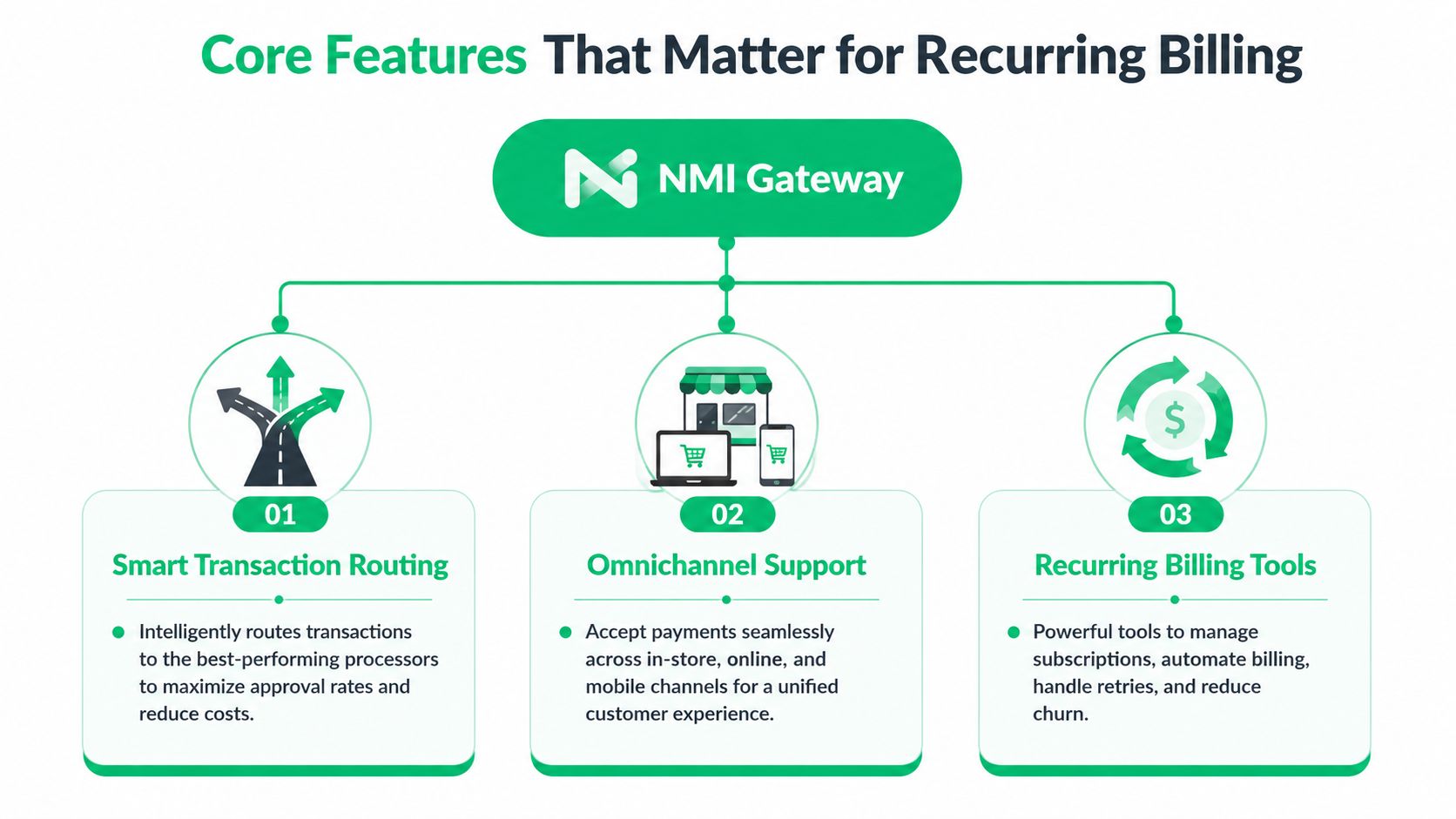
NMI matters most when you stop judging it like a generic gateway and start judging it like recurring-billing infrastructure. For a subscription SaaS team, the question is narrower. Can you route transactions the way your billing model needs, support more than one payment surface, and keep payment data moving cleanly between browser and backend? If it cannot do those things, the rest is noise.
Smart routing is the feature subscription teams care about most
NMI's gateway is built for ISOs and SaaS platforms that need smart transaction routing. It can choose which merchant identification numbers, or MIDs, to use based on active routing directives, which helps when you want to steer traffic by geography, risk, processor load, or renewal type (NMI product page).
For recurring billing, that is the feature that matters. You can send renewals down one path and first-time checkouts down another, or keep higher-risk segments separate from standard subscriptions without forcing every charge through a single rigid flow. If your platform serves multiple brands, regions, or customer classes, that routing control is the part worth paying for.
Omnichannel support matters if your SaaS spans more than one checkout surface
NMI is described as omnichannel, which means it supports in-store, online, and mobile payments in one platform. For pure SaaS, that can sound irrelevant until your product starts selling through a mix of web checkout, embedded payment flows, field apps, or mobile experiences (NMI product strategy guide).
The point is consistency. If your billing team wants one gateway layer across those surfaces, NMI gives you that setup. That matters when you are dealing with plan changes, retry logic, and customer payment methods that originate from different environments. NMI is not the subscription engine. It sits underneath the subscription engine and handles the payment rails.
For teams that need to support more than cards, this guide to accepting ACH payments is worth a look.
Tokenization keeps raw card data out of your app
NMI's payment component splits frontend tokenization from backend payment processing. The browser-facing component uses a public tokenization key to collect card data and return a payment token, while the server forwards that token to NMI's Payments API using a private API security key that must never be exposed client-side (NMI docs). That separation is the reason subscription teams evaluate it in the first place.
The practical takeaway is straightforward. You get a cleaner boundary between customer-facing checkout and server-side payment execution, which is what a recurring billing stack should have. Apple Pay and Google Pay are supported in the same component, and sandbox testing does not move real money.
Security, PCI Scope, and Tokenization
Security questions around gateways usually get buried under jargon. For a subscription company, the core issue is simple. Where does raw card data live, who touches it, and how much of that responsibility sits inside your own app? NMI is useful because it narrows that surface area.
The browser collects, the server forwards
NMI's payment component uses a clean split. The browser collects card details with a public tokenization key, then returns a payment token. Your server uses a private API security key to send that token to NMI's Payments API, and that key must stay off the client side. The result is a billing flow that keeps raw PANs out of the browser-to-backend path, which is the part SaaS teams should be trying to avoid.
That matters for PCI scope. It does not remove compliance work, but it does cut out one of the riskiest patterns in billing architecture, which is letting card data drift into systems that were never meant to store it. If you run subscriptions and your engineers ship often, that is a practical gain, not a theoretical one.
My view: Any gateway worth considering for SaaS billing should keep card data out of your app as much as possible. NMI handles that part correctly.
Wallet support is useful, sandbox behavior is exactly what you want
NMI supports Apple Pay and Google Pay in the same component, so wallet acceptance stays aligned with card tokenization instead of being split into a separate path. For recurring billing, that lowers the chance of brittle checkout branches and keeps payment method handling in one place.
Sandbox testing matters too. NMI's sandbox does not move real money. That sounds basic, but it is the right guardrail when your team is testing retries, saved payment methods, or upgrade flows. You want a test environment that behaves like production without creating financial noise.
The part NMI still will not do is own your full compliance story. Your team still has to secure its app, protect keys, and manage access around the server-side integration. The gateway reduces exposure, it does not remove responsibility. For a recurring billing stack, that is the right trade-off.
How NMI Compares to Stripe for SaaS Billing
The choice becomes practical fast. Stripe is the default when a SaaS company wants billing live quickly and developer experience matters more than routing strategy. NMI belongs in the conversation when gateway flexibility, processor choice, and integration control are the key priorities. These are different tools for different operating models.
Convenience versus control
Stripe gives teams a tight, modern billing stack with a lot of the heavy lifting bundled in one place. NMI gives you more room to shape how transactions move, especially if your business needs a separate merchant account and more than one processor relationship. If you are early and moving fast, convenience wins. If you are scaling across markets, supporting white-label requirements, or running partner-led payment setups, control starts to matter more.
The simplest way to frame it is this. Stripe is usually the faster path to launch. NMI is usually the better path once single-stack assumptions stop matching how your billing operation works.
NMI vs Stripe for Subscription SaaS
| Dimension | NMI | Stripe |
|---|---|---|
| Core model | Gateway that routes transaction data to a separate merchant account and processor | All-in-one billing and payments stack |
| Processor flexibility | Broad processor ecosystem, described as 200+ global processors | More opinionated, less centered on multi-processor routing |
| Best fit | Multi-acquirer, multi-MID, partner-led, or white-label payment setups | SaaS teams that want billing live quickly with minimal routing complexity |
| Checkout control | Strong fit for custom routing and embedded flows | Strong fit for fast deployment and clean developer experience |
| Subscription strategy | Better when billing logic and processor logic need separation | Better when you want one tightly managed billing stack |
The table is blunt because the choice is blunt. NMI is a poor fit if your team wants one vendor to own everything and your subscription model is straightforward. It becomes the better answer when the billing stack has to support multiple processors, multiple routes, or multiple business lines.
If you are comparing Stripe-connected recovery and retention tooling alongside a payment stack, Revcover is one example of software that sits on top of Stripe billing and handles cancel-flow orchestration, payment recovery, and outcome attribution. That is a separate layer from gateway selection, and it is worth keeping those decisions separate.
Pricing, Fit, and When NMI Is the Wrong Choice
NMI is a gateway-first model, so don't evaluate it like a simple all-in processor. That's the wrong mental model. The commercial setup usually makes more sense when you have a real reason to keep the gateway separate from the merchant account and want the ability to route across processors, not when you just need to accept recurring card payments quickly.
Who gets value from NMI
The strongest fit is straightforward. Platforms, ISOs, and SaaS companies with multi-MID or multi-acquirer needs tend to get the most out of it. If your company cares about white-label control, processor portability, or segmenting payment traffic by geography or risk, NMI is worth the integration effort.
If you're a subscription team with multiple checkout surfaces, the omnichannel architecture also helps. That does not mean you need every feature. It means NMI is built for a business that expects payment operations to evolve.
Who should pass
A five-person startup that just wants recurring billing and clean invoicing should probably skip it. You do not need a routing platform if you do not have routing complexity. A managed billing stack is the smarter default when the priority is speed, not control.
The quickest fit check is this:
- Do you need more than one processor relationship? If no, NMI is probably overkill.
- Do you need to separate gateway logic from merchant-account strategy? If yes, keep evaluating.
- Do you need routing by region, risk, or MID? If yes, NMI fits the problem.
- Do you want the fastest possible launch with minimal ops overhead? If yes, look elsewhere.
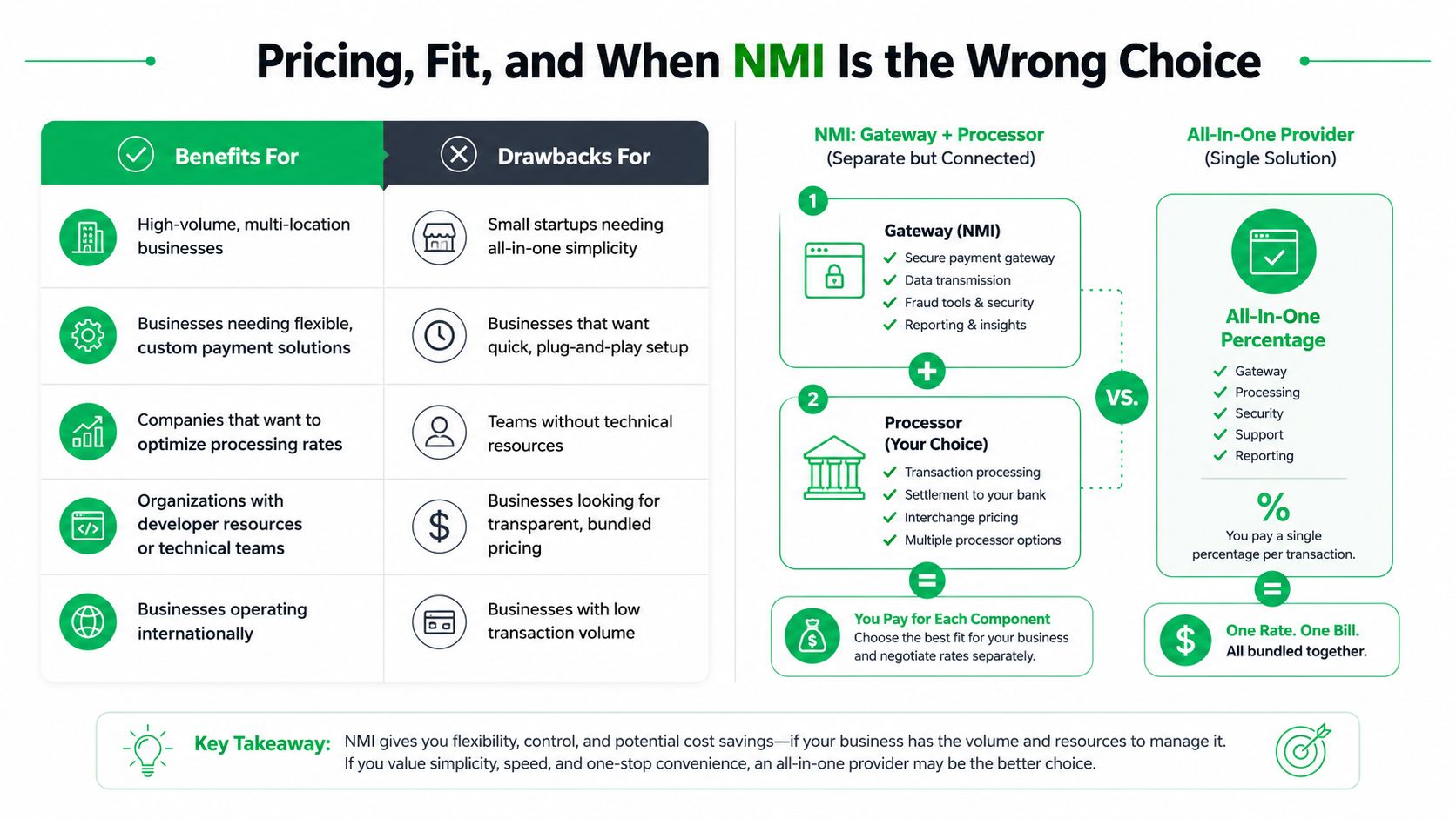
The conclusion is simple. NMI pays off when payment structure matters as much as payment acceptance. If your stack is still small and clean, it's too much gateway for too little problem.
Integrating NMI Into an Existing Subscription Stack
The cleanest NMI projects start with a blunt question. Are you replacing your payment stack, or are you adding a routing layer under an existing subscription workflow? Most SaaS teams are doing the second one. That matters, because the integration has to preserve your billing logic instead of forcing you to redesign it around the gateway.
A sane migration path starts in sandbox
Start by standing up sandbox access and mapping your recurring events to NMI's API surface. Get token handling working first, keep the private key server-side only, and make sure your application passes payment tokens correctly. Treat that as an application security task, not a front-end convenience.
If you are moving from Stripe-first billing, focus on preserving customer payment methods and deciding which pieces of the subscription workflow stay where. Rebuilding every retry rule and dunning path on day one is a waste of time. Prove the token flow, validate the checkout path, then move subscription events in a controlled order.
Common integration mistakes are predictable
The mistakes are boring, which is why teams keep making them. The worst one is exposing the private API key client-side. The next one is assuming currency handling will behave the same across processors without checking. The third is underestimating how much of your dunning flow lives outside the gateway and has to be rebuilt or reconnected.
A clean migration checklist looks like this:
- Keep the private key server-side. Never ship it to the browser.
- Test tokens in sandbox first. NMI's sandbox is for validation, not live money.
- Map recurring events before cutover. Do not improvise plan changes in production.
- Verify wallet support and checkout behavior. Apple Pay and Google Pay should behave the way your UX expects.
- Audit post-failure recovery. Failed-payment handling is usually where migrations break.
Do not let gateway migration turn into a hidden churn event. If the customer sees a broken renewal flow, retention takes the hit.
Real-time visibility helps here. A real-time notification layer can separate gateway work from retention work, so teams do not cram payment routing, cancellation handling, and recovery logic into one migration project.
Frequently Asked Questions About the NMI Payment Gateway
Does NMI handle recurring billing natively?
Yes, NMI supports recurring billing and billing schedules, but subscription teams should treat it as gateway infrastructure first, not as a full subscription platform. The recurring logic still has to fit your billing model and your processor setup.
How does NMI handle card-on-file updates and dunning?
NMI gives you the tokenized payment layer and routing control, but dunning is still a billing workflow you own or layer on through another platform. That's the right way to think about it. The gateway helps you charge and route, it doesn't replace your recovery strategy.
Can a Stripe-first team move to NMI without rebuilding everything?
Usually, yes, but not without work. The practical path is to keep your subscription logic intact where you can, migrate token handling carefully, and rebuild any assumptions that were tied to Stripe's billing stack. The gateway swap is manageable. The surrounding workflow changes are what usually take time.
Do you need an ISO or partner-led onboarding model?
NMI is positioned for ISOs, SaaS platforms, and partner-led payment setups, so the onboarding motion is often partner-driven rather than self-serve. That's not a downside if you need flexibility. It's a downside if you want instant signup and minimal implementation effort.
If your SaaS billing pain is processor rigidity, routing control, or the need to separate gateway logic from your merchant account strategy, put NMI on the shortlist and test it against your real recurring-billing flows. If you mainly need fast, simple subscription billing, skip the complexity and stay with a more managed stack. If you want help reducing churn and recovering failed or canceled revenue alongside your payment changes, start with Revcover and evaluate how retention tooling fits around the gateway you choose.