
Your Guide to a B2B Payments Platform for 2026

Ayush Soni
Founder, Revcover

On this page
- The Hidden Costs of an Outdated B2B Payment Process
- What Is a B2B Payments Platform Really
- Why B2B payment flows are structurally different
- Why a checkout tool isn't enough
- The Core Architecture of a Modern Platform
- The ledger is the control point
- The billing layer decides how revenue behaves
- Security and integrations can't be bolt-ons
- SaaS Evaluation Criteria Beyond Transaction Fees
- MRR protection matters more than headline pricing
- What to test in a live demo
- Your B2B Payments Platform Implementation Checklist
- Start with failure mapping
- Questions to press vendors on
- Rollout discipline prevents expensive surprises
- From Cost Center to Strategic Growth Engine
You're probably dealing with some version of this already. Stripe is collecting money, the finance team is exporting CSVs, someone in RevOps is trying to match invoices to subscription events, and failed renewals are getting treated like a support issue instead of a revenue issue. Meanwhile, your Head of Growth wants a clean view of churn, your Product team wants better cancellation feedback, and none of those systems are speaking the same language.
That's the trap with payments in a SaaS business. Teams treat them as back-office plumbing until renewal failures, messy reconciliation, and blind cancellation paths start showing up in MRR. At that point, the question stops being “which processor has the lowest fee?” and becomes “which stack protects revenue without slowing the business down?”
The Hidden Costs of an Outdated B2B Payment Process
The familiar pattern looks harmless at first. Sales closes a customer, finance sends an invoice, billing lives in Stripe, enterprise accounts want ACH or wire, and the team patches the gaps with spreadsheets, inbox rules, and manual follow-up. That works for a while.
Then the leaks show up.
A card expires on a recurring contract and nobody notices until access is interrupted. An accounts payable contact changes at the customer side, but the invoice still goes to the old inbox. A high-value account wants net terms, but the billing system was built for self-serve card payments. The customer isn't trying to leave, but your process makes it easy for revenue to slip.
Practical rule: If your team can't explain exactly why a payment failed, why a subscription was canceled, or where an invoice sits in approval, you don't have a payment process. You have a collection of workarounds.
For SaaS operators, these aren't finance-only problems. They hit retention, expansion, and forecasting. When recurring billing logic is weak, involuntary churn rises. When reconciliation is slow, finance loses confidence in reporting. When cancellation flows are blunt, Growth loses the chance to save an account or learn what drove churn.
The urgency isn't hypothetical. The global B2B payments market reached USD 1,273.0 billion in 2025 and is projected to reach USD 2,274.3 billion by 2034, at around 6.7% CAGR, according to this B2B payments market projection. That growth is tied to stronger financial decision-making and better security, which is exactly where outdated internal stacks fall short.
An effective B2B payments platform isn't just another vendor in the stack. For a subscription business, it's revenue infrastructure. It determines how cleanly you bill, how quickly you recover failed payments, how clearly you track customer intent, and how much friction buyers feel when they try to keep paying you.
What Is a B2B Payments Platform Really
A B2B payments platform is often described too narrowly. People hear “payments platform” and think processor, gateway, or checkout page. That framing misses its core function.
In a SaaS business, a B2B payments platform is the operating layer that handles how businesses buy from you, renew with you, approve invoices, change payment methods, and reconcile what happened across finance and revenue systems. It sits much closer to your commercial model than a typical B2C checkout tool.
Why B2B payment flows are structurally different
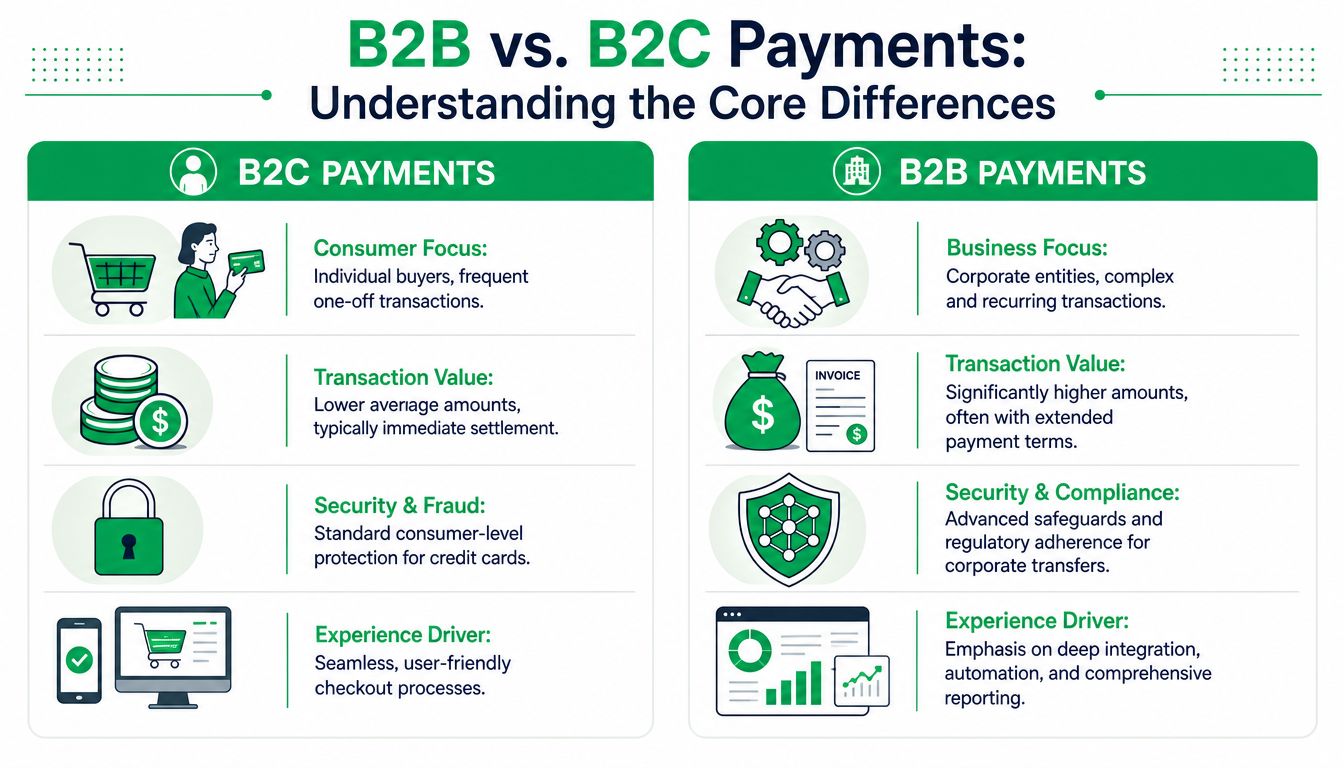
Consumer payments usually optimize for speed and simplicity. Someone buys once, pays quickly, and expects minimal friction. Business payments work differently.
In B2B, the transaction often sits inside a broader commercial relationship. You may be dealing with annual contracts, monthly recurring invoices, procurement rules, tax handling, approval chains, and a buyer who isn't the same person as the payer. A controller may approve. An AP manager may pay. An end user may depend on the product every day.
That's part of why the shift away from paper is meaningful. 64% of companies made more than half of their B2B payments electronically in 2022, while 28% of transactions were still processed manually, according to Resolve's review of real-time B2B payment adoption. Digital adoption is moving forward, but many companies are still carrying manual baggage inside that transition.
A practical comparison looks like this:
| Dimension | B2C setup | B2B setup |
|---|---|---|
| Buyer behavior | Individual, one-off | Team-based, recurring or contract-driven |
| Payment options | Card-first | Card, ACH, wire, invoice, open banking |
| Approval path | Immediate | Often multi-step |
| Reconciliation need | Lighter | Much heavier |
| Revenue impact of failure | Lost order | Potential churn, delayed cash, account risk |
Why a checkout tool isn't enough
SaaS teams encounter difficulties when they use a B2C-shaped tool for a B2B motion, then wonder why exceptions pile up.
A simple hosted checkout can collect payment. It usually can't handle the operational complexity around recurring invoices, approval workflow visibility, customer-specific billing terms, payment method changes, and the handoff between product, finance, and customer success.
B2B payment infrastructure has to support the relationship, not just the transaction.
If your customers include both self-serve and sales-led accounts, the platform has to support both without forcing your team into duplicate systems. It should handle card payments for one segment, ACH for another, invoice workflows for larger accounts, and clean reconciliation across all of it.
The best way to think about it is this. A processor moves money. A B2B payments platform helps your company manage the commercial realities around that money.
The Core Architecture of a Modern Platform
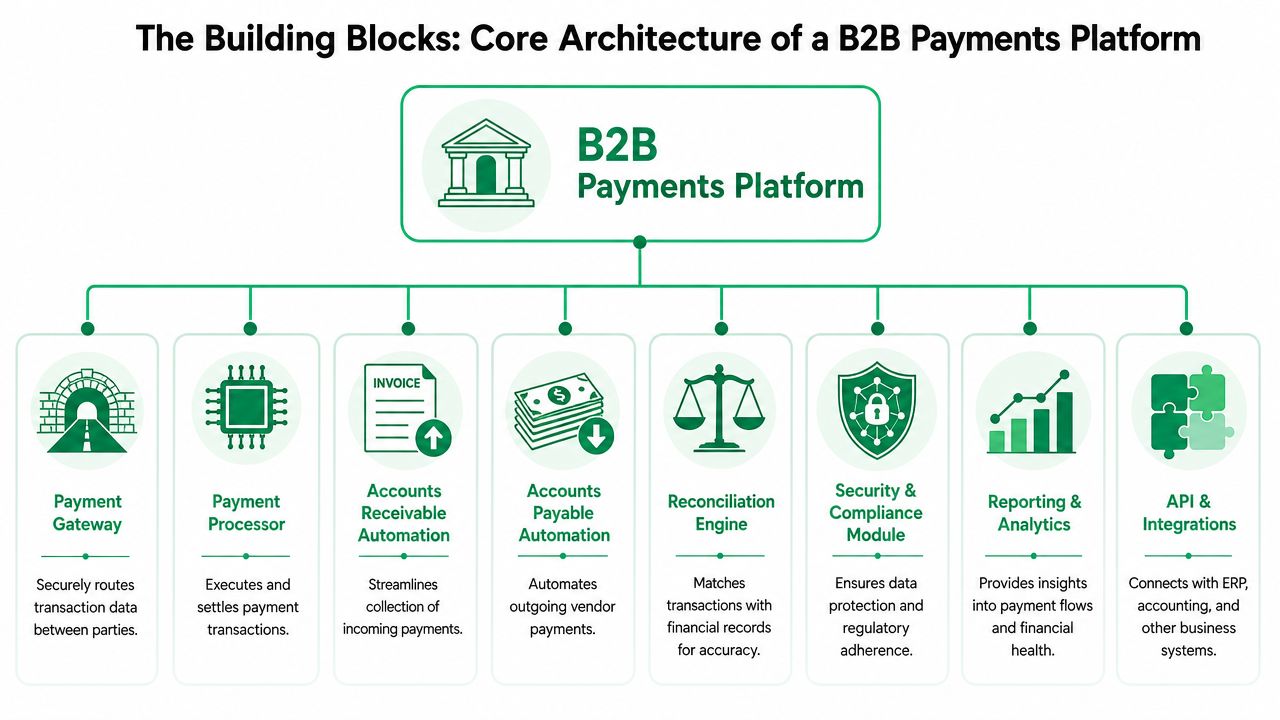
If the commercial model is recurring, the payment stack has to behave like a revenue system, not a collection tool. The strongest platforms share a common architectural shape. They keep a durable record of what happened, expose that data through APIs, and process events fast enough that your billing logic and customer experience don't drift apart.
The ledger is the control point
The first thing to inspect is whether the platform is built around a ledger. That sounds technical, but the business implication is simple. You need one reliable record of every payment state, adjustment, retry, refund, and reconciliation event.
According to SDK.finance's guide to payment system architecture, a modern platform should be ledger-based, API-first, capable of real-time processing, and maintain PCI DSS compliance through tokenization. That combination matters because recurring billing breaks down when different tools disagree on what happened.
Without a ledger-based design, teams end up asking basic but expensive questions:
- Did the payment fail or is the webhook delayed
- Was the invoice paid or partially settled
- Did the subscription change before or after the retry
- Is the CRM showing the same account state as billing
When those answers require manual investigation, your team burns time and customers feel the lag.
A useful technical example is how teams think about bank payments. If you're evaluating support for lower-cost rails, this guide on accepting ACH payments is a good reference point for what operational readiness involves.
The billing layer decides how revenue behaves
A modern stack also needs a billing and invoicing engine that can model real subscription complexity. That includes renewals, mid-cycle plan changes, contract terms, invoice generation, collections timing, and account-level exceptions.
This isn't glamorous architecture, but it's where a lot of SaaS revenue friction starts. If your billing engine can't cleanly handle downgrade timing, proration, paused access, or payment method changes, the team compensates with support tickets and finance workarounds. That creates delay at exactly the moments when customers are deciding whether to stay.
Here's a simple way to think about the core layers:
- Ledger and reconciliation keep the record straight.
- Billing logic determines how contracts and subscriptions behave.
- Event processing keeps customer-facing systems current.
- API exposure lets CRM, support, and analytics tools act on the same truth.
Security and integrations can't be bolt-ons
Later-stage SaaS teams usually discover this the hard way. The payment stack isn't isolated. It needs to connect with product entitlements, CRM records, accounting systems, support tools, and sometimes internal approval workflows.
That's why API-first design matters so much. It lets the business add or replace adjacent tools without rewriting the payment core. It also makes it possible to pass meaningful events across teams, such as failed renewal notices to Customer Success or billing-state changes to product access rules.
For a quick visual walkthrough of how these parts fit together, this short video is useful:
The security layer matters just as much. Tokenization and PCI discipline aren't abstract compliance boxes. They reduce risk when you're storing payment credentials, updating cards, or routing payment events through multiple integrated systems. In practice, the best architecture is the one your finance lead trusts, your engineering team can extend, and your Growth team can use without waiting on a quarterly rebuild.
SaaS Evaluation Criteria Beyond Transaction Fees
A lot of buyers still start in the wrong place. They compare headline processing fees, ask about discounts at volume, and make the platform decision like they're buying commodity infrastructure.
That's a mistake for subscription software. The better question is whether the platform helps you keep revenue that is otherwise easy to lose.
MRR protection matters more than headline pricing
If your revenue is recurring, then payments touch churn more often than commonly acknowledged. Failed charges create involuntary churn. Weak cancellation flows create avoidable churn. Rigid subscription logic creates frustrated churn. Poor reporting hides all three.
So yes, transaction economics matter. But they matter inside a wider revenue equation.
One example is payment rail strategy. A multi-rail architecture can reduce average transaction costs by 40% to 60% by routing payments intelligently, while also simplifying reconciliation and error handling, according to Monite's explanation of multi-rail B2B payments. That matters because it gives SaaS teams more flexibility in how they handle enterprise invoices, self-serve renewals, and larger contract payments.
Still, cheaper routing by itself won't protect MRR. The criteria that deserve more attention are these:
- Automated payment recovery: When a recurring payment fails, does the platform support retry logic, reminders, card update flows, and internal visibility into account status?
- Cancellation interception: Can you segment save paths by plan, account value, billing status, or stated reason, rather than showing every user the same cancellation page?
- Subscription flexibility: Can the system handle pauses, downgrades, seat changes, contract exceptions, and prorations without manual intervention?
- Attribution and reporting: Can the team see which recovery actions or retention offers preserved recurring revenue?
The cheapest payment stack often becomes the most expensive once you count lost renewals, manual recovery work, and weak churn visibility.
There's also an organizational trade-off here. A narrow payment setup usually pushes work onto finance and support. A stronger platform gives Growth, Product, and RevOps a shared operating surface. That changes how quickly you can test interventions and how confidently you can report what worked.
If your team is also weighing operational ownership models, this overview of a merchant of record model helps frame where payments responsibility sits and how that affects the rest of the stack.
What to test in a live demo
A polished sales demo can hide a lot. Ask vendors to work through the ugly cases.
Have them show what happens when a card fails on a high-value renewal. Ask how the customer updates payment details. Ask where the failed payment status appears for internal teams. Ask what changes in the ledger, what changes in the subscription state, and what gets logged for later analysis.
Then test cancellation logic. Don't settle for “yes, we support custom flows.” Ask whether the system can route by segment, capture reason data in context, and connect the result back to revenue outcomes. If a customer chooses downgrade over cancellation, you should be able to trace that decision all the way through billing and reporting without stitching together five dashboards.
A quick evaluation lens looks like this:
| Question | Weak answer | Strong answer |
|---|---|---|
| How do you handle failed recurring payments | Generic retry support | Coordinated retries, reminders, update paths, status visibility |
| How do you handle cancellation intent | Static cancel page | Context-aware flows with reason capture and save options |
| How does reporting work | Basic payment logs | Revenue-linked attribution across recovery and churn actions |
| How hard is integration | Requires custom glue | Works alongside existing billing and finance systems |
The buying decision should reflect the business model you're running. For B2B SaaS, the payment stack is part of retention infrastructure, not just checkout infrastructure.
Your B2B Payments Platform Implementation Checklist
Choosing the platform is only half the job. Implementation is where teams either build a cleaner revenue engine or recreate the same mess on newer software.
The biggest mistake I see is starting with vendor features before mapping internal failure points. If you skip that step, the new stack inherits old confusion. You end up with better screens and the same revenue leakage.
Start with failure mapping
Before you compare vendors, document how money moves through the business today. Follow the full path from contract signature to first payment, renewal, failure state, cancellation, and reactivation.
Look for the points where people, not systems, are holding the process together. Those are usually your real selection criteria.
A practical internal checklist:
- Map recurring billing states: Identify every subscription status your team uses, including pauses, exceptions, overdue states, and manual overrides.
- Trace failed payment handling: Write down what happens after a card decline, invoice non-payment, or bank transfer delay. Include who gets notified and what the customer experiences.
- Audit reconciliation work: Note where finance has to export, merge, or manually verify records across Stripe, ERP, CRM, and support tools.
- Inspect cancellation paths: Review what users see when they try to leave, what reason data you capture, and whether anyone can tie that feedback to revenue impact.
- List payment method realities: Enterprise buyers often want invoicing, ACH, or procurement-friendly workflows even when self-serve users pay by card.
Manual processes are still widespread, with 80% of SMB invoices paid manually by check, which creates delays and poor visibility, according to Qolo's discussion of common B2B payment challenges. Even if your company is more digital than that, the same visibility problem shows up whenever approvals, invoice status, and payment events are fragmented.
If nobody can see where an invoice is stuck, your cash collection process depends on luck and inbox archaeology.
Questions to press vendors on
A serious evaluation should sound less like procurement and more like systems design. You want proof that the platform can handle your failure cases, not just your happy path.
Use questions like these in demos and technical reviews:
- Show the dunning sequence Don't accept a verbal description. Ask the vendor to walk through a failed recurring payment from first decline to either recovery or churn. You need to see retries, notifications, payment update flow, and subscription-state handling.
- Show how revenue gets attributed If an account accepts a downgrade instead of canceling, or updates a card after a failed renewal, where is that outcome recorded? Can Growth and Finance both see the result without manual interpretation?
- Show workflow transparency B2B payments often involve approvals and handoffs. Ask what internal teams can see when a payment is pending, failed, partially settled, or waiting on customer action.
- Show integration boundaries If you use Stripe Billing, NetSuite, HubSpot, Salesforce, or internal product access logic, ask exactly where the platform writes data and where it reads it. Ambiguity here becomes reporting debt later.
- Show exception handling Ask about partial payments, invoice disputes, payment method changes mid-cycle, and account-level billing exceptions. Mature systems have clear answers. Thin systems force manual cleanup.
One useful supporting question is whether the platform gives customers a direct way to resolve common billing issues before support gets involved. The same principle applies when a card is declined by the issuer. Fast customer resolution protects renewal revenue and reduces internal tickets.
Rollout discipline prevents expensive surprises
Once you've selected a platform, resist the urge to flip everything at once. Payment systems touch finance accuracy, customer communication, and access control. Small rollout mistakes can create outsized trust issues.
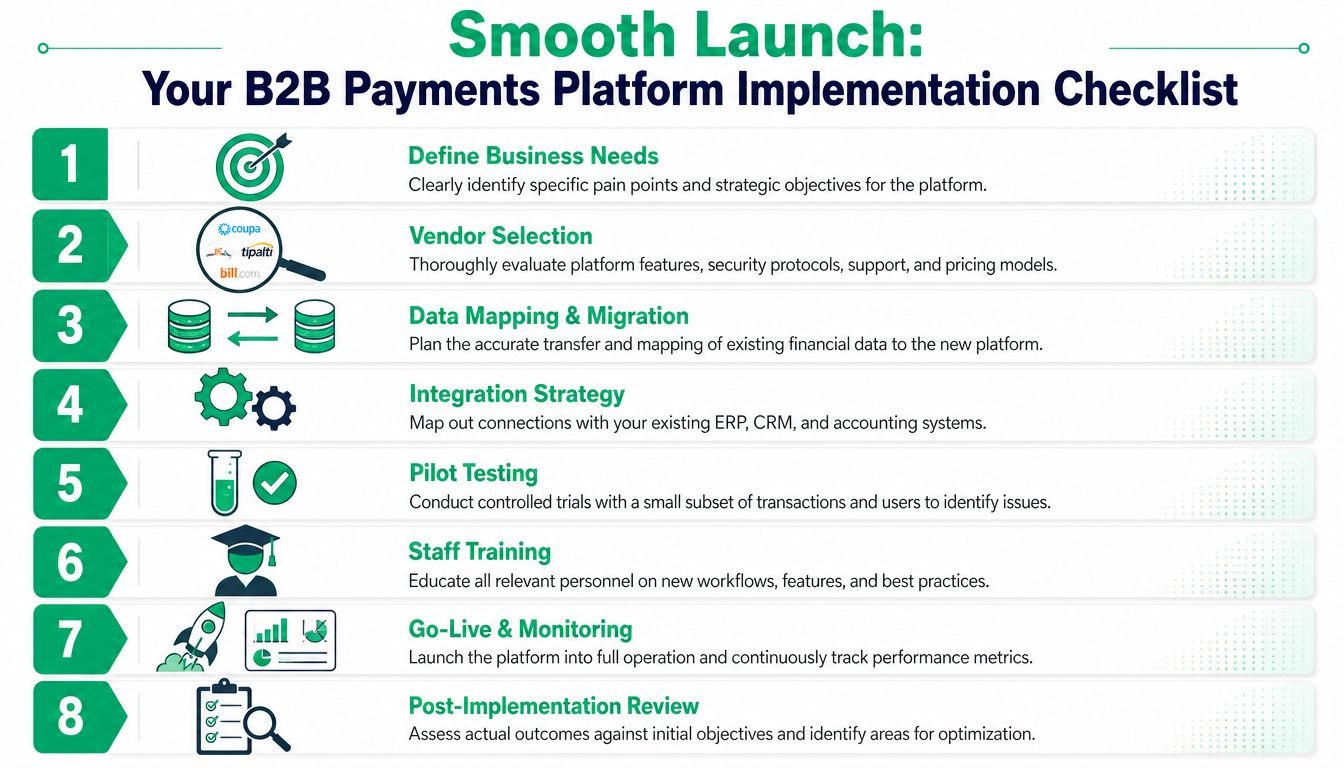
A clean implementation usually follows this pattern:
| Phase | What to validate |
|---|---|
| Data mapping | Customer records, invoice states, subscription objects, payment methods |
| Integration testing | CRM sync, accounting exports, webhook reliability, internal alerts |
| Pilot cohort | A limited group of accounts across self-serve and sales-led segments |
| Operational training | Finance, Support, Success, and RevOps know what changed |
| Go-live monitoring | Failed payments, reconciliation gaps, customer confusion, support volume |
Keep ownership explicit. Finance should own reconciliation confidence. RevOps should own workflow integrity and reporting consistency. Growth should own retention experiments tied to cancellation and recovery flows. Product should own the customer-side billing experience and access-state logic.
The implementation is successful when these teams stop debating what happened and start acting on the same record. That's when a B2B payments platform becomes usable infrastructure instead of another dashboard.
From Cost Center to Strategic Growth Engine
Most SaaS companies still inherit an outdated mental model of payments. Finance owns it. Engineering maintains it. Growth sees the outputs after the damage is done.
That model breaks once recurring revenue becomes the center of the business. At that point, billing, cancellations, retries, payment methods, and reconciliation all shape retention. They influence whether a customer renews smoothly, downgrades intelligently, or disappears through a preventable failure.
A strong B2B payments platform changes the conversation. Instead of asking how to process a transaction more cheaply, the team starts asking how to preserve revenue, reduce friction, and make customer intent visible sooner. That's a better operating model for SaaS because it ties technical choices to actual commercial outcomes.
The companies that do this well don't treat payments as isolated back-office software. They treat payment infrastructure as part of the revenue lifecycle. That means recurring billing logic is deliberate, recovery workflows are measurable, cancellation paths are designed instead of ignored, and finance data can support strategic decisions rather than just close the books.
If your current stack still relies on manual patches, disconnected tools, and generic cancel flows, it's already costing more than it appears to cost. The issue isn't just efficiency. It's lost MRR, weaker forecasting, slower learning, and avoidable churn.
If you want a practical layer on top of Stripe that focuses on cancellation flows, failed payment recovery, and revenue attribution, Revcover is built for subscription software teams that need to protect MRR without replacing their core billing system.