
FTC Negative Option Rule: What SaaS Teams Must Do Now

Ayush Soni
Founder, Revcover
On this page
- The Cancel Button That Became a Legal Problem
- Why the risk changed
- What this article is really for
- What Negative Option Actually Means
- Why the FTC cares
- How to recognize it in your own product
- The 2024 Rule, the Vacatur, and What Still Applies
- What survived and what didn't
- The Four Compliance Pillars That Survived the Vacatur
- Pillar one, clear disclosure before billing
- Pillar two, separate express informed consent
- Pillar three, a simple cancellation mechanism
- Pillar four, charges stop immediately
- Same Medium, Easy Cancellation, and the Mixed-Channel Trap
- Where compliant flows usually break
- How to design the flow without breaking the rule
- Designing Save Offers That Reduce Churn Without Crossing the Line
- What a lawful save offer looks like
- What crosses the line
- Mapping Revcover to Each Compliance Pillar
- A 30-Day Compliance Plan and What to Watch Next
You're probably looking at a cancel button that seemed harmless six months ago and now feels like a liability. Maybe it says Contact Support to Cancel, maybe it pushes users through three retention screens, or maybe it only works if the customer replies to an email. Under the FTC negative option rule, that's no longer a UX debate, it's a compliance problem.
The hard part is that most guides blur together three different things, the FTC's 2021 enforcement posture, the 2024 final rule, and the July 2025 vacatur. Those are not the same thing, and treating them as one blob leads SaaS teams to overbuild in some places and miss real risk in others. The practical question isn't whether cancellation should feel easy, it's which obligations still bite today and how to ship a flow that survives scrutiny.
If you run growth, RevOps, product, or support, the answer has to be operational, not theoretical. You need to know what disclosure belongs on the checkout page, what consent evidence you should keep, where a save offer crosses the line, and when a human-assisted cancellation path becomes a problem. By the end, you should be able to look at your current Stripe-backed flow and decide what to keep, what to remove, and what to rewire immediately.
The Cancel Button That Became a Legal Problem
A founder opens the dashboard, clicks through the cancellation path, and sees the mistake instantly. The user can sign up in under two minutes, but canceling requires a support ticket, a follow-up email, or a phone call during business hours. That setup looks like classic friction, and regulators have been trained to see the same thing.
Why the risk changed
The subscription business used to treat cancellation as a retention lever first and a legal issue second. That's backwards now. The FTC's 2021 policy statement already said consumers must be told the charge amount, frequency, deadline to cancel, and all information needed to cancel, and the 2024 final rule tried to turn that thinking into a nationwide compliance framework for subscriptions, free trials, continuity plans, and automatic renewals (FTC policy statement).
The important shift is that the cancel button is no longer just part of your UX. It is evidence. If your process makes cancellation hard, opaque, or channel-switched, the FTC has a path to argue that the flow is deceptive or unfair under longstanding law, even where the 2024 amendments later fell away.
Practical rule: If a customer can enroll online, your default assumption should be that they should be able to cancel online with the same clarity and without extra friction.
What this article is really for
You don't need a law-school memo. You need a clean read on which parts of the FTC negative option rule still matter, what the July 2025 vacatur took off the table, and what your team should ship anyway because the underlying enforcement risk didn't vanish. The section that follows defines the model, because many teams only discover they've built a negative option flow after legal gets involved.
What Negative Option Actually Means
A negative option is simple in theory and messy in practice. The customer's silence, or failure to take action, counts as consent to keep being charged. The kinds of products people already know well include automatic renewals, free trials that convert into paid subscriptions, and continuity plans. The FTC's own description in its 2026 notice breaks those categories out clearly, and the agency's blog says negative option marketing includes pre-notification plans, continuity plans, automatic renewals, and free-to-pay plans (FTC blog on negative option regulations).
Why the FTC cares
The FTC cares because bad actors have historically used this billing model to bury cost, hide renewal timing, and make cancellation a maze. The business model itself isn't the problem. The problem is when the seller relies on customer inaction while making it hard to understand what's being bought, when the charge starts, or how to stop it.
A normal one-time purchase doesn't raise the same issue, because the customer affirmatively buys a single item and the charge ends there. A negative option flow is different because the service keeps going unless the customer intervenes. That's why the agency has focused on material terms, express informed consent, and a simple cancellation mechanism.
How to recognize it in your own product
Think about the last streaming service or software trial you used. If the trial rolled into a paid plan unless you canceled before a deadline, that was a negative option feature. If the checkout page buried renewal language, or if the customer had to hunt for the cancel path later, the FTC sees the same risk pattern that's been litigated for years.
Negative option flows aren't illegal by default. They become a problem when the seller turns silence into payment and then makes the customer work too hard to escape it.
The 2024 Rule, the Vacatur, and What Still Applies
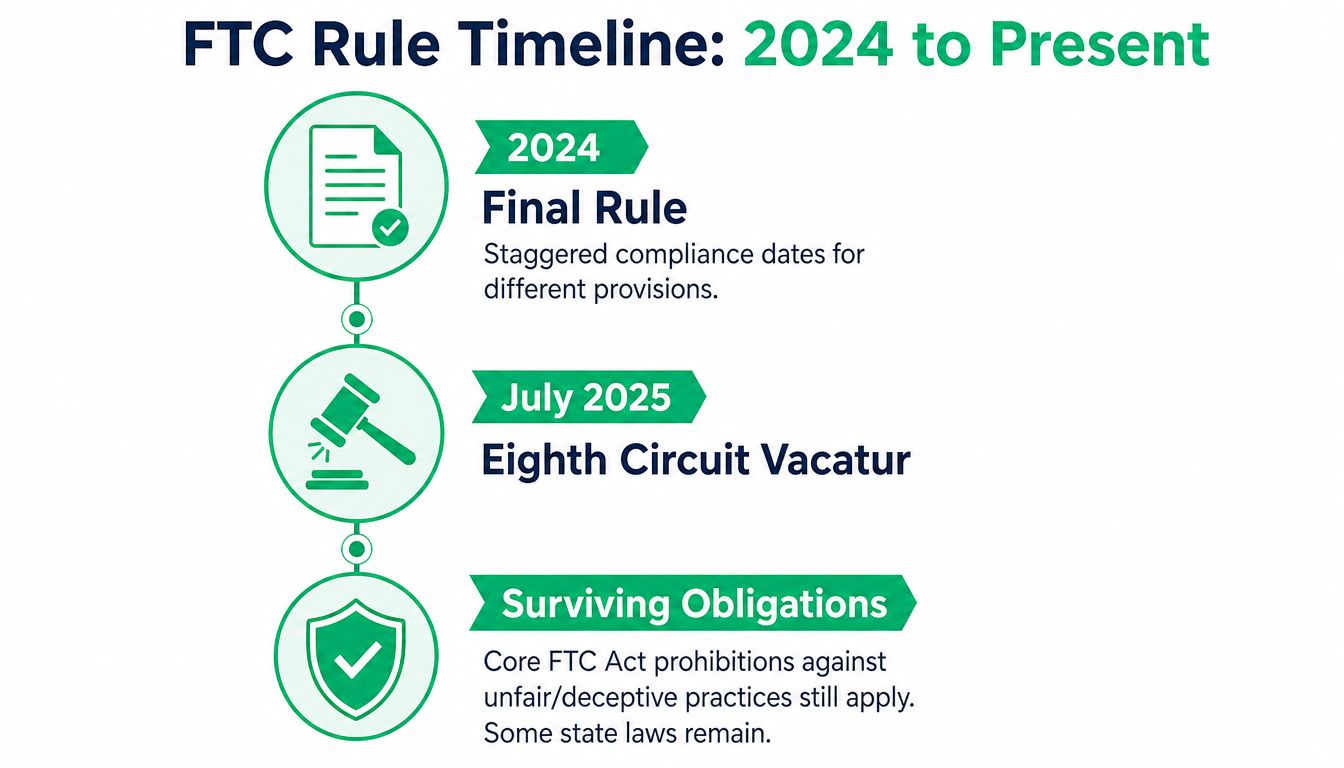
The timeline matters more than most explainers admit. The FTC finalized its negative option rule in 2024, but it set staggered dates. The ban on material misrepresentations became effective on January 14, 2025, while the core disclosure, consent, and cancellation requirements were set to take effect on May 14, 2025. The rule also required businesses to present key terms clearly and conspicuously before billing info is collected, obtain separate express informed consent for the negative option feature, and keep consent records for at least 3 years unless proving the transaction is technologically impossible without that consent (Latham & Watkins summary of the FTC rule).
That's the part many teams remember. The part they miss is the July 2025 Eighth Circuit vacatur, which changed the compliance conversation entirely. A lot of content still talks as if the 2024 amendments are live law. They aren't. The safer mental model is that Section 5, the FTC's 2021 enforcement policy, and state automatic renewal laws still matter, while several of the 2024 rule's prescriptive features no longer provide the same nationwide rulebook.
What survived and what didn't
The FTC's earlier enforcement position still matters because it already demanded clear disclosure of material terms, express informed consent, and no cancellation obstruction. The vacated 2024 rule would have added broader click-to-cancel style mechanics and formal recordkeeping. After vacatur, teams need to separate enduring enforcement risk from obligations that depended on the amended rule taking effect.
The one thing I'd tell any SaaS operator is this, stop designing around the assumption that the 2024 compliance calendar still controls your product. Design around the underlying risk categories that still exist, then layer in state law where it applies. California and New York still have their own automatic renewal requirements, so a federal vacatur doesn't mean your state-level work is done.
The reason this matters for SaaS is simple. If your team spent months trying to satisfy a vanished federal checkbox while ignoring the live disclosure and cancellation risks, you burned effort in the wrong place. If you need a state-law reference point, this overview of California automatic renewal law is the kind of parallel reading legal should keep open.
The Four Compliance Pillars That Survived the Vacatur
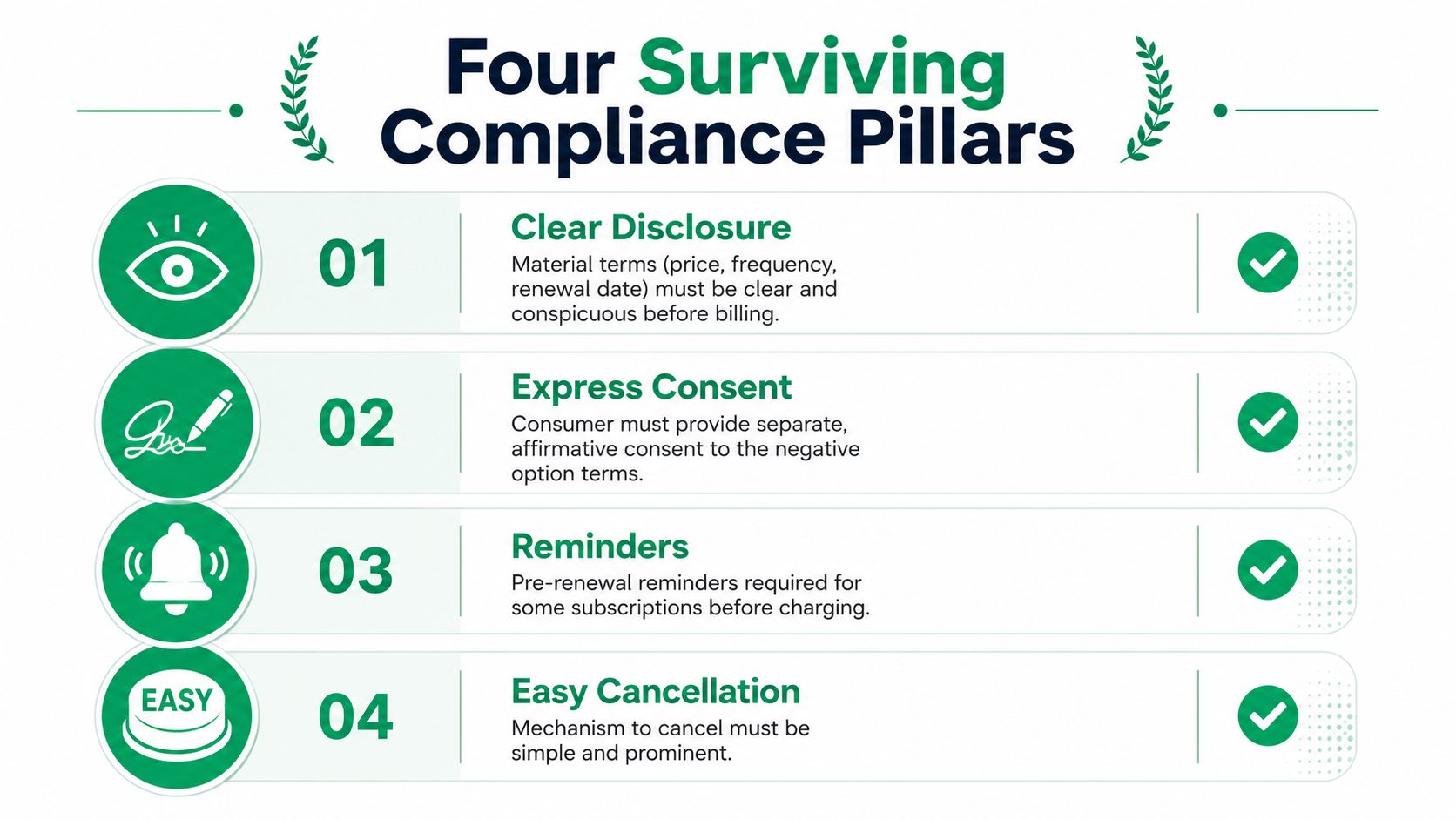
Forget the noise. The durable requirements are easy to remember if you think like a builder, not a lawyer. You need clear disclosure, real consent, a cancellation path that doesn't block the customer, and immediate stopping of future charges once cancellation happens. That's the operational core.
Pillar one, clear disclosure before billing
Your pricing page and checkout have to show material terms clearly and conspicuously before you collect payment details. Don't bury renewal timing in a footer, don't hide the frequency in gray text, and don't assume a tooltip solves the problem. A compliant example is a checkout page that plainly states the billing cadence, renewal behavior, and cancellation terms before the card form appears.
A buggy pattern is the opposite. If the only meaningful terms live behind a modal, a footnote, or a second-screen detour after payment entry, you're creating the exact disclosure gap regulators look for.
Pillar two, separate express informed consent
Consent needs to be affirmative and specific to the negative option feature. Don't bundle it into a generic terms checkbox where the customer can't tell what they're authorizing. Make the consent action separate, obvious, and tied to the recurring charge.
Pillar three, a simple cancellation mechanism
The FTC's operational benchmark is a simple mechanism that is at least as easy as sign-up and available through the same medium used to enroll. A compliant SaaS example is an online self-serve cancellation inside the account area when the customer signed up online. A risky pattern is forcing a call, a support ticket, or a live-agent step after a web signup.
Pillar four, charges stop immediately
Once the customer cancels, recurring charges need to stop immediately. If your flow still lets the system bill on the next cycle because finance has a delayed backend update, you've got a real problem. The customer should not have to chase your internal systems to get the cancellation they already completed.
Same Medium, Easy Cancellation, and the Mixed-Channel Trap
Scaling SaaS teams get burned here. The rule is not just “let them cancel.” It is cancel the same way they signed up, or at least through the same medium, without adding friction. If enrollment happened on the web, cancellation can't be more burdensome than the web flow that created the subscription.
A startup with a slick online checkout and a hidden support-only cancel process is the obvious failure case. But the harder case is hybrid onboarding. Sales closes the deal on Zoom, the customer signs an order form by email, and support assumes cancellation can be handled by ticket or phone. That's where teams over-rotate on retention and accidentally create a mixed-channel trap.
Where compliant flows usually break
The failure usually isn't malicious, it's organizational. Product owns signup, support owns cancellation, and sales owns the relationship. No one owns the medium parity problem. The result is a clean web enrollment path and a fragmented cancellation path that asks the customer to find the “right” internal team.
The FTC's guidance on the cancellation mechanism says the path should be available through the same medium used to sign up, and the company must stop recurring charges immediately once cancellation happens (FTC announcement on the click to cancel rule). That means you can't make the customer call if they enrolled online, and you can't hide the cancel button behind a maze of account settings if your signup was one click from the pricing page.
How to design the flow without breaking the rule
Use a consistent channel first. If signup is self-serve web, put cancellation in the account area, then let the customer confirm the decision without sending them to a human by default. If signup is sales-assisted, give the customer a documented self-serve path too, not a mystery inbox. The key is that the customer isn't trapped in a different medium than the one used to enroll.
A retention conversation is fine only after the customer reaches the point of cancellation on their own terms. Don't make the save path the gate to the exit.
For a tighter operational lens on cancellation design, the cancelling a service discussion is useful because it forces you to think in terms of actual customer motion, not policy language.
Designing Save Offers That Reduce Churn Without Crossing the Line
Retention teams want to save the account. Regulators want the customer to exit cleanly if that's what they chose. Both goals can coexist, but only if the save offer comes after a valid cancel choice and doesn't become a barrier in disguise.
What a lawful save offer looks like
A clean save path is short, clear, and optional. A pause offer can be fine. A downgrade can be fine. A targeted discount can be fine if it's presented as a choice, not a tollgate. A retention team can ask why the customer is leaving, but the question has to feel like a question, not a locked door.
What crosses the line
Forced multi-step flows are the first warning sign. So are hidden dark patterns, confusing button labels, and any requirement that the customer call to claim a discount after they already tried to cancel online. If your “save” screen makes the clean cancellation option hard to find, you're not retaining customers, you're obstructing them.
A good structure is simple:
- Let the customer choose cancel.
- Offer one short save option.
- Make clean cancellation visibly available on the same screen.
- Finish cancellation immediately if they decline.
That sequence gives growth a chance to preserve the relationship without making the exit path fake. It also creates cleaner data because the churn reason is captured at the point of intent instead of being reconstructed from angry support messages later. If you want a practical way to standardize that data, the reason for cancellation material is the right kind of internal anchor for a taxonomy conversation.
Mapping Revcover to Each Compliance Pillar
The abstract compliance checklist becomes real when you connect it to configuration. A Stripe-connected cancellation layer should capture the customer's intent at the moment it happens, preserve evidence of the path they took, and keep the clean exit available without burying it behind retention logic.
| Compliance Pillar | Revcover Capability | Configuration Surface |
|---|---|---|
| Clear Disclosure | Capture structured churn and billing context at intent | Checkout, subscription settings, cancel entry point |
| Express Consent | Record cancellation and save-path decisions with audit context | Consent capture, routing, event logging |
| Simple Cancellation | Present clean cancellation alongside save options | Cancellation flow, routing rules, account area |
| Stop Charges Immediately | Sync subscription state back to Stripe as the source of truth | Stripe billing actions, cancellation event handling |
The point isn't to make retention vanish. It's to separate the clean legal exit from the save logic, then use routing rules to personalize offers only after the customer has been given a real choice. Slack alerts and CRM syncs are useful for high-value account follow-up, but they shouldn't sit in the way of the cancellation itself.
A 30-Day Compliance Plan and What to Watch Next
Start with the flow you already ship. Audit medium parity, capture consent evidence at checkout, structure churn reasons, and make clean cancellation obvious. Then run a save-path test that includes a true cancellation control, and review payment recovery so it doesn't block access before polite attempts are done.
What I'd watch next is simple. The FTC and state AGs are likely to keep looking at involuntary churn handling, AI-driven personalization that creates uneven customer outcomes, and dark patterns in upsell modals. Build for a customer who can leave cleanly, and you'll be in a much safer place than a team that optimizes every screen for retention and hopes the legal review won't notice.
A CTA for Revcover.