
Cancelling a Service: A SaaS Playbook for Retention

Ayush Soni
Founder, Revcover
On this page
- The Cancellation Moment of Truth
- Why that moment is strategically useful
- Why Customers Cancel and How to Listen
- Why the reason must be captured in the flow
- Designing Intelligent Cancellation Flows
- Start with honest options
- Keep the flow transparent
- Don't confuse friction with retention
- Personalizing Retention with Routing Rules
- Build routing around context, not guesswork
- Use the record for operations, not just analytics
- Recovering Revenue from Failed Payments
- Treat failed payment as a recovery sequence
- Keep the experience low-friction
- Measuring and Acting on Retention Insights
- Measure the outcomes that matter
- Turn churn reasons into action
You're staring at a cancellation request, and it rarely arrives in a neat, predictable way. Maybe it's a customer in a monthly plan who clicked through your billing portal, or someone who emailed support because the button was hard to find, or a card that stopped working and made the subscription look abandoned from your side. The mistake is treating that moment like a dead end. It's really the clearest signal you'll get about price pressure, product friction, payment risk, and whether your retention engine is doing any real work.
The Cancellation Moment of Truth
The first instinct in many SaaS teams is to see a cancellation as a loss and move on. That's the wrong mental model. A cancellation event is one of the few places where a customer tells you, with real intent, that something in the experience no longer works for them.
That matters because cancellation isn't always final in a clean, linear way. In UK consumer law, many services booked online, by phone, or by mail order fall under a 14-day cooling-off period, where a customer can cancel for any reason and get a full refund, including deposits or upfront payments, unless they specifically asked for the service to start during that window. The same guidance also notes that once a contract is formed outside that window, customers are generally unlikely to get all their money back unless the contract has a generous cancellation clause, and fees may apply, which makes the operational handling of cancellation part legal, part billing, part support workflow. Citizens Advice on cancelling a service
Why that moment is strategically useful
A cancellation request is where the customer's resistance becomes legible. A good cancel flow doesn't just ask them to stay, it learns whether they're reacting to price, timing, quality, or a broken expectation. That's the difference between an abandoned subscription page and a retention system that can improve the business.
Practical rule: treat every cancellation as a structured signal, not an emotional event.
That's also why the legal side matters operationally. If the customer is cancelling inside a defined refund window, your onboarding, billing, and refund logic needs to know that immediately. If they're outside it, your flow should still make the path clear, because a confusing termination experience tends to create disputes instead of resolution.
For SaaS leaders, the useful question isn't “How do we stop everyone from leaving?” It's “What does this cancellation tell us, and what should the system do next?” If you can answer that well, cancellations become a source of product insight, save revenue, and cleaner support handling instead of a blind spot.
Why Customers Cancel and How to Listen
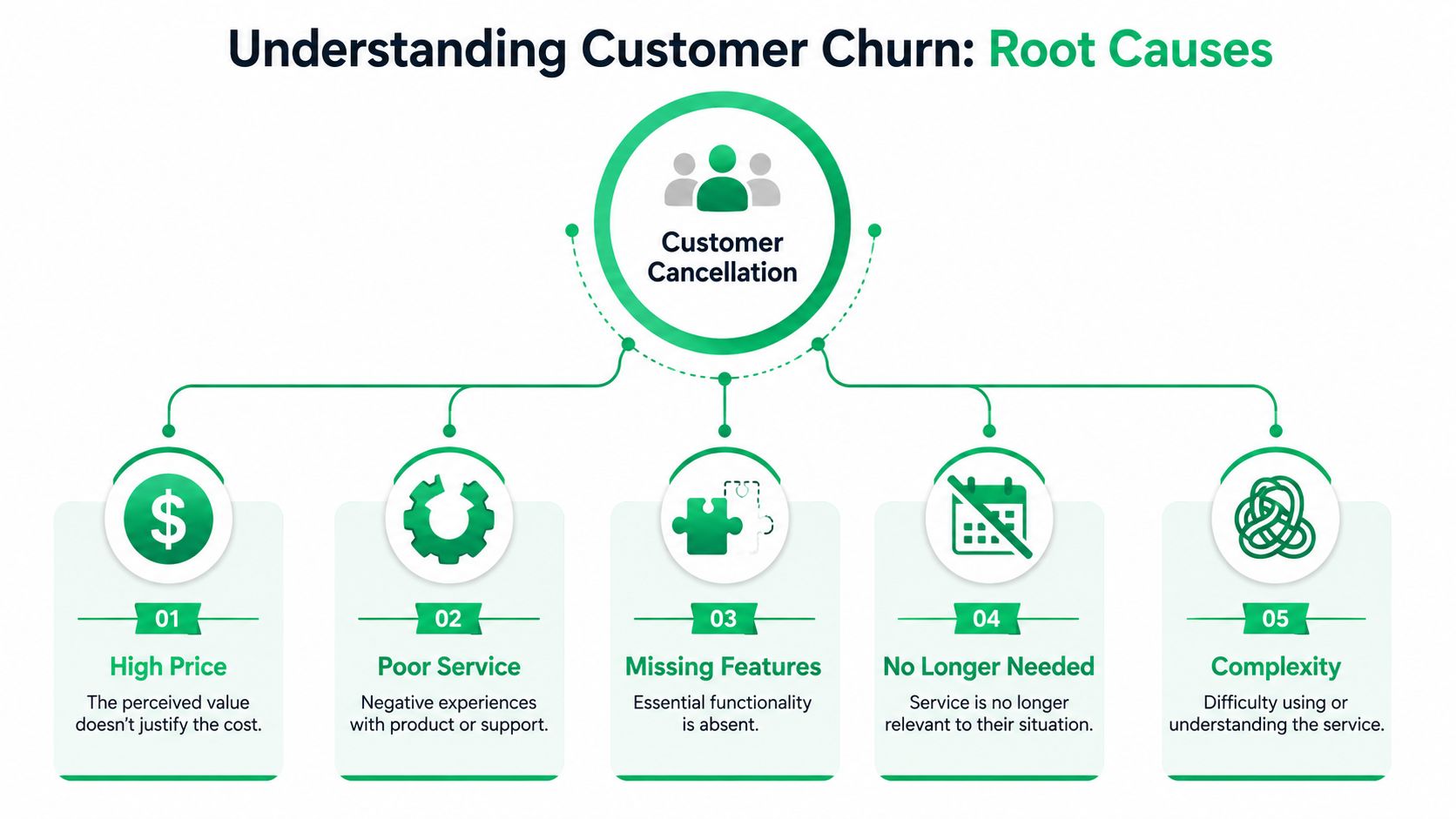
Cancellation reasons usually look messier in practice than they do in product dashboards. Customers do not always leave because of one dramatic failure. They leave because the value slipped below the price, a project ended, a better option appeared, the product felt harder than expected, or the service no longer fit their situation.
The pattern shows up in both service and subscription markets. Analysts in a 2026 compilation of service-sector appointment data found the average cancellation rate across service industries was 19%, with medical and dental appointments around 24% and free consultations or discovery calls reaching 28%. The same source identified scheduling conflicts (34%) and finding a better option (22%) as the top reasons. In subscription markets, YouGov found that 31% of UK consumers had cancelled or removed at least one streaming service in the previous 12 months, and 39% said they were likely to cancel at least one service in the next 12 months, with 39% of likely cancellers trying to save money and 33% saying their current services are too expensive. Cancellation rate statistics compilation
Why the reason must be captured in the flow
If you ask people days later, you get memory, not motive. Ask them inside the cancellation flow, and you capture the reason closest to the decision. That is the difference between anecdote and usable data.
The strongest pattern is simple, ask for a reason at the moment of intent, then make that reason structured enough to analyze later. Free text is still useful, but only if you can group it into themes that product, success, and marketing can act on. Without that system, churn stays hidden inside support tickets, billing notes, and one-off complaints.
Customers rarely leave for a single “mystery reason.” They leave because friction stacks up until cancellation feels easier than continuing.
That is why cancellation capture should be specific. If someone says price, you need to know whether they mean the absolute amount, the current plan's value, or a temporary budget issue. If they say missing features, you need to know whether that is a workaround problem or a deal-breaker. If they say they found something better, that is a competitive signal, not just a lost account.
A good internal taxonomy makes this much easier. Keep categories tight, then attach the raw customer language to each one. The goal is not to force every answer into a neat box. It is to stop the business from losing the signal inside a pile of uncategorized comments.
For a practical example of structuring those reasons in a cancel flow, the most useful reference point is the original reason collection, because downstream decisions are only as good as the signal you capture at the start.
Designing Intelligent Cancellation Flows
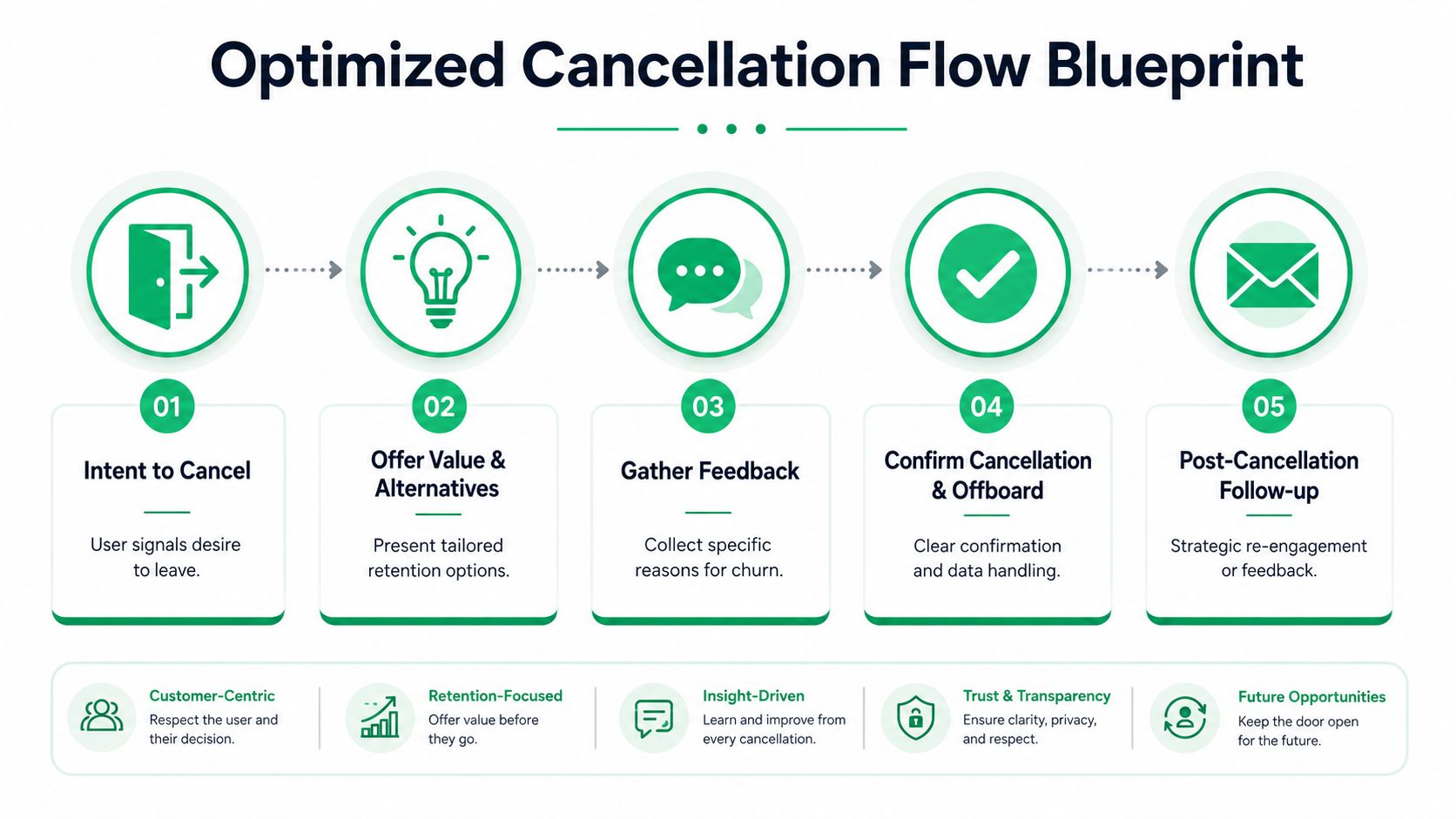
A cancellation flow should do two jobs at once. It should let the customer exit without friction, and it should turn that exit into usable product, pricing, and retention signal. If you force people into a maze, you usually get more support volume, more chargebacks, and more resentment. If you give them one blunt path, you lose the chance to learn why the account is leaving and what, if anything, could have changed the outcome.
Start with honest options
A pause fits a customer who still sees value in the product but needs time, budget relief, or room to breathe. It works best for temporary constraints, not for a relationship that has already broken down. If the account is caught between projects or dealing with a short-term cash issue, a pause can protect the relationship without pretending the business is healthy right now.
A downgrade is the right move when the customer still needs the product, just not at the current scope or price. That is usually a better answer than a blanket discount, because it keeps the plan aligned with actual usage. If the plan is the problem, reduce the plan. Do not force the customer to stay in a tier they no longer need.
A save offer makes sense when there is real value at risk and a targeted intervention might keep the account alive. That could be a limited-time discount, a plan adjustment, or a handoff to a human who can handle the objection directly. Restraint matters here. If every customer sees the same offer, you train the market to wait for the next discount instead of paying full price.
Keep the flow transparent
The cancellation path should never feel like a trap. The customer needs to know what happens next, what access they keep, and whether any fees or term rules apply. That clarity matters in consumer services and in SaaS billing, because confusion is where disputes start.
A practical flow usually follows a simple sequence. The user signals intent, the system presents relevant alternatives, a structured reason gets captured, and the outcome is confirmed and recorded cleanly for billing and analytics.
For teams that want a useful starting point for cancellation mechanics, value-based segmentation for retention and cancellation routing is a useful reference for thinking through reason capture, save options, and offboarding logic as one system instead of separate screens.
Don't confuse friction with retention
Obstructive cancellation flows can create short-term wins while damaging trust. Customers who cannot find the button do not become loyal. They become frustrated, and that frustration often shows up later as support tickets, disputes, or negative reviews.
The better approach is to keep the exit easy and make the alternatives relevant. A good flow says, in effect, “Here are the most useful options based on what you told us.” That creates a better commercial conversation than hiding the exit and pretending friction is retention.
Personalizing Retention with Routing Rules
A generic save offer is too blunt to work well for long. High-value accounts, low-usage accounts, and price-sensitive accounts don't need the same treatment, and they definitely don't deserve the same default discount. The system should route them differently because the business problem is different in each case.
Enterprise software already handles cancellation this way. SAP requires a cancellation reason to be selected and saved, and the service order status is updated with that structured metadata; Microsoft Dynamics 365 also supports canceling entire orders, individual lines, and batch cancellation with traceable messaging. That approach matters because the cancellation record becomes useful downstream, not just present at the moment of exit. Modern SaaS flows should borrow that logic and treat cancel events as structured state transitions, not loose UI events. SAP cancellation reason and status handling
Build routing around context, not guesswork
The right routing rules should combine at least three things, customer value, stated reason, and current account state. If someone on a higher plan says a missing feature is blocking them, that's a very different situation from a light user saying the price is too high. One deserves a product conversation or success outreach. The other may need a cleaner downgrade path.
Here's the practical logic:
- High-value account plus missing feature: route to a human follow-up, because product gap or roadmap pressure matters more than a short-term offer.
- Low-usage account plus price concern: surface a downgrade or pause, because the customer is telling you they still want the product, just not the current commitment.
- Billing-state risk plus cancellation intent: separate the payment issue from the product issue, because these aren't the same problem and they shouldn't use the same response.
Practical rule: the offer should match the reason, or it'll feel like noise.
That's where segmentation becomes useful. Cancellation data can't just sit in one field. It needs to inform routing logic, lifecycle messaging, and eventual win-back. If you want a good mental model for that kind of branching, value-based segmentation is the right lens, because it aligns the response with account importance instead of treating every departure as equal.
Use the record for operations, not just analytics
The moment a customer chooses a path, write it down in a structured way. That means the original reason, the offer shown, the offer accepted or rejected, and the final outcome. Without that chain, you can't tell whether a save was real or just a postponement.
Routing rules offer two distinct advantages. First, they improve the customer experience by reducing irrelevant offers. Second, they create cleaner data for later analysis, so the team can see which interventions work for which segments. The cancellation flow becomes part of your operational memory, not a disposable page.
Recovering Revenue from Failed Payments
Voluntary cancellation gets most of the attention, but involuntary churn eats a lot of recurring revenue. A card expires, a bank declines a charge, a payment authorization gets revoked, and the customer disappears from the billing system even though they never actively chose to leave. That's a different customer problem, but it lands in the same revenue bucket.
The gap in many retention programs is that they split cancellation and payment recovery into separate conversations. That misses the fact that failed payments often look like cancellations from the business side. The mechanics of retries, card updates, reminders, and access control are a critical, underexplained part of revenue recovery. Negative-option billing and recurring-charge disputes
Treat failed payment as a recovery sequence
A weak dunning process assumes the first decline is the whole story. A better one communicates clearly, gives the customer a way to update payment details quickly, and retries with judgment instead of aggression. The goal isn't to annoy the customer into paying. It's to remove accidental failure from intentional churn.
The customer should understand what happened and what comes next. If you bury the problem inside an invoice system, the account feels broken. If you make the path to update billing obvious, the customer has a chance to fix a problem they may not have noticed.
One reason this deserves the same attention as active cancellation is that the operational response is different but related. A user who clicks cancel wants a retention conversation. A failed charge wants a payment recovery workflow. Both are churn-adjacent, both affect revenue, and both need to be instrumented properly.
For teams building that motion, dunning management is the useful framing, because it links retry timing, card update paths, and customer communication without pretending those choices are purely about UX polish.
Keep the experience low-friction
The best recovery path is often the least annoying one. Let customers update payment details without hunting through support. Use reminders that are specific about the problem. Avoid overreaching access blocks until the system has exhausted polite recovery attempts.
That distinction matters because failed-payment recovery is not the same as blocking a deliberate cancellation. The customer experience should reflect that difference. If you handle both with the same tone and same sequence, you'll frustrate people who were still willing to stay.
Retention systems become more complete. They don't just save a cancellation page. They coordinate account status, payment recovery, and reactivation logic so the business can recover revenue that never had to be lost in the first place.
Measuring and Acting on Retention Insights
A cancellation flow that doesn't report back is just an exit screen with extra steps. Significant value emerges when the business can tell which offers were accepted, which routes prevented churn, and which customer reasons keep appearing across segments. If you can't attribute that outcome, you can't improve it.
The FTC's guidance on cancellation disputes is a good reminder of what durable evidence looks like. Consumers are told to keep a copy of the cancellation request and timestamps, which means businesses also need an auditable record of the request, confirmation, and outcome. That record supports dispute resolution, but it also gives internal teams clean data for analytics and review. FTC guidance on handling cancellation disputes
Measure the outcomes that matter
Three signals matter most in practice. First, how often an offer is accepted. Second, how often the cancellation is deflected into a pause, downgrade, or recovery path. Third, how much revenue is preserved, not just delayed.
The last one matters most because it keeps teams honest. A flow that saves accounts on paper but churns them a month later isn't a retention win. It's a delay.
You also need to connect the qualitative and quantitative layers. If lots of cancellations cite the same feature gap, that should show up in product planning. If price objections cluster around a specific plan, that should influence packaging. If payment failures rise after card update friction, the billing workflow needs work, not just the cancel page.
Practical rule: every cancellation should leave behind a decision record, a reason record, and an outcome record.
Turn churn reasons into action
Customer feedback is only useful if someone owns it. Product should see feature gaps. Customer success should see recurring objections. Marketing should see message mismatch. Revenue operations should see billing friction and failed-payment patterns.
That's how cancellation stops being a support-only problem. It becomes a feedback loop that improves the product, sharpens positioning, and reduces the number of reactive saves needed later. The business doesn't just fight churn. It learns from it.
The most effective teams treat cancellation as a data-rich inflection point. They don't hide it, they instrument it, route it, and measure it. That's the difference between a basic unsubscribe experience and a retention engine that compounds.
If you're building or cleaning up your cancellation and recovery motion, start by mapping the reasons customers leave, the routes they should see, and the records your team needs after the click. Then put that logic into one system and review the outcomes weekly. If you want a platform built around that workflow, Revcover is the next place to look.