
SaaS Free Trial Program: Build & Optimize

Ayush Soni
Founder, Revcover
On this page
- Designing Your Free Trial Foundation
- Choose the trial model based on intent
- Set duration around time to value
- Engineering the Path to Activation
- Define activation before you design onboarding
- Build the first session around progress
- Use sticky actions, not vanity clicks
- Measuring What Matters for Conversion
- Use the right denominator
- Build a dashboard that explains behavior
- Use cohorts to make decisions, not just reports
- Integrating Billing and Automating Payment Recovery
- Make the handoff from trial to paid feel expected
- Treat failed payments as a product flow
- Avoid duplicate billing logic
- Intercepting Cancellation Intent with Save Offers
- Generic cancel buttons throw away context
- Route people by reason and trial behavior
- Closing the Loop with Experiments and Win-Backs
- Run retention experiments with attribution
- Use win-backs to recover missed value
Most advice about a free trial program stops at one question: how do you get more users to convert?
That's too narrow. A trial isn't just an acquisition mechanic. It's the first half of your retention system. If the trial attracts the wrong users, hides the core value moment, or hands billing off with no context, you don't just get lower conversion. You create customers who arrive mis-sold, under-activated, and more likely to cancel the moment they hit friction.
The better way to run a SaaS free trial program is to connect trial design, activation, billing, cancellation, and win-back into one operating loop. The teams that do this don't treat churn as a separate department problem. They use what happened during the trial to decide how to onboard, whom to convert, what to bill, and how to save accounts later.
Designing Your Free Trial Foundation
A free trial program usually goes wrong before onboarding even starts. Teams pick a model because a competitor uses it, then pick a duration because it feels standard. Both decisions shape who signs up, how seriously they engage, and how much cleanup your sales, support, and retention teams inherit later.
Choose the trial model based on intent
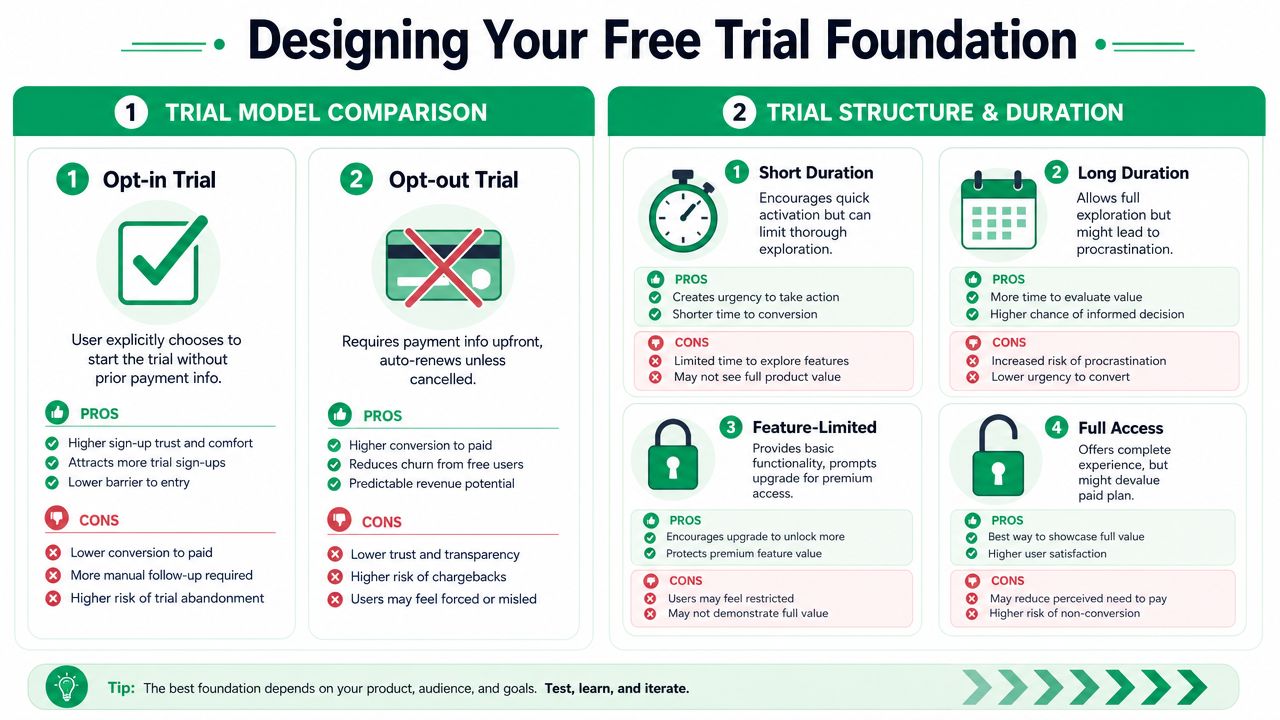
The first choice is whether users start with an opt-in trial that doesn't require a credit card, or an opt-out trial that does. These are not small UX variations. They are different funnel architectures.
According to SaaS free trial conversion benchmarks collected here, the global average trial-to-paid conversion rate is around 25%, but the model changes everything. Opt-out trials average 48.8% conversion, while opt-in trials average 18.2% conversion. The same source notes that 66% of SaaS vendors convert at 25% or less.
That doesn't automatically mean credit-card-upfront is better. It means it filters harder. If your product has clear purchase intent, short evaluation cycles, and pricing that buyers already understand, an opt-out model can qualify demand fast. If you need broad top-of-funnel learning, easier product sharing, or lower-friction adoption across teams, opt-in may still be the right call.
A practical comparison looks like this:
| Decision area | Opt-in trial | Opt-out trial |
|---|---|---|
| Signup friction | Lower | Higher |
| Lead quality | Broader, often noisier | Narrower, often stronger intent |
| Billing handoff risk | Lower compliance anxiety, more conversion work later | More pressure to set expectations clearly |
| Best fit | Product-led discovery | Intent-led qualification |
Practical rule: choose the model that matches your sales motion, not the model with the prettier headline conversion rate.
Set duration around time to value
Trial length gets treated like a branding choice. It isn't. It's a bet on how long users need to reach a value moment before procrastination beats momentum.
Research summarized in this field-experiment analysis of free trial duration found that longer trial periods increase trial adoption by 11.098% and delayed conversion by 42.36%, even though they don't significantly improve immediate conversion. The same analysis says a uniform 7-day policy can yield a 5.59% increase in subscriptions over a 30-day policy in some settings because shorter windows reduce delayed decision-making.
That sounds contradictory until you look at product complexity. More time helps users learn. More time also gives them room to defer. Both are true.
Use these criteria instead of copying another company's duration:
- Short trial fits when the product reaches value quickly, setup is light, and the primary job is obvious in one session.
- Longer trial fits when users need data imports, collaboration, integrations, or habit formation before value becomes visible.
- Feature-limited trial fits when your premium capabilities are expensive to serve or easy to abuse.
- Full-access trial fits when the upgrade decision depends on users experiencing the complete workflow, not a sandbox.
The cleanest method is simple. Measure the median time from signup to first real activation event. If users usually get there early, extra days often dilute urgency. If they need more time because the product naturally unfolds over days or weeks, shortening the clock will understate the product's value.
Engineering the Path to Activation
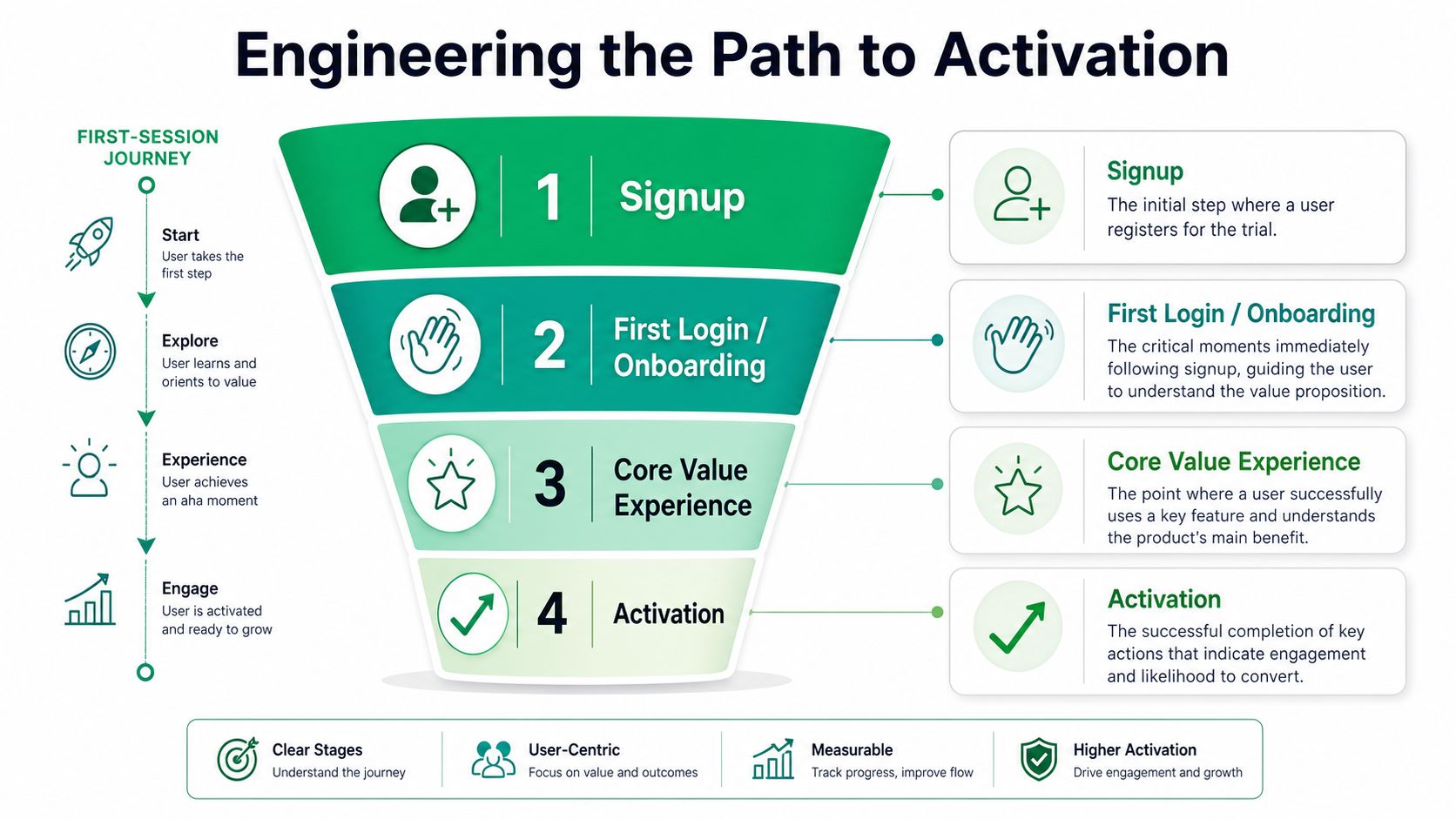
Most SaaS teams celebrate signup volume too early. A signup is just a record in your database. Activation is the moment a user experiences why the product matters.
Define activation before you design onboarding
If you can't describe activation in one sentence, your onboarding will drift into generic product tours.
For a CRM, activation might be importing contacts and sending the first sequence. For an analytics tool, it might be connecting one data source and viewing a live dashboard. For a support platform, it may be resolving the first ticket with automation turned on. The point is not feature exposure. The point is a completed workflow that proves usefulness.
This analysis of SaaS trial activation makes the hierarchy clear: activation is the strongest predictor of conversion. It also reports that AI-guided onboarding flows increased activation rates by up to 27% in product-led growth companies, while top-quartile companies achieve 65–75% activation rates versus a 52% median.
That's why the first session needs an explicit destination. Teams that convert well usually know three things:
- Time to first value. How quickly users reach the first meaningful outcome.
- Day 1 activation. Whether they got there during the session that matters most.
- Feature adoption depth. Whether they only touched the surface or completed the sticky behavior tied to retention.
Build the first session around progress
The onboarding flow should narrow choices, not multiply them. New users don't need a full map of the platform. They need the shortest path to a successful result.
A strong first-session structure usually includes:
- Role or goal selection so the app can tailor the next steps to the user's job.
- One visible checklist that turns setup into progress rather than exploration.
- Contextual nudges after inactivity, especially when someone stalls before the core action.
- Milestone feedback that confirms the user just did something valuable.
Don't open with a product tour. Open with the job the user came to finish.
I've seen teams bury value under “education.” They explain every module, every navigation label, every possible use case. Users leave informed but uncommitted. Better onboarding does less. It removes optionality until the user reaches the first proof point.
Use sticky actions, not vanity clicks
Not every interaction should count the same. Logging in, opening a template, or clicking through a modal isn't meaningful unless it contributes to the behavior that predicts conversion.
A useful pattern is to tag actions into three buckets:
| Bucket | What it means | What to do with it |
|---|---|---|
| Exploration | Light browsing and setup | Reduce friction |
| Value actions | Core workflow completion | Prioritize in onboarding |
| Retention actions | Repeat, collaborative, or integrated usage | Prompt after activation |
This becomes important later. The actions users complete, or ignore, during the trial should follow them into your lifecycle messaging. If someone activated through one path but never touched a second critical feature, that gap should shape your upgrade prompts and eventual save offers.
Measuring What Matters for Conversion
A free trial program gets distorted when the dashboard starts with signups and ends with conversion rate. Those are useful summary numbers, but they don't tell operators where the funnel is breaking.
Use the right denominator
The easiest way to fool yourself is to calculate conversion against the wrong cohort. Teams often divide paid conversions by installs, website accounts, or paywall views. That inflates or compresses performance depending on the product and traffic mix.
The denominator for trial-to-paid conversion is the cohort that started the trial. Anything else makes benchmarks meaningless, especially if you're comparing different acquisition paths or different trial models.
Another common mistake is mixing opt-in and opt-out results into one number. That hides the effect of signup friction and lead quality. Report them as separate funnels, then compare each against its own context.
A practical conversion readout should answer four questions:
- Who started the trial
- Who activated
- Who reached repeated product use
- Who became paying customers
If one team reports “conversion” from account creation and another reports it from trial start, the debate that follows is noise, not analysis.
Build a dashboard that explains behavior
Your dashboard should show the chain from acquisition quality to activation quality to paid outcomes. Not every metric needs executive visibility. But your growth, product, and lifecycle teams should be able to trace what changed and why.
I'd include these views:
- Activation by acquisition channel to see whether certain channels drive curious signups or serious evaluators.
- Time-to-value by segment to expose onboarding friction across roles, plans, or company sizes.
- Feature adoption depth by cohort so you can identify the behaviors most associated with conversion.
- PQL velocity to show how quickly trials turn into sales-worthy or upgrade-worthy accounts.
- Drop-off points in forms and onboarding to locate friction before users ever experience value.
For teams refining those behavioral views, a solid companion read is this guide to engagement metrics for subscription products.
Use cohorts to make decisions, not just reports
Cohort analysis matters because aggregate numbers lie. A new onboarding flow can improve activation for one segment while hurting another. A longer trial can attract more evaluators while introducing more indecision. A pricing-page tweak can increase starts from low-intent traffic and make the whole program look “bigger” while quality declines.
The question isn't whether a metric moved. The question is whether the change improved the behavior that predicts durable revenue. In practice, that means looking at trial cohorts by start date, acquisition source, plan, and activation pattern. When a cohort converts poorly, examine what they didn't do during the trial. That's usually where the next experiment comes from.
Integrating Billing and Automating Payment Recovery
The conversion event isn't the finish line. It's a handoff. If the move from trial to paid feels abrupt, confusing, or brittle, you'll lose revenue that the product already earned.
Make the handoff from trial to paid feel expected
The best billing transitions don't surprise anyone. Users know when the trial ends, what happens next, what they'll pay, and how to update billing without opening a support ticket.
That requires coordination between product, billing, and lifecycle messaging. Stripe or another billing system should remain the system of record for charges and subscription state. Your app should handle expectation-setting: in-app reminders before the end date, billing visibility inside account settings, and a clear path to confirm or update payment details.
A clean implementation usually includes:
- Pre-expiration notices inside the product, not just in email.
- Visible plan and billing terms on the upgrade path.
- A direct card-update flow when payment details change or expire.
- Post-conversion confirmation that explains what happened and what access the customer now has.
When teams skip this, support inherits avoidable tickets. Worse, users feel tricked even when the billing logic is technically correct.
Treat failed payments as a product flow
Involuntary churn isn't just a finance issue. It's an experience issue. When a card fails, the customer often still wants the product. They just need a coordinated path back to good standing.
That means building dunning as a sequence, not a one-off email. The sequence should combine retry timing from your billing platform with in-app notices, account-level alerts, and a simple payment update path. The tone matters. You're not collecting a debt. You're helping an active customer restore service with minimal interruption.
A useful operational checklist looks like this:
| Recovery element | Why it matters |
|---|---|
| Retry schedule | Gives temporary failures time to resolve |
| Email reminders | Reaches users outside the app |
| In-app notifications | Catches active users immediately |
| Card update page | Removes support dependency |
| Temporary gating when needed | Preserves leverage without abrupt lockout |
For teams handling issuer-related failures, this breakdown of why a card gets declined by the issuer is helpful context when shaping messaging and support playbooks.
Avoid duplicate billing logic
One of the fastest ways to create billing chaos is to spread subscription decisions across too many custom workflows. Let the billing platform own subscription truth. Build orchestration around it, not instead of it.
That means your app can trigger reminders, route users to update payment methods, and adjust access states gracefully. But plan changes, invoices, and payment records should stay consistent with the source system. Otherwise, you'll spend more time reconciling exceptions than recovering revenue.
Intercepting Cancellation Intent with Save Offers
A default cancel button is one of the laziest patterns in SaaS. It assumes every customer who tries to leave is making a final decision based on complete information. That isn't what usually happens.
Generic cancel buttons throw away context
The biggest gap in most free trial program advice is that it treats conversion and churn as separate systems. They aren't. Users bring trial expectations into the paid period. If those expectations were never met, cancellation is often just delayed trial failure.
This analysis of trial-to-churn disconnects makes that explicit. It reports that 68% of trial converts who churn within 30 days cite “product didn't solve my problem”, and that companies integrating trial behavior data into cancellation flows recover 22% more MRR than teams using generic save offers.
That should change how you design cancellation. When someone clicks cancel, the first job isn't to show a discount. It's to learn why they're leaving and combine that reason with what happened during the trial and early paid usage.
Route people by reason and trial behavior
A smart cancellation flow behaves like a routing engine.
If a customer says they never got value and their trial data shows they skipped the core setup step, send them to guided support or implementation help. If they activated fully but say the price is too high, a downgrade or pause may be more appropriate. If they barely used the product at all, a clean cancellation with feedback capture may be the right outcome.
One option in this category is Revcover, which connects with Stripe to capture churn reasons inside the product, apply routing rules by plan, usage, value, or billing state, and coordinate save paths without replacing billing as the source of truth.
A practical cancellation decision tree often includes:
- Price pressure. Offer downgrade, usage-based fit, or a pause.
- Missing value. Route to support, onboarding help, or a scoped extension.
- Temporary timing issue. Offer a pause rather than forcing full churn.
- Technical or billing friction. Resolve access or payment problems before processing cancellation.
- Clear misfit. Allow a fast, honest cancellation.
For teams trying to make sense of qualitative churn input at scale, this guide to customer feedback analysis is useful when turning freeform reasons into themes you can act on.
Here's a practical walkthrough of how modern cancellation experiences can be structured:
The cancellation flow should answer one question: what is the smallest intervention that solves the user's actual problem without trapping them?
That last part matters. Save flows should be clear and non-obstructive. If the customer is done, let them go. The goal is to recover good-fit revenue, not frustrate people into staying one more billing cycle.
Closing the Loop with Experiments and Win-Backs
The free trial program that performs best this quarter probably won't be the one that performs best next quarter. User intent changes. Acquisition mix changes. Product maturity changes. The system has to keep learning.
Run retention experiments with attribution
Teams often experiment on acquisition and onboarding, then stop being rigorous once billing and cancellation begin. That leaves a lot of money in the dark.
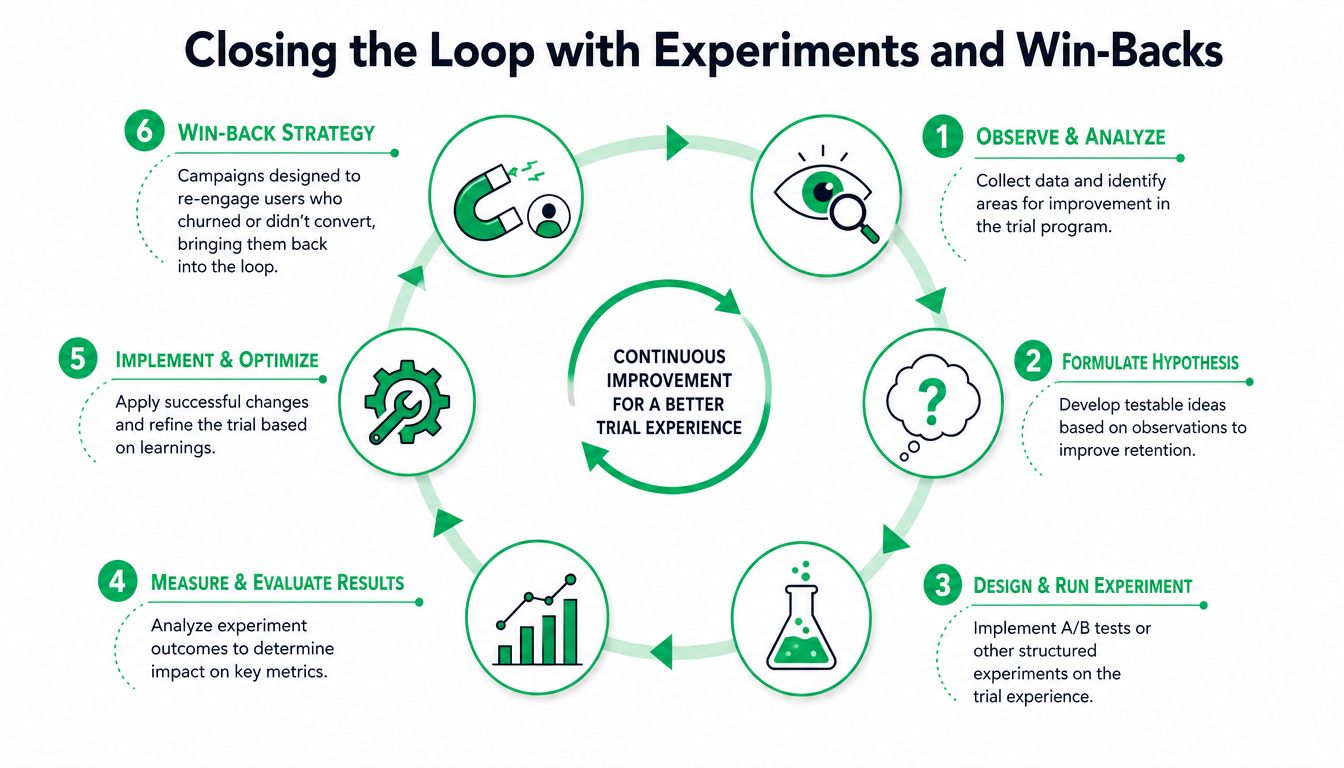
The better model is one loop. Trial behavior informs save paths. Save outcomes inform onboarding changes. Churn themes inform product fixes. Win-back performance informs which users were early-fit but badly timed versus mismatched.
That loop only works if you can attribute outcomes. Track which cancellation reason appeared, which save offer was shown, whether it was accepted, and what happened afterward. A pause accepted by lightly engaged accounts may outperform a discount offered to everyone. A support handoff might save high-value accounts that never finished setup. Without attribution, every offer looks plausible and none are provable.
A simple experiment backlog might include:
- Different save paths by churn reason
- Pause versus downgrade for seasonal customers
- Support intervention for under-activated accounts
- Timing of billing reminders for at-risk renewals
- Post-trial win-back copy based on ignored features
Use win-backs to recover missed value
Not every lost trial or canceled customer is gone for good. Some left because timing was off. Some hit a setup hurdle. Some never saw the one capability that would have made the product click.
According to this overview of free trial recovery tactics, successful programs use win-back campaigns and targeted outreach to recover 1–5% of free-trial cancellations, with personalization based on usage data playing a central role.
That means your win-backs shouldn't be generic “come back” emails. Segment them by what happened:
| Segment | Win-back angle |
|---|---|
| Inactive trials | Help completing the first setup step |
| Activated but not habitual | Reminder tied to the specific workflow they started |
| Power users who didn't convert | Sales outreach or a tailored plan conversation |
| Early churn after conversion | Save message tied to the value they expected but didn't reach |
Recovery gets easier when the message reflects the user's last real interaction with the product, not your marketing calendar.
The most valuable output of this loop isn't the campaign itself. It's the learning. If a specific ignored feature keeps appearing in churn feedback, that's not only a retention problem. It may be an onboarding problem, a packaging problem, or even a trial-qualification problem.
A platform like Revcover fits this operating model when you need to connect Stripe-based cancellation flows, payment recovery, save offers, and feedback analysis into one measurable system. The important part isn't adding another tool. It's building a single data loop from trial activation to churn recovery so growth, product, billing, and success teams act on the same customer story.