
8 SaaS Example of Playbook Models for 2026

Ayush Soni
Founder, Revcover
On this page
- 1. Reason-Based Routing & Intelligent Save Paths
- What works and what doesn't
- 2. Coordinated Failed-Payment Recovery & Smart Retry Logic
- Why sequence matters
- 4. Plan-Level Downgrade Funnels & Tiered Save Offers
- How to set the thresholds
- 4. Plan-Level Downgrade Funnels & Tiered Save Offers
- Put the options in the right order
- 6. Cohort Analysis & Attribution of Recovered MRR to Specific Offers
- 6. Cohort Analysis & Attribution of Recovered MRR to Specific Offers
- Make attribution operational
- 7. Multi-Channel Win-Back Orchestration & Lifecycle Nurture
- Keep the cadence disciplined
- 8. Qualitative Feedback Mining & Product-Driven Churn Prevention
- Treat feedback like an operating input
- 8-Point Retention Playbook Comparison
- Start Building Your Revenue Recovery Engine Today
Your cancellation button is probably doing exactly what it was designed to do, and that's the problem. It gives customers a clean exit, but it also hands you a missed save opportunity, a lost billing conversation, and a pile of unstructured feedback you can't act on fast enough. A strong example of playbook turns that moment into a controlled workflow, with rules for routing, escalation, and recovery that your team can repeat instead of improvising. That's the value here, not another generic template.
In SaaS, a playbook is more than a document. It's a structured guide that defines repeatable workflows, roles, tools, and best practices so teams can execute consistently, which is why playbooks work best when they behave like a control system rather than a static reference (dataplaybook on playbooks). That matters for retention because cancellation recovery, payment retries, and win-back outreach all depend on the same thing, a documented sequence that can be tested, measured, and improved. The fastest path to better revenue recovery is to use the right playbook at the right trigger, not to overload every customer with the same save offer.
1. Reason-Based Routing & Intelligent Save Paths
A cancellation flow becomes far more effective when it stops treating every account the same way. The strongest SaaS playbooks start by capturing the stated churn reason, then combining that signal with usage, billing state, plan type, and account value so the response matches the situation. Zendesk's customer-success guidance follows the same pattern, mapping the customer journey, segmenting by behavior and company size, then turning the most common responses into reusable scripts and templates (Zendesk customer success playbook).
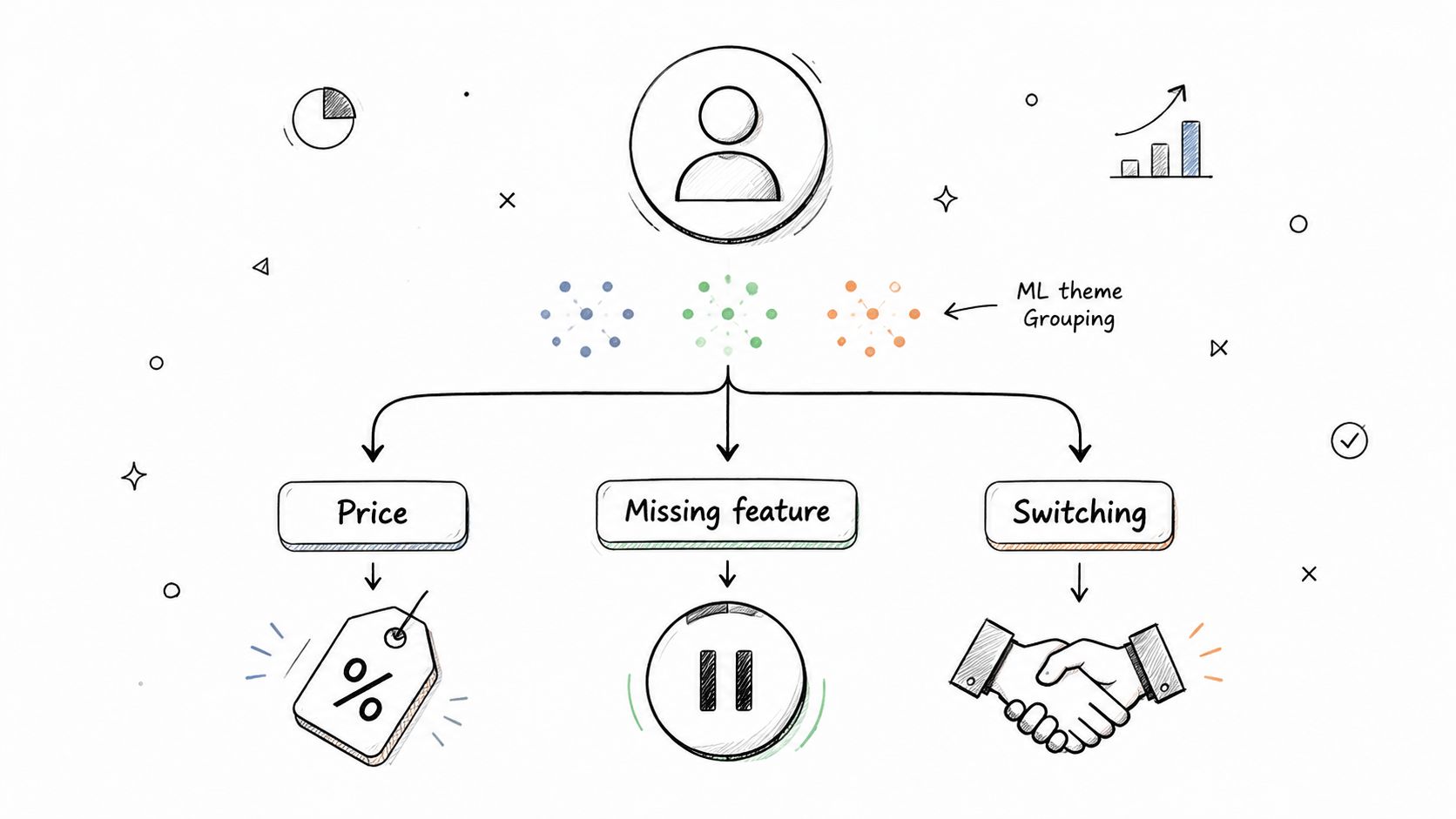
A useful example of playbook here is not “show discount to everyone.” It is a routing system. Price-sensitive users can be sent to a downgrade path, feature-driven churners can get a temporary pause or roadmap context, and competitor mentions can trigger a side-by-side comparison plus a fast sales or success handoff. For Revcover, that routing logic matters because cancellation intent, save offers, and payment-retry actions all need to follow a documented sequence that fits the user's state, and the dunning management guide shows how that sequence is usually structured in practice.
Practical rule: start with a small set of reason categories that match your real churn drivers, then add nuance only after you see signal.
The trade-off is straightforward. More branching improves fit, but it can also create messy operations if you add too many paths too soon. Start with three to five reasons, validate the stated reason against usage and NPS, and review the theme patterns with product every month so you can separate quick fixes from roadmap items. A playbook becomes useful when the routing logic is clear enough for a new team member to follow without tribal knowledge.
See how Revcover structures reason capture at cancellation.
What works and what doesn't
What works is a save path that matches the trigger. What doesn't work is a generic retention discount that ignores whether the customer is underused, confused, over-licensed, or evaluating a competitor. If your team wants measurable retention behavior, the routing rules have to be explicit, and the save options have to be tied to actual customer context.
- Use usage signals: Pair the stated reason with feature adoption, seat usage, and billing status before deciding the next action.
- Keep escalation visible: High-MRR cancellations should surface immediately in Slack so the right rep can respond before the user disappears.
- Review monthly: Product and support should see the top reason themes often enough to spot a fix, not just a save opportunity.
2. Coordinated Failed-Payment Recovery & Smart Retry Logic
Involuntary churn is usually a workflow problem, not a persuasion problem. The customer did not decide to leave, the payment failed, and the recovery system either handled the moment well or let it drift into silence. In practice, the best dunning playbooks combine polite reminders, timed retries, and light feature gating so the account can be saved without making the customer feel punished.
Stripe's payment events make this a natural automation point, because the failure can trigger the next step immediately instead of waiting for a manual review. That matters for SaaS billing records, where the recovery sequence has to stay clean and auditable while the retry logic runs in the background. A coordinated playbook can send an in-app notice, follow up by email, then retry at a chosen interval based on your customer base and billing model.
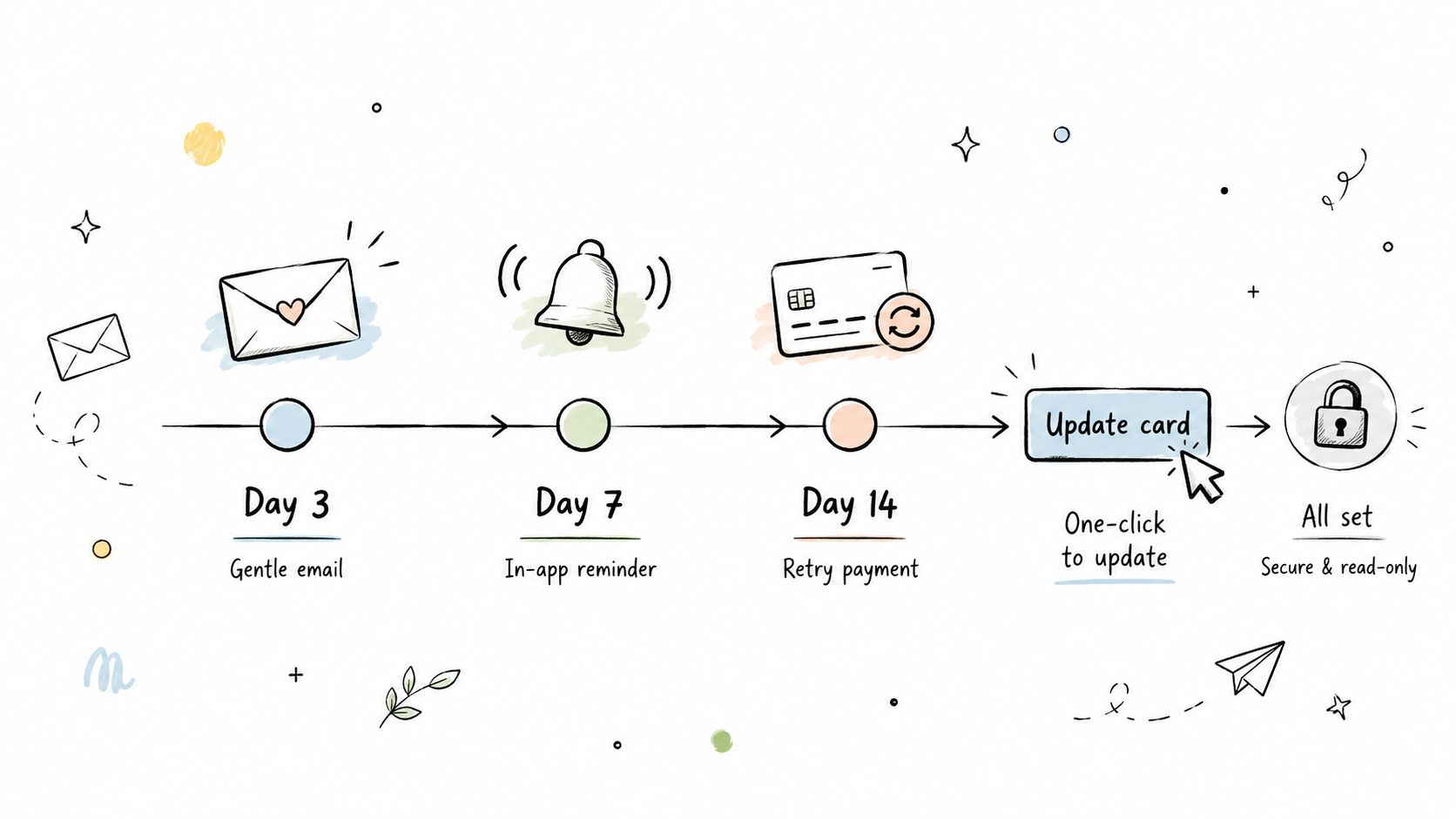
A solid example of playbook here is a B2B billing flow that waits longer between retries than a consumer subscription would, then escalates high-value accounts to personal outreach only if the automated sequence stalls. That follows the same orchestration logic used in incident-response playbooks, where the trigger, required actions, and end state are defined before the event happens (incident-response playbook guidance). The lesson carries over cleanly. Define the initiating condition, define the required steps, then define when the human handoff begins.
Clear messaging matters more than pressure. A direct line like, “We could not process your payment. Update your card here to stay subscribed,” does more for recovery than a guilt-heavy message.
The biggest mistake is retrying once and hoping for the best. A better approach is to coordinate the retry window with support visibility, billing-state logic, and a graceful feature gate if the issue persists. That gives you room to recover the payment without creating a support ticket storm.
Review Revcover's payment recovery approach.
Why sequence matters
If you gate too early, you frustrate customers who would have fixed the payment in minutes. If you gate too late, you let revenue leak while the account remains active in spirit but not in billing reality. The best sequence is calm, visible, and specific. It tells the customer what failed, what to do next, and what happens if nothing changes.
4. Plan-Level Downgrade Funnels & Tiered Save Offers
Some customers are ready to leave, but they do not need to disappear from the account history. A downgrade or pause playbook gives them a middle path, and that often protects the relationship while keeping some revenue in place. It is one of the most practical example of playbook models because it reflects a real SaaS pattern, many cancellations come from pricing pressure or lower usage, not a clean rejection of the product.
The strongest downgrade flows give customers honest choices. A team in a hiring freeze might pause billing for a month. A video platform user with extra storage might move to a lower tier. A design team that cut headcount might reduce seats automatically instead of being pushed into a full cancellation. Each option keeps the customer inside the system and preserves room for future expansion.
The rules need to exist before the customer reaches the cancel screen. If usage drops or seat counts fall below a defined threshold, the playbook can present a downgrade first, then a pause, then clean cancellation only if the customer still wants out. That mirrors the same required-step logic used in incident playbooks, where the workflow has to be explicit enough that each branch is predictable (incident-response playbook guidance).
Do not discount below contribution margin just to stop the cancel click. A bad save is still a bad deal.
The trade-off is margin versus retention. A discount may keep the logo and some monthly revenue, but it can also train customers to ask for a lower price whenever usage changes. A pause can preserve the relationship without giving away too much value, while a downgrade keeps the account active and creates a path back to expansion later. The right choice depends on how much revenue you can give up without turning a save into a longer-term loss.
That is where tiered offers help. Present the least expensive fix that still matches the customer's actual situation, then move upward only if the first option fails. A low-usage startup may only need a smaller package. A larger account with strong fit may respond better to a temporary pause or a seat reduction instead of a permanent contract reset.
The best teams make these offers measurable. Track how many customers accept a downgrade, how many later re-expand, and how much revenue stays inside the account after the save. For a deeper look at practical examples of this kind of structured offer design, see sales playbook examples and compare how routing and offer sequencing change the outcome.
A useful example of playbook is a churn-intent customer who first sees a lower-tier plan, then a short pause option, then a final cancellation path if neither offer fits. That sequence keeps the customer moving through a clear decision tree instead of forcing an all-or-nothing choice at the first click.
How to set the thresholds
The threshold logic should reflect product usage, account value, and margin, not a blanket rule. If the account is barely active, a downgrade may be the only sensible save path. If the account still shows strong usage or expansion potential, a pause or targeted discount can make more sense than a permanent tier change. The point is to match the offer to the account state, not to give the same concession to everyone.
- Define the trigger: Seat drops, usage decline, or payment risk can all start the downgrade flow.
- Match the offer to the account: Low-usage, price-sensitive customers usually need a simpler option than strategic accounts.
- Measure the trade-off: Track retained revenue, later expansion, and margin impact, not just save rate.
Use Revcover's value-based segmentation approach when you want downgrade routing to reflect account value instead of treating every cancellation the same.
4. Plan-Level Downgrade Funnels & Tiered Save Offers
Some customers do want out, but they don't need to disappear. A downgrade or pause playbook gives them a middle path, and that often preserves the relationship while keeping revenue partially intact. This is one of the most practical example of playbook models because it acknowledges a real SaaS truth, many cancellations are really pricing or capacity mismatches, not outright rejection.
The strongest downgrade flows present a menu of honest options. A team in a hiring freeze might pause billing for a month. A video platform user with excess storage might move from a premium tier to a lower one. A design team that cut headcount might reduce seats automatically instead of forcing a full cancel. Each path keeps the customer inside the system and makes future expansion possible.
The key is to define the rules before the user reaches the cancel screen. If declining usage or a seat drop crosses a threshold, the playbook can offer a downgrade first, then a pause, then clean cancellation as a last resort. That is the same “required versus optional action” thinking used in incident playbooks, where the workflow must be explicit enough for the next step to be predictable (incident-response playbook guidance).
Don't discount below contribution margin just to stop the cancel click. A bad save is still a bad deal.
The trade-off is margin versus retention. A discount may look attractive in the moment, but a structured downgrade can preserve healthier long-term value if the customer needs a smaller plan. RevOps has to stay disciplined, because the playbook should protect future upsell potential, not just mask short-term churn.
Put the options in the right order
The order of save options matters. Some teams convert better when they show pause first, others when they start with downgrade. The only reliable answer is to test it by cohort and let the behavior tell you which path creates the best balance of save rate and future expansion.
6. Cohort Analysis & Attribution of Recovered MRR to Specific Offers
Retention teams like to say they saved revenue. Finance and leadership want to know which offer did the work. That is why attribution belongs inside the playbook itself. A useful example of playbook does not stop at “the user stayed,” it records the offer type, the segment, the timestamp, and the billing result so you can see what produced the recovery.
Cohort testing is the practical way to separate signal from noise. The play should be tied to a specific gap and a specific conversion outcome, not to vague guidance about what might work. In a retention setting, that means comparing a clean cancellation baseline with the save path you introduced, then assigning the incremental result to the intervention instead of to normal customer behavior.
The value is better decision-making on the next offer. If a pause outperforms a discount in one segment, route that segment to pause first. If a downgrade creates better later expansion than a discount, protect the relationship instead of giving away margin too early. The goal is not the highest immediate save rate, it is the intervention that produces the best recovered value over time.
Track the offer, not just the outcome. Without offer-level tags, you are guessing which save motion created the result.
This also changes how product and marketing use the data. Product can see which churn reasons respond to a pause, a downgrade, or a credit. Marketing can compare whether a reactivation incentive works better by cohort or by channel, then adjust messaging around the motions that recover MRR. Analysts need that level of detail because a save that looks good in aggregate can hide weak economics in a specific segment.
The cleanest setup tags each offer at the moment it is shown, then ties that tag to the final billing state and later account behavior. That gives RevOps a record of what was offered, who saw it, and what happened after the decision. It also makes it easier to retire weak offers and keep the ones that recover revenue without creating unnecessary discount dependency.
6. Cohort Analysis & Attribution of Recovered MRR to Specific Offers
Retention teams love saying they “saved revenue.” Finance and leadership usually want to know which offer saved it. That's why attribution belongs inside the playbook itself. A useful example of playbook does not stop at “the user stayed,” it records the offer type, the segment, the timestamp, and the resulting billing outcome so you can tell what worked.
Cohort testing becomes essential. SalesMotion's guidance on playbooks is useful here because the play should be tied to a specific gap and a specific conversion outcome, not to vague advice (sales playbook examples). In a retention context, that means you compare a clean cancellation baseline with the save path you introduced, then attribute the incremental result to the intervention instead of to natural behavior.
The practical payoff is better prioritization. If a pause beats a discount for one segment, route that segment to pause first. If a downgrade leads to better later expansion than a discount, preserve the relationship instead of burning margin. The point isn't to chase the highest immediate save rate, it's to choose the intervention that creates the best recovered value over time.
Track the offer, not just the outcome. Without offer-level tags, you're guessing which save motion created the result.
This also changes how product and marketing work. Product can see which churn reasons keep showing up. Marketing can shape the reactivation message around the best-performing save path. RevOps gets the cleanest view of what's pulling revenue back into the system.
Make attribution operational
Every save session should carry a consistent metadata trail in Stripe or your billing stack. If you don't tag the offer and the segment at the moment of action, you lose the ability to compare cohorts later. Once the data is there, the playbook can be improved like any other measurable system.
7. Multi-Channel Win-Back Orchestration & Lifecycle Nurture
Single-channel win-back is usually too thin for a serious retention motion. A stronger playbook uses email, SMS, retargeting, and selective sales follow-up as part of a planned sequence that unfolds over weeks, not hours. The point is to stay present without spamming, and to match the channel to the customer's value and engagement level.
The rhythm matters. Early email can reopen the conversation. SMS can work for high-value accounts that are likely to notice it. Retargeting ads can reinforce the message without requiring a direct reply. Sales outreach should be reserved for accounts where the likely upside justifies the human cost. That layered approach is closer to a lifecycle system than a one-off campaign.
A useful example of playbook is a high-value SaaS churn cohort that gets email first, then a targeted text for the accounts most worth recovering, then ads that reinforce the reason to return, and finally a human call only when the account merits it. That keeps the reach broad without making the experience feel random.
Keep the cadence disciplined
Without cadence rules, multi-channel outreach turns into fatigue. Set frequency caps, respect opt-outs, and avoid blasting every channel at once. Email, SMS, and ads should feel coordinated, not desperate.
- Start with email: Prove message-market fit before layering more expensive channels.
- Add SMS selectively: Reserve it for accounts where the channel is likely to be seen and valued.
- Use ads with intent: Retargeting should reinforce a known message, not replace one.
The best lifecycle nurture programs also measure payback, not just reactivation. If a channel produces weak returns, it should be narrowed or removed. Multi-channel only works when the sequence is deliberate.
8. Qualitative Feedback Mining & Product-Driven Churn Prevention
The best churn playbook doesn't just save accounts, it prevents the same loss from happening again. That starts with mining the freeform cancellation text customers leave behind, then clustering it into themes product, marketing, and support can use. Guru's playbook guidance points in this direction too, emphasizing documented process, user feedback, and ongoing updates rather than static scripts (playbook reference).
A practical system routes feedback by theme. Feature requests go to product, competitor mentions go to marketing, and UX or education issues go to support or customer success. The important part is attaching revenue context to each theme so the team knows whether it's a nuisance or a meaningful source of churn. If you don't connect the words to the account value, you're just collecting comments.
One strong example of playbook is a company that sees the same setup complaint appear repeatedly, then uses that feedback to improve onboarding before the churn pattern spreads. Another is a product team that notices competitor mentions rising and responds by tightening differentiation in both roadmap and messaging. In both cases, the playbook turns commentary into action instead of letting it sit in a spreadsheet.
Treat feedback like an operating input
The feedback loop has to run on a schedule. Weekly or monthly clustering is enough for many teams, but the important thing is consistency. If the same churn theme shows up over and over, the playbook should force an owner, a response, and a review date.
If customers are repeating the same reason, the product is handing you a roadmap signal, not just a cancellation note.
The playbook stops being a save script and becomes a company system. Product gets better prioritization. Support gets sharper education. Marketing gets better positioning. RevOps gets a clearer picture of what's preventable and what isn't.
8-Point Retention Playbook Comparison
| Playbook | Implementation complexity | Resource requirements | Expected outcomes | Ideal use cases | Key advantages |
|---|---|---|---|---|---|
| Reason-Based Routing & Intelligent Save Paths | Medium | Stripe + NLP clustering, routing rules, CS/product collaboration | Higher recovery when offers match reasons; clearer product gaps; improved CSAT | Voluntary churn where customers provide reasons; mixed-plan portfolios | Personalized, context-aware offers; feedback loop to product; fewer generic saves |
| Coordinated Failed-Payment Recovery & Smart Retry Logic | Medium–High | Stripe webhooks, retry scheduler, email + in‑app messaging, billing logic | Recovers ~15–25% of failed payments; fewer involuntary churns | Involuntary churn from payment failures; subscription billing businesses | Smooth card-update flow; smart timing; graceful feature gating to preserve relationships |
| Segmented Win‑Back & Reactivation Campaigns | Medium | API connections to email/ads/CRM, cohort tracking, marketing ops | Lower CAC reactivations; reason-specific uplift (often 40–60% vs generic) | Recently churned or early-post churn cohorts; value-segmented campaigns | Cost-effective reactivation by segment; measurable ROI and attribution |
| Plan‑Level Downgrade Funnels & Tiered Save Offers | Medium | Stripe subscription API, pricing rules, UX design, CS oversight | Retains 30–50% as lower-tier revenue; many later upgrade (months) | Price-sensitive or low-usage accounts; customers needing temporary relief | Preserves customer relationship and partial MRR; pause/downgrade flexibility |
| Real‑Time Churn Alert Routing & Escalation Workflows | Low–Medium | Slack/notification integration, alert rules, available sales/CS reps | Faster response for high-value churn; higher save rates for prioritized accounts | High-MRR, long-tenure, or competitive-threat cancellations | Immediate, contextual alerts; SLA tracking; focuses effort on high-leverage saves |
| Cohort Analysis & Attribution of Recovered MRR to Specific Offers | High | Clean data pipeline, Stripe tagging, SQL/analytics, experimentation capability | Accurate attributed recovered MRR; optimized offer mix and spend efficiency | Data-driven teams optimizing retention spend and offer ROI | Proves causal impact of offers; guides prioritization and budget with metrics |
| Multi‑Channel Win‑Back Orchestration & Lifecycle Nurture | High | Integrations with email, SMS, ad platforms, compliance, marketing operations | Higher multi-touch reactivation rates vs single channel; channel ROI visibility | High-value cohorts needing sustained multi-touch re-engagement | Orchestrated journey across channels; balances reach with fatigue control |
| Qualitative Feedback Mining & Product‑Driven Churn Prevention | Medium–High | NLP/text analytics, data pipeline, product & support coordination | Identifies fixable churn drivers with MRR context; reduces preventable churn | Organizations prioritizing product improvements to stop churn | Surfaces high-impact product gaps tied to revenue; enables closed-loop fixes |
Start Building Your Revenue Recovery Engine Today
These playbook examples work because they turn cancellation, payment failure, and churn feedback into repeatable operating logic. That's the shift. Instead of reacting to lost customers after the fact, your team gets a structured way to route intent, escalate the right cases, recover revenue, and learn from every outcome. The strongest SaaS teams don't rely on a single save offer or a generic cancel page, they build systems that keep improving because the workflow is documented and measured.
The pattern is consistent across all eight models. Capture the trigger. Decide the route. Assign ownership. Measure the outcome. Then revise the playbook based on what the data and feedback show. That's how a cancellation flow becomes a retention engine, and how a billing problem becomes a product signal.
If you're a RevOps, growth, or customer success leader trying to reduce churn without adding chaos, start with one playbook and make it measurable. A reason-based cancel flow or a smart payment recovery sequence is enough to prove the model, and once the routing logic is working, the rest of the system gets easier to expand.
Revcover helps SaaS teams intercept cancellation intent, recover failed payments, and attribute outcomes to recovered MRR inside a Stripe-connected workflow. If you want a practical way to turn these playbook ideas into a live retention system, visit Revcover and see how the routing, save offers, and recovery reporting fit together.