
10 SaaS Customer Retention Strategies That Work in 2026

Ayush Soni
Founder, Revcover
On this page
- 1. Cancellation Flow Optimization with Churn Reason Capture
- Keep the survey short and tied to action
- 2. Intelligent Routing and Save-Path Orchestration
- Build a routing tree before you build more offers
- 3. Failed Payment Recovery and Smart Retry Logic
- Treat dunning like an instrumented recovery flow
- 4. Customer Insights Dashboard with Feedback Clustering and Segmentation
- Prioritize by revenue impact, not complaint volume
- 5. Discount and Offer Experimentation with Revenue Attribution
- Judge offers on retained revenue, not clicks on "accept"
- 6. Proactive At-Risk Account Identification and Outreach
- 7. Win-Back Campaigns and Segmented Reactivation Workflows
- Segment by why they left, not just when
- 8. Customer Success Onboarding and Value Realization Programs
- Define value milestones by segment
- 9. Transparent Pricing Models and Flexible Plan Options
- Good pricing creates a downgrade path
- 10. Community Building and User Advocacy Programs
- Top 10 Customer Retention Strategies Comparison
- From Strategy to System: Your Next Move
Beyond "Customer Love": Building a Retention Machine
It can cost five to 25 times more to acquire a new customer than to retain an existing one. For subscription SaaS, that isn't a soft brand lesson. It's a margin lesson, a systems lesson, and usually a product lesson too. Teams that treat retention as a vague customer success goal miss the bigger point. Retention is one of the clearest places where product instrumentation, billing operations, and lifecycle messaging need to work together.
The software sector specifically sits at a 77% average customer retention rate. That's a useful benchmark, but it doesn't tell you why users stay, why they leave, or which intervention recovered revenue. In practice, the best customer retention strategies for SaaS are measurable. They capture intent, route users by context, recover failed payments, and feed clean data back into product and growth decisions.
That's the shift that matters. Stop treating churn as a single event at the end of the lifecycle. Treat it like a stream of signals you can instrument, segment, and act on.
1. Cancellation Flow Optimization with Churn Reason Capture
Most cancel pages are dead ends. A user clicks cancel, confirms, and disappears. That's a waste of the most valuable retention moment you have.
A better flow intercepts cancellation intent inside the product and asks one short question about why the user is leaving. If you collect that reason at the exact moment of intent, you stop guessing. Product sees missing features. Success sees onboarding friction. Marketing sees positioning gaps. Support sees recurring trust issues.
Keep the survey short and tied to action
Use one required field and, at most, one optional follow-up field. Anything longer feels like stalling, and users will abandon it or give low-quality answers.
- Ask for a primary reason: Use options like too expensive, missing feature, low usage, switching to another tool, temporary pause, or support issue.
- Keep an escape hatch: Always include "other" or "prefer not to say" so the flow doesn't feel coercive.
- Map every reason to an owner: Missing feature goes to product. Setup difficulty goes to onboarding. Price objection goes to packaging or save offers.
Practical rule: If your cancellation survey creates friction but doesn't change what happens next, it's just decoration.
Many teams fail here. They collect churn reasons in a spreadsheet or form, then nobody acts on them. Review themes weekly. Search free-text responses for competitor names, pricing objections, and repeated feature requests. Then turn those themes into experiments, not slide decks.
2. Intelligent Routing and Save-Path Orchestration
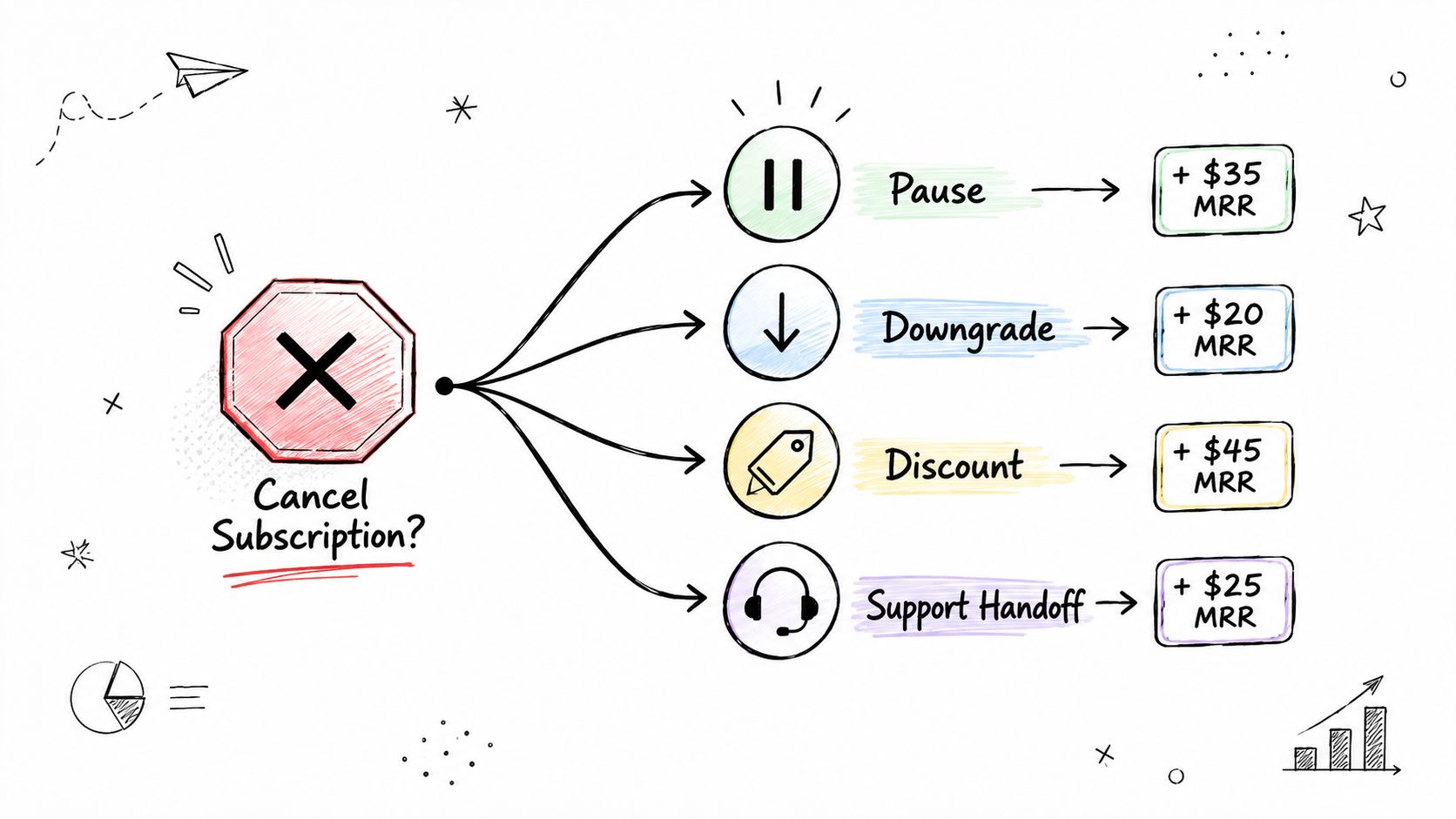
A single cancellation path for every user is lazy design. A trial user with no activation, a long-term customer on a mid-tier plan, and a high-value account with recent billing issues shouldn't all see the same page.
Context-aware routing performs better than static flows. Zendesk notes that SaaS companies using personalized save paths saw a 15% to 20% higher retention rate than teams using static cancellation flows. That makes intuitive sense. The right intervention depends on who the customer is and what problem they're trying to solve.
Build a routing tree before you build more offers
Start with a few variables your team already trusts. Plan type, recent usage, stated cancellation reason, and billing state are enough to make better decisions than a generic flow.
For example, a user who says the product is too expensive may need a downgrade option. A customer with strong usage but a support complaint may need a handoff to customer success. A user with low usage during trial may need onboarding help, not a discount.
- Route by account value: High-value accounts often deserve a human conversation.
- Route by intent: Downgrade intent should lead to a lower plan, not a binary stay-or-leave choice.
- Preserve a clean exit: Some customers should cancel quickly and without friction.
Good orchestration doesn't mean trapping people. It means matching the offer to the problem. The best customer retention strategies increase saves without making the product feel hostile.
3. Failed Payment Recovery and Smart Retry Logic
Failed payments drive a meaningful share of subscription churn, and the root cause usually has nothing to do with product fit. Expired cards, issuer declines, insufficient funds, and authentication failures can cancel an account that still wants the service.
That makes payment recovery a retention system, not just a billing task.
Treat dunning like an instrumented recovery flow
Strong teams build this flow the same way they build onboarding or cancellation prevention. They map failure types, define retry rules by decline reason, trigger reminders across the right channels, and remove friction from the card-update path. Every step should be measurable: recovery rate, time to recovery, recovered MRR, involuntary churn rate, and the share of failures caused by hard declines versus soft declines.
Retry logic should match the failure. A soft decline may justify another attempt after a short delay. A hard decline usually needs a card update, not repeated charges. If your team is seeing issuer declines, start by reviewing common failure patterns and recovery options in this guide to customer feedback analysis and this guide to issuer decline handling in subscription billing.
The trade-off is operational, and it shows up fast. Retry too aggressively and you create support tickets, customer distrust, and a higher chance of triggering fraud controls. Retry too slowly and good accounts slip into churn because no one created a fast path back to a successful charge.
A better setup keeps the experience proportional to the risk. Maintain access during the first recovery window when the account has a strong payment history. Escalate messaging when retries fail. Gate non-critical features before full suspension if you need pressure without creating unnecessary resentment. Most of all, send users straight to an update-payment action instead of making them hunt through billing settings while their account is in limbo.
The teams that recover the most revenue do one more thing well. They feed failed-payment outcomes back into the retention system. Decline reason, retry result, card update completion, and final account status should all flow into reporting so billing, product, and customer success can see where revenue is leaking and which fixes reduce churn.
4. Customer Insights Dashboard with Feedback Clustering and Segmentation
Raw feedback is noisy. One person says "too expensive." Another says "can't justify it." Another says "budget freeze." If your team reads those as separate issues, your prioritization will drift.
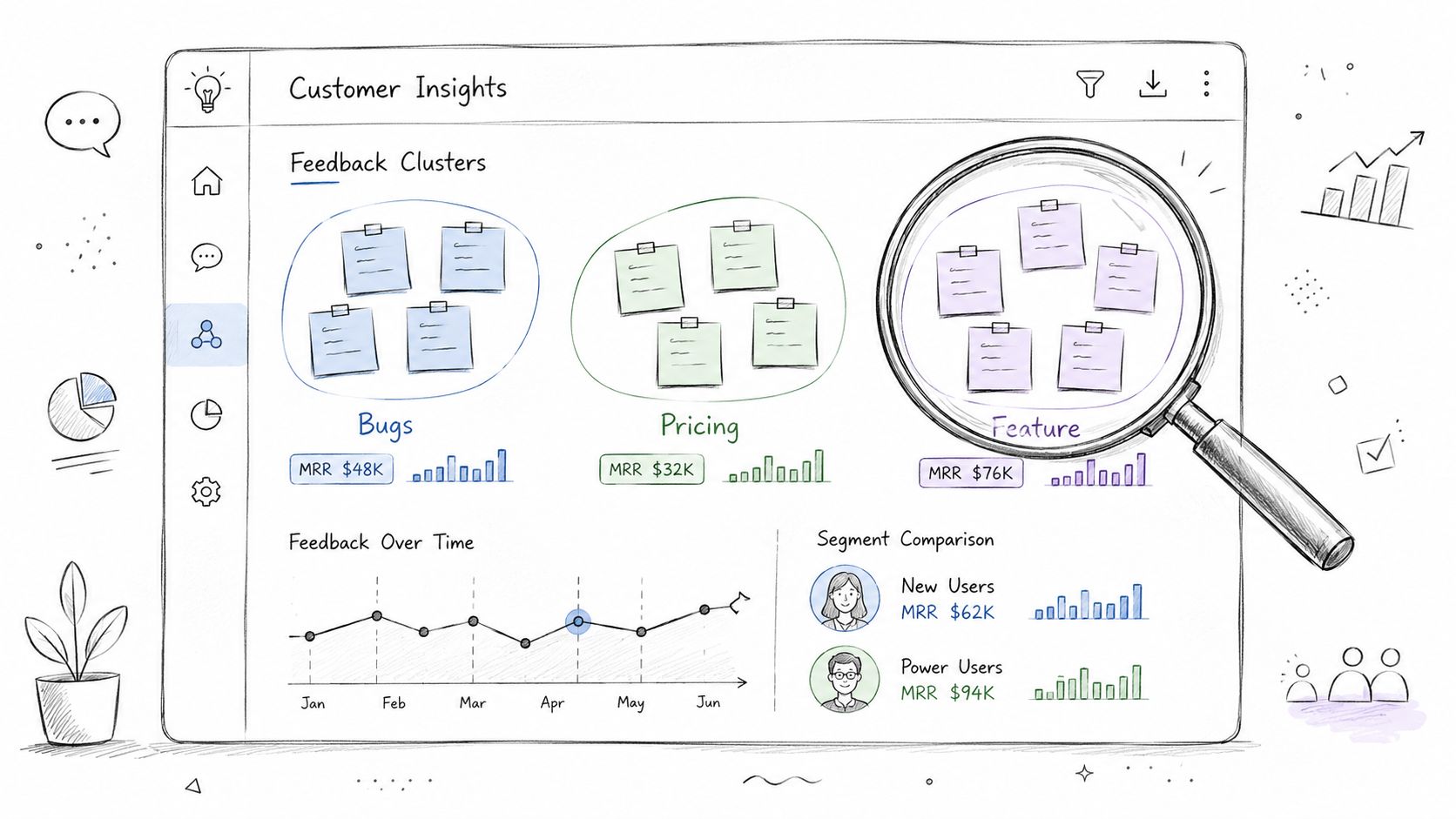
An insights dashboard should cluster freeform feedback from cancellations, support tickets, renewal calls, and low-usage accounts into themes. Then it should layer account context on top. Not every complaint matters equally. A repeated issue tied to valuable accounts deserves attention faster than a long tail of minor annoyances.
A strong workflow starts with customer feedback analysis that groups open-text responses into usable patterns.
Prioritize by revenue impact, not complaint volume
Retention becomes an engineering and ops discipline. Cluster the feedback, segment it by plan and lifecycle stage, and connect it to revenue exposure.
- Tag by business context: Plan, tenure, account owner, billing state, and recent product usage all matter.
- Spot competitor mentions: They often reveal missing capabilities or positioning weaknesses.
- Review themes weekly: If churn feedback sits in a monthly report, nobody acts fast enough.
A short walkthrough can help teams visualize what a feedback loop should look like in practice.
When teams do this well, product meetings change. Instead of debating the loudest anecdote, they can discuss which theme is attached to the most risk and what experiment should reduce it.
5. Discount and Offer Experimentation with Revenue Attribution
A saved cancellation can still be a bad retention outcome. If the customer accepts a discount, churns 30 days later, and leaves with lower realized revenue, the offer did not work. It only delayed the loss.
That is why discount testing in subscription SaaS needs the same discipline as product experimentation. Track the save event, then track what happens after it: rebill success, active status after one or two billing cycles, expansion or downgrade behavior, and support load. Teams that skip that instrumentation usually overvalue acceptance rate and miss the margin cost.
If your team still reports offer performance based only on conversions in the cancellation flow, build a revenue attribution model for subscription retention experiments before expanding the program.
Judge offers on retained revenue, not clicks on "accept"
The useful comparison is incremental retained revenue against a control group, adjusted for discount cost and downstream churn. In practice, that means asking a harder set of questions:
- Would this account have stayed anyway? Some customers accept an offer they never needed.
- How long did the save hold? A 90-day retention window is often more honest than same-session acceptance.
- What margin did you give up? A save with a steep discount can underperform a lower-cost downgrade or pause.
- Did the offer create repeat behavior? Customers learn fast if the best time to negotiate is at cancellation.
Segmentation matters here because response patterns vary by account type. Self-serve monthly users often react to price and flexibility. Larger accounts may respond better to plan restructuring, term changes, or a human conversation tied to adoption and procurement constraints.
A few rules hold up under real usage:
- Test one variable per experiment: Change the discount, the pause length, or the message. Do not change all three at once.
- Include non-discount saves: Downgrades, temporary pauses, annual conversions, and support escalation often preserve more revenue.
- Set a clear holdout group: Without one, teams tend to credit the offer for saves that would have happened anyway.
- Review by cohort after the save: Measure retained MRR, renewal behavior, and churn recurrence by segment.
Retained customers often have more long-term value than newly acquired ones, as noted earlier. That does not justify aggressive discounting across the board. The job is to protect revenue efficiently, not to approve every save at any price.
The strongest programs connect cancellation flow logic, billing outcomes, and feedback into one system. If a specific churn reason converts best with a pause, use that. If failed-payment accounts recover without a concession, do not offer one. If discount takers show weak retention after the next invoice, cut the offer and reroute the segment. That is how retention becomes measurable, repeatable, and worth scaling.
6. Proactive At-Risk Account Identification and Outreach
A large share of SaaS churn is visible before the cancellation event. The practical advantage is simple. Teams that score risk early can intervene while there is still product behavior, billing context, and account history to work with.
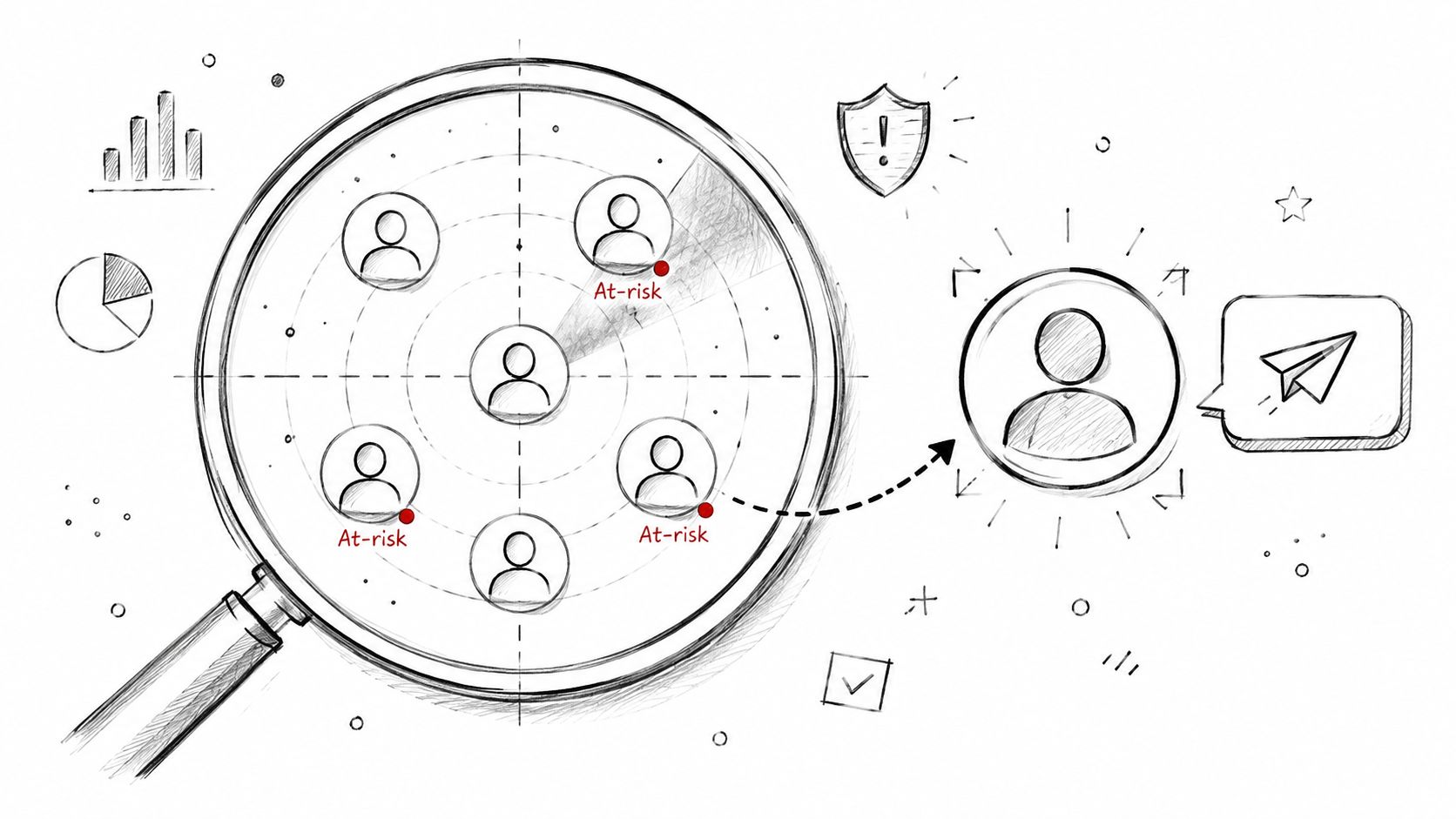
At-risk detection should be treated as instrumentation, not intuition. Start with signals your team can explain and your systems can capture reliably: login decline, stalled feature adoption, seat contraction, unresolved support tickets, NPS drops, invoice failures, and renewal inactivity. Gainsight outlines this pattern in its overview of customer health scoring, where behavioral and relationship signals are combined to flag accounts that need attention.
A simple model beats a complex one nobody trusts.
In practice, I start with an account score built from a small set of weighted inputs. Product usage usually carries the most weight. Support friction, payment failures, and negative feedback refine the picture. The point is not to predict churn with academic precision. The point is to route the right account to the right playbook early enough to change the outcome.
The outreach has to match the trigger. An admin who stopped using a core workflow needs a use-case intervention. An account with repeated failed payments needs billing recovery, not a success call. A team with rising ticket volume and flat adoption may need implementation help, training, or a plan reset.
That is why the risk layer should sit inside the same retention system as cancellation reasons, dunning events, and feedback clustering. If those signals live in separate tools, teams send generic check-ins and call it proactive outreach. If they are unified, outreach becomes operational. Trigger, route, action, result.
One warning matters here. Alert volume can get out of hand fast. If every dip in activity creates a task, customer success teams stop trusting the queue. Set thresholds, suppress duplicate alerts, and measure whether flagged accounts churn at a higher rate than the baseline. If they do not, adjust the model before adding more automation.
7. Win-Back Campaigns and Segmented Reactivation Workflows
Not every churned customer is gone for good. Some left because timing was wrong. Some hit a budget constraint. Some needed a feature you didn't have then but do have now.
Win-back campaigns work best when you treat former customers like known users with known history, not cold leads. The message should reflect why they left, what changed, and what next step makes sense.
Segment by why they left, not just when
A pricing-sensitive former customer should get different messaging than an account that churned because onboarding failed. If someone cited missing functionality, lead with product updates or a new use case. If they paused for seasonal reasons, time the outreach around their active period.
This is also where restraint matters. Some accounts shouldn't be pushed back into the funnel quickly, especially if they had a poor support experience or were a poor fit from the start.
A few practical patterns help:
- Start with high-value former accounts: They justify more personalized outreach.
- Use the original churn reason: That context makes reactivation messages feel relevant, not automated.
- Separate reactivated cohorts: Measure them independently so you know whether win-backs stick.
The mistake I see most often is sending one generic "come back" campaign to every churned user. That treats churn like a list hygiene problem instead of a diagnosis problem.
8. Customer Success Onboarding and Value Realization Programs
A large share of SaaS churn is decided in the first few weeks. Customers do not stay because onboarding felt busy. They stay because they reached a clear, measurable outcome fast enough to justify renewal.
For subscription SaaS, onboarding should be instrumented like a product system. Track time-to-first-value, activation rate by segment, milestone completion, and 30, 60, and 90-day retention by onboarding path. If a step does not improve downstream retention or expansion, cut it or redesign it.
Define value milestones by segment
Different account types reach value in different ways. A self-serve team may need product tours, lifecycle email, and in-app prompts that push them to one useful action. A larger account usually needs implementation support, role-based training, and a success plan tied to the use case sold in the deal.
The milestone map should reflect that reality.
- Name the first wins: Import data, connect an integration, invite teammates, publish a report, or launch a workflow.
- Assign milestones by role: Admins need setup confidence, end users need task completion, and economic buyers need evidence that adoption is producing the expected outcome.
- Trigger outreach at risk points: No data imported, no second login, or no shared artifact after setup are better intervention signals than waiting for a complaint.
- Measure milestones against retention: Keep the steps that correlate with renewal. Remove the ones that only make the checklist look complete.
I have seen teams overload onboarding with webinars, check-ins, and training modules because they look thorough. That creates activity, not value realization. The better approach is narrower and harder. Identify the two or three product events that predict retention, then build onboarding around getting customers to those events with as little friction as possible.
This section matters because it connects directly to the rest of the retention system. Weak onboarding increases cancellation volume later, creates support-heavy accounts, and pollutes churn feedback with avoidable complaints about setup or adoption. Strong onboarding gives payment recovery, save flows, and customer success outreach a much better starting point because the customer has already seen real value.
9. Transparent Pricing Models and Flexible Plan Options
Pricing friction causes churn long before a customer clicks cancel. In subscription SaaS, that friction usually shows up as surprise overages, unclear upgrade triggers, or no acceptable option between full price and zero.
Teams often treat packaging as a positioning problem. Retention teams should treat it as a measurable system. Every downgrade, pause, seat reduction, overage dispute, and cancel-after-renewal request should feed back into pricing design. If customers repeatedly ask support how billing works, the issue is rarely education alone. The plan structure is creating avoidable uncertainty.
Stripe is a useful reference point because the pricing logic is clear and the billing mechanics are easy to understand. Notion also does this well. Users can tell who each plan is for, what changes at each tier, and what happens when usage grows.
Good pricing creates a downgrade path
A retention-focused model gives customers a controlled step down instead of forcing an all-or-nothing decision. That can mean monthly and annual options, a lighter usage tier, a temporary pause, or feature-based downgrades that preserve account history and make reactivation easy.
This needs instrumentation, not guesswork.
Track which accounts downgrade and later expand again. Measure whether paused accounts reactivate at a higher rate than fully canceled accounts. Review support tickets tied to billing confusion, feature gating, seat limits, and unexpected invoices. Those signals belong in the same retention system as cancellation flow data and failed payment recovery, because they point to revenue that can be saved through better packaging rather than better persuasion.
A few rules hold up in practice:
- Limit plan sprawl: Too many packages increase hesitation and push customers into support just to compare options.
- Show feature differences clearly: Buyers should understand what they keep, lose, and pay for at each tier.
- Add a real downshift option: Pause, seat reduction, or usage-based contraction often preserves more revenue than a hard cancel.
- Set billing expectations early: Renewal timing, overages, user limits, and annual commitment terms should be obvious before checkout and inside the account.
There is a trade-off here. More flexibility can protect retention, but it can also create packaging complexity, revenue leakage, and heavier billing operations. The right answer is not maximum choice. It is the smallest set of plan paths that reduces involuntary exits, captures customers who need less, and keeps billing understandable.
If a customer says, "I only need less," the product and billing system should support that request without sending them to cancellation.
10. Community Building and User Advocacy Programs
Community programs matter because retained SaaS revenue rarely comes from product access alone. Accounts stay longer when users build habits, share operating knowledge, and see professional value in staying connected to your ecosystem.
The useful version of community is tied to observable product behavior. It shows up in onboarding cohorts, admin roundtables, implementation clinics, template exchanges, certification tracks, and user-led Q&A tied to real jobs in the product. A quiet forum full of company announcements does not change retention. A community layer that helps users solve live workflow problems often does.
For subscription SaaS, community should be instrumented like any other retention system. Track whether community participation changes activation rate, feature adoption, seat expansion, support volume, renewal rate, and win-back performance. Measure the gap between accounts with meaningful participation and accounts with none. If there is no measurable lift, the program is a content expense, not a retention strategy.
Advocacy should run on the same logic. Ask for reviews, referrals, case studies, or speaking participation after clear value milestones, not at random. Good triggers include successful onboarding, repeated usage of a core feature, expansion to a second team, or a strong health score over a defined period. That timing produces better advocacy rates and avoids pushing customers who are still struggling.
The best programs also feed your retention data model. Community questions reveal product friction. Certification drop-off shows where users get stuck. Referral activity can identify power accounts before they show expansion intent in billing data. I have seen teams treat community as a brand project and miss its real value. It is a feedback and retention surface that belongs in the same dashboard as churn reasons, payment recovery, and save-path performance.
There is a trade-off. Community takes moderation, programming, and measurement discipline. Poorly run spaces create support debt, attract low-signal posts, and disappoint customers who expected peer help. Start with one format tied to a high-value use case, then expand only if participation correlates with retention, expansion, or advocacy outcomes.
Strong advocacy programs do not rely on vague enthusiasm. They give customers a practical reason to keep showing up, keep learning, and bring other users with them.
Top 10 Customer Retention Strategies Comparison
The right retention strategy depends less on which idea sounds best and more on what you can instrument, maintain, and tie back to recurring revenue. In subscription SaaS, a strategy only matters if the team can measure lift, isolate trade-offs, and feed results back into product, billing, and customer success decisions.
| Strategy | Implementation complexity | Resource requirements | Expected outcomes | Ideal use cases | Key advantages |
|---|---|---|---|---|---|
| Cancellation Flow Optimization with Churn Reason Capture | Medium, requires billing integration and UX design | Dev + UX, feedback tagging, analytics pipeline; 2 to 4 weeks | Lower preventable churn and better revenue-linked feedback | SaaS subscription products that need in-the-moment churn reasons | Captures high-intent feedback, ties reasons to MRR, reduces survey fatigue |
| Intelligent Routing and Save-Path Orchestration | High, requires data integration and rule development | Data engineering, rules engine, testing and maintenance; 4 to 8 weeks | Higher save rates than generic offers | Complex plan portfolios and high-value accounts | Personalized interventions, less unnecessary discounting, supports controlled testing |
| Failed Payment Recovery and Smart Retry Logic | Medium, requires billing webhook integration | Payment webhooks, messaging flows, card-update path; 2 to 3 weeks | Recover revenue otherwise lost to payment failures | Subscription businesses with meaningful involuntary churn from declines | Recovers revenue, improves user experience, automates dunning and self-service fixes |
| Customer Insights Dashboard with Feedback Clustering and Segmentation | Medium, requires tagging or NLP plus data pipeline work | Analytics dashboard, data ingestion, feedback clustering, MRR overlay; 3 to 4 weeks | Better product prioritization and clearer churn patterns by segment | Product and leadership teams that need revenue-weighted feedback | Aggregates qualitative feedback, groups themes, provides MRR context |
| Discount and Offer Experimentation with Revenue Attribution | High, requires statistical discipline and data infrastructure | Experimentation framework, cohort analytics, monitoring; 4 to 6 weeks setup | Better retention ROI and clearer offer economics | Teams testing pricing, save offers, and retention spend | Measures long-term impact, protects margin, yields segment-specific rules |
| Proactive At-Risk Account Identification and Outreach | High, requires product analytics integration and modeling expertise | Usage data, CRM alerts, playbooks, scoring model; 6 to 8 weeks | Earlier intervention and better prioritization of churn risk | Enterprise and high-touch customers showing usage decline | Flags risk before cancellation, improves save rates, focuses teams on high-value accounts |
| Win-Back Campaigns and Segmented Reactivation Workflows | Medium, requires segmentation and multi-channel orchestration | Marketing automation, segmentation, ads integration, campaign workflows; 3 to 4 weeks | Reactivate a portion of churned customers and improve cohort value | Lapsed customers with known churn reasons or changing needs | Lower acquisition cost than net-new growth in many cases, addresses original objections, shortens time to renewed value |
| Customer Success Onboarding and Value Realization Programs | High, requires staffing, content creation, and workflow design | Customer success staffing, content/tooling, structured workflows; 6 to 12 weeks | Lower early churn and faster time-to-value | New customers in the first months and higher ACV deals | Accelerates value realization, reduces expectation gaps, supports expansion |
| Transparent Pricing Models and Flexible Plan Options | Medium, requires billing system integration and plan migration support | Pricing design, billing changes, communication plan; 4 to 6 weeks | Lower pricing-related churn and more downgrades instead of cancellations | Price-sensitive markets and customers needing downgrade paths | Builds trust, reduces price shock, preserves accounts that would otherwise leave |
| Community Building and User Advocacy Programs | Medium, requires a community platform and ongoing moderation | Community platform, moderation, events, advocacy programs; launch 8 to 12 weeks, long-term upkeep | Stronger engagement, more advocacy, and retention gains when participation is real | Products with network effects or active user bases | Creates peer support, habit, and social switching costs |
Use this table to choose sequence, not just tactics.
I usually advise SaaS teams to start with the areas that produce structured data fastest: cancellation flow, failed payment recovery, and a dashboard that combines churn reasons, payment failure states, and account segments. Those three systems create the operating layer for everything else. Without that layer, offer testing becomes noisy, outreach gets reactive, and customer feedback stays anecdotal.
There are real trade-offs. High-control routing logic improves save performance, but it also increases maintenance burden. Discount testing can reduce churn, but weak attribution often hides margin damage until months later. Community and onboarding programs can pay off, but they take longer to show impact than billing fixes or cancellation flow improvements.
The strongest retention programs are not the ones with the longest list. They are the ones that connect cancellation events, recovery workflows, and feedback loops into one measurable system.
From Strategy to System: Your Next Move
Effective retention doesn't come from isolated tactics. It comes from a connected system. Cancellation reasons should feed your routing logic. Routing outcomes should shape offer testing. Failed payment recovery should sit beside voluntary churn prevention, not in a separate billing silo. Feedback themes should influence onboarding, pricing, and product prioritization.
That unification matters because retention is already the economic center of many SaaS businesses. Across industries, average retention falls between 70% and 80%, and software specifically lands at 77% in the benchmark cited earlier. For subscription companies, improving that number isn't just about customer happiness. It's about protecting recurring revenue, improving customer lifetime value, and reducing how much pressure acquisition carries every quarter.
I also wouldn't separate retention into neat departmental boxes. Product owns part of it. Billing owns part of it. Customer success owns part of it. Growth owns part of it. The teams that make the biggest gains usually share one operating model: every churn event, failed payment, and save attempt becomes structured data that the rest of the company can use.
There are practical trade-offs inside each strategy. More aggressive save offers can hurt margin. More retry attempts can frustrate customers. More routing rules can make the experience brittle if nobody maintains them. More feedback collection can create noise if you don't cluster and prioritize it. That's why instrumentation matters. When each intervention is measurable, you can prune what doesn't work and scale what does.
If you're deciding where to start, pick one system boundary and tighten it. For many teams, that's the cancellation flow. It's the fastest place to capture intent, learn why users leave, and test alternatives like pause, downgrade, support handoff, or clean cancellation. For others, the fastest win is payment recovery, especially when billing failures are creating silent churn and no one owns the fix end to end.
The common thread is simple. Start with one measurable workflow. Connect it to revenue outcomes. Then build outward. The strongest customer retention strategies aren't campaigns you launch once. They're operating systems you keep improving.
If you're using Stripe and want to turn cancellation intent, failed payments, and churn feedback into a single measurable workflow, Revcover is built for that job. It helps subscription software teams intercept cancellation intent in-product, route users to the right save path, recover revenue from failed payments, and tie outcomes back to recovered MRR so your team can improve retention with evidence instead of guesswork.