
Churn Prediction: A SaaS Guide to Recovering MRR

Ayush Soni
Founder, Revcover
On this page
- Why Every SaaS Business Needs Churn Prediction
- Churn compounds through the whole funnel
- What Churn Prediction Is and Is Not
- What it actually does
- What it does not do
- The Data You Need for Accurate Predictions
- Four data categories that matter most
- Feature engineering matters more than raw volume
- Choosing Your Churn Prediction Model
- Start with a baseline you can explain
- Random Forest is often the practical middle ground
- Use deep learning when sequence matters
- From Prediction to Action with Smart Interventions
- Turn a score into a route
- Match the intervention to the failure mode
- Measuring Success with Recovered MRR and Experimentation
- Use revenue, not model vanity metrics, as the north star
- Test interventions, not just scores
- Two Critical Pitfalls Most Teams Overlook
- Pitfall one ignores involuntary churn signals
- Pitfall two treats every account with one threshold
Most SaaS teams don't have a growth problem first. They have a retention leak. Industry data puts the average annual SaaS churn rate between 10% and 14%, while less than 5% is considered strong performance. On a business with $10 million in ARR, running at 14% churn instead of 5% means an extra $900,000 in recurring revenue lost each year, according to Revenera's SaaS churn benchmark.
That's why churn prediction matters. Not as a dashboard vanity metric, and not as a data science side project, but as a system for deciding who needs intervention before revenue disappears. When it's done well, it changes the operating rhythm of Growth, RevOps, Support, and Product. Teams stop explaining churn after the fact and start preventing it while there's still something to save.
Why Every SaaS Business Needs Churn Prediction
A lot of teams still treat churn as a lagging KPI. Finance reviews it monthly. Product studies cancellation reasons quarterly. Customer Success escalates the loudest accounts. By the time that work happens, the customer is already gone.
Churn prediction shifts retention from reporting to intervention. That's the fundamental difference.
When a subscription business knows which accounts are drifting, it can act while there's still room for intervention. That might mean fixing onboarding friction, routing a high-value account to a human conversation, or offering a lower-commitment path before the user hits the cancel button. The point isn't to predict perfectly. The point is to create enough lead time to save revenue.
There's also a strategic reason Growth leaders should care. New acquisition can hide retention weakness for a while, but it can't fix it. If your acquisition engine gets more efficient while your customer base keeps leaking, you're scaling waste. The teams that compound efficiently watch both sides of the equation.
Churn compounds through the whole funnel
A customer leaving doesn't just reduce current MRR. It changes how you evaluate CAC payback, expansion potential, sales efficiency, and the health of every segment you've already paid to acquire.
A practical operating model usually starts with a few questions:
- Who is likely to leave soon: not in theory, but in a window where your team can still intervene.
- Why are they at risk: product disengagement, onboarding stall, support friction, or billing trouble.
- What action should happen next: message, offer, handoff, or payment recovery.
- How will revenue be attributed: so the business can tell whether the intervention worked.
Churn prediction becomes useful when it changes what the team does this week, not what the dashboard says next month.
For Growth and RevOps leaders, that means pairing predictive signals with operational metrics that already matter. If you're building that foundation, it helps to align churn work with the broader engagement metrics that show product health over time.
What Churn Prediction Is and Is Not
Think of churn prediction like a weather forecast for your customer base. A forecast doesn't tell you with certainty that it will rain on one street at one exact minute. It tells you the conditions are strong enough that you should carry an umbrella and adjust your plans.
A churn model does the same thing. It assigns a probability of leaving or a risk score to an account, based on patterns in behavior, billing, support, and lifecycle data. That score gives your team time to respond before cancellation lands.
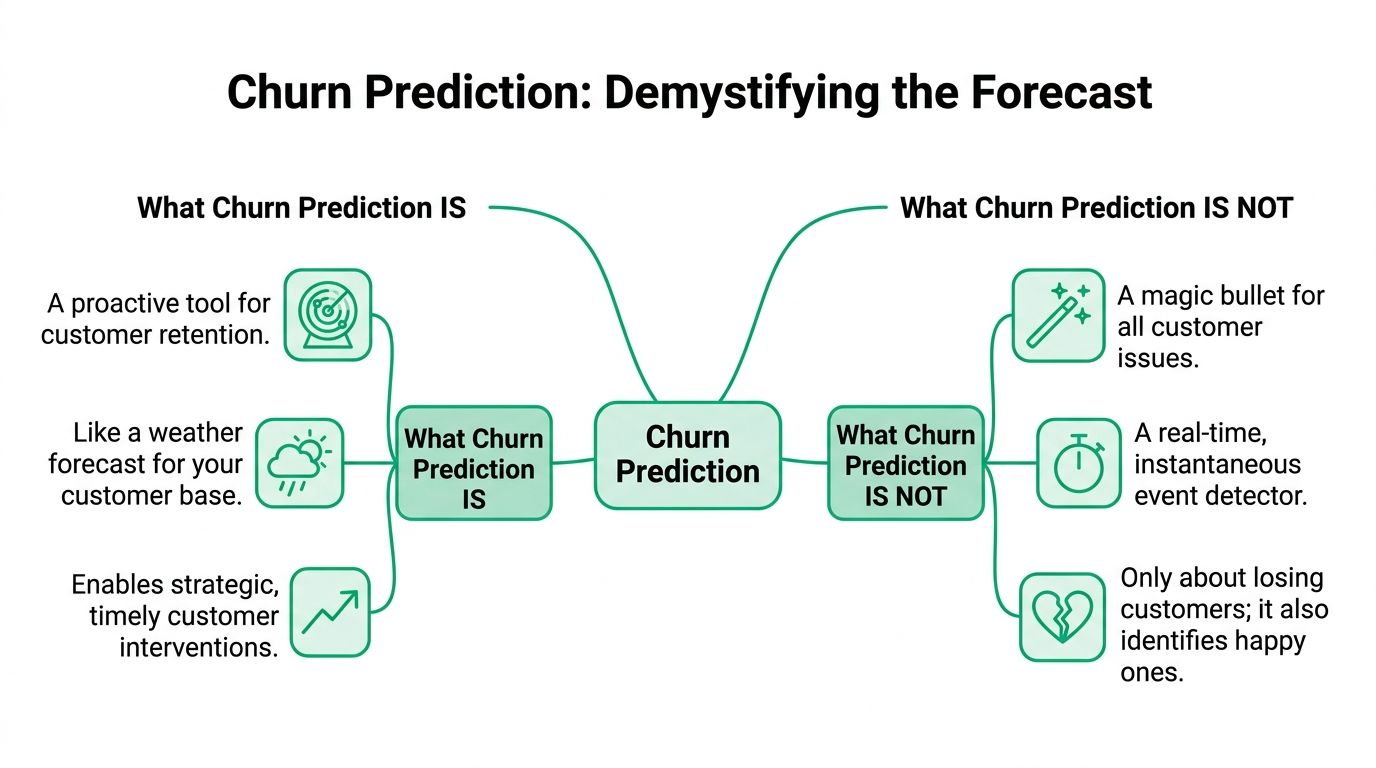
The mistake I see most often is confusing prediction with analysis. Churn analysis looks backward. It asks who left and why. That's useful for product strategy and postmortems. Churn prediction looks forward. It asks who is likely to leave soon enough that an action can still change the outcome.
What it actually does
A practical churn prediction system usually produces a small set of outputs that non-technical teams can use:
| Output | What the team does with it |
|---|---|
| Risk score | Prioritizes which accounts need attention first |
| Risk drivers | Helps choose the right intervention |
| Time window | Tells Growth or Success how fast to act |
| Segment context | Prevents one-size-fits-all retention plays |
The model itself is never the product; the actual product is the decision your team makes because the model surfaced a risk signal early enough.
What it does not do
Churn prediction won't solve every retention problem on its own. It won't rescue bad onboarding, unclear positioning, weak support, or pricing mismatch if the underlying customer experience stays broken.
It also isn't an instant event detector. Prediction models are typically run on a schedule and combine signals over time. That's different from reacting to a single support ticket or one failed charge in isolation.
- It's not a magic bullet: if your product isn't delivering value, the model will identify risk, not remove the cause.
- It's not only about losses: low-risk and healthy accounts matter too, because they show what good adoption looks like.
- It's not only for data scientists: Growth, RevOps, Lifecycle, and Support all need to understand how scores trigger action.
A useful churn score isn't a verdict. It's an early warning system tied to a playbook.
The Data You Need for Accurate Predictions
Most weak churn models fail for a simple reason. They're built on one narrow signal and expected to explain a complex decision.
The strongest models combine several inputs. Churn prediction performs best when it uses 5 to 7 distinct data sources, and one of the clearest behavioral signals is a month-over-month drop of 30% or more in login frequency or feature adoption, which correlates strongly with churn in the following 60 days, as outlined in CustomerScore's guide to SaaS churn prediction.
That should immediately change how you think about data collection. Don't ask for the one metric that predicts churn. Build the smallest set of connected signals that reflects how customers behave.
Four data categories that matter most
I like to think about the inputs as ingredients. No single one makes the meal.
- Billing data: Stripe events matter because subscription status tells you what usage alone can't. Failed payments, plan changes, coupon usage, subscription age, downgrade attempts, and delinquency patterns often show risk that product analytics misses.
- Product usage data: The clearest behavior change typically manifests in product usage data. Logins, feature adoption depth, session recency, and usage across core workflows tell you whether the customer is still getting value.
- Support interactions: Ticket volume, unresolved issues, escalation patterns, and the tone of conversations can reveal friction before cancellation intent is explicit.
- CRM and lifecycle data: Segment, firmographic context, onboarding completion, owner assignment, renewal stage, and account history help explain why the same behavior means different things for different accounts.
Feature engineering matters more than raw volume
A common trap is dumping every available field into the model. More columns don't automatically improve predictions. What helps is turning raw events into interpretable patterns.
For example, instead of storing only total logins, build features around trend and change:
- Usage direction: up, flat, or down relative to the prior period
- Adoption depth: whether customers still use the features tied to activation
- Support pressure: whether tickets cluster before a downgrade or cancellation
- Billing volatility: whether payment behavior is getting less stable over time
In early lifecycle stages, activation milestones often matter more than long-term engagement trends. In mature accounts, the pattern flips. That's why a good model respects lifecycle context instead of flattening every customer into one generic profile.
Teams usually get better results when they join product, support, billing, and CRM signals than when they keep optimizing usage data in isolation.
If you're pulling in qualitative inputs too, a solid layer of customer feedback analysis for retention work helps translate comments and cancellation reasons into signals your model and team can act on.
Choosing Your Churn Prediction Model
Model selection gets too much attention in some teams and not enough in others. One camp spends weeks debating algorithms before the data is ready. The other throws a black-box model into production and can't explain why an account was flagged.
The better question is simpler. What level of accuracy, interpretability, and maintenance can your team support?
Start with a baseline you can explain
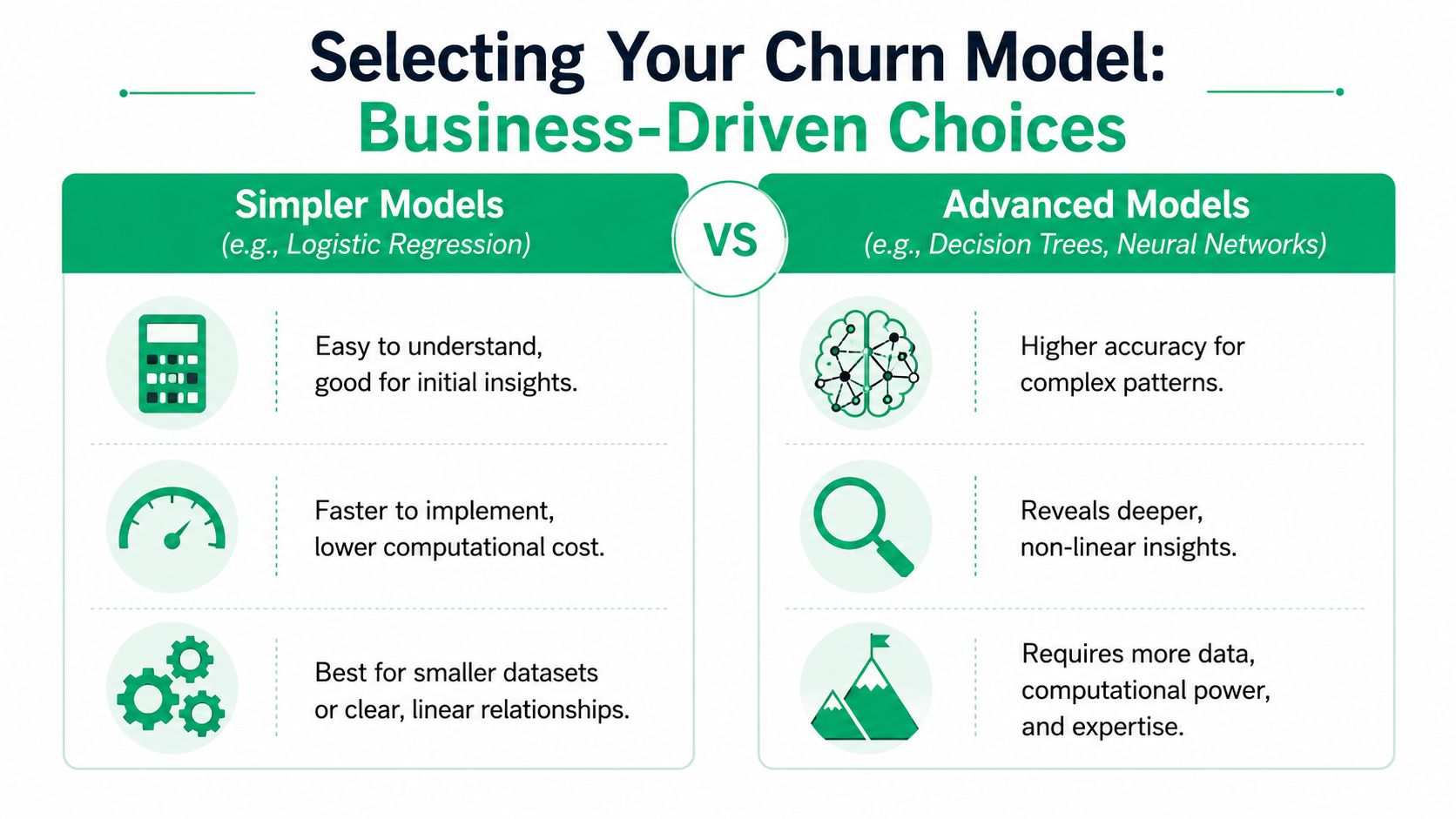
A basic logistic regression model is often the right first production step. It gives you a clean baseline, it's easier to explain to non-technical stakeholders, and it forces the team to be disciplined about feature quality.
That interpretability matters early on. If Growth, Support, and RevOps can't understand why the system is flagging customers, they won't trust the output enough to change behavior.
Random Forest is often the practical middle ground
For many subscription businesses, ensemble tree models are the most sensible next move. In high-churn industries, Random Forest classifiers have shown up to 99% accuracy in some studies, and more commonly around 85% accuracy with ROC-AUC above 0.85, according to a review published on ScienceDirect covering churn prediction performance.
That range matters. It shows both the upside and the reality. You shouldn't expect the best headline result from another dataset to transfer cleanly into your SaaS environment. But you can treat Random Forest as a strong option when you want better non-linear pattern detection without the operational burden of a more complex deep learning stack.
Here's the business view:
| Model type | Strength | Trade-off |
|---|---|---|
| Logistic regression | Easy to explain and deploy | Misses more complex relationships |
| Random Forest | Strong performance and accessible implementation | Less transparent than simple linear models |
| Deep learning | Can capture sequential and richer behavior patterns | Harder to explain, tune, and maintain |
Use deep learning when sequence matters
If your churn risk depends heavily on event timing and sequence, not just static snapshots, deep learning becomes more compelling. A BiLSTM-CNN architecture reported 81% accuracy, 66% precision, 64% recall, and 65% F1-score in churn prediction tasks in Scientific Reports from Nature.
That doesn't mean every SaaS team should jump there. It means sequence-aware models can outperform simpler approaches when you have the data, the expertise, and a real need to model behavioral trajectories over time.
Don't choose the most advanced model your team can describe. Choose the one your operators will trust and your systems can keep fresh.
From Prediction to Action with Smart Interventions
A churn score without an intervention path is just an interesting number. Teams don't recover MRR because a model exists. They recover MRR because the model triggers the right response at the right moment.
The biggest gap between data science and growth teams usually shows up here. The model flags risk, but no one defines what should happen next. Or worse, every at-risk user gets the same generic email, regardless of whether the issue is onboarding friction, product disengagement, or billing trouble.
Turn a score into a route
A strong retention system maps risk states to operational routes. Not every at-risk customer should see the same offer, and not every save motion should happen in email.
In practice, the routing logic often looks like this:
- High-risk, active product friction: trigger an in-app support handoff, concierge outreach, or education prompt around the blocked workflow.
- High-risk, price-sensitive behavior: present downgrade, pause, or plan-fit options inside the cancellation flow.
- High-risk, billing-linked signals: route into payment recovery, card update prompts, and smarter retry communication.
- Healthy but expressing cancellation intent: offer a clean exit with feedback capture, because forcing a save can damage trust.
In-app intervention surpasses generic lifecycle messaging. The customer is already making a decision inside the product. If your system waits for a batch email later, you've usually missed the highest-intent moment.
Match the intervention to the failure mode
One of the most profitable routes is billing-related churn prevention because the customer may not want to leave. But not all failed payments mean the same thing. Some are accidental. Some are a signal of disengagement. Some need immediate frictionless recovery.
If billing risk is part of your model, the intervention should connect directly to payment resolution. Teams that handle this well build customized messaging around common failure reasons and remove extra steps from the update path. That's especially important when dealing with issues like card declined by issuer events that stall renewals unexpectedly.
After the initial route is live, review how customers move through it:
- Where do users abandon the save flow
- Which offers are accepted but later reverse
- Which reasons cluster by plan or lifecycle stage
- Which paths recover revenue quickly versus only delay churn
A useful walkthrough helps teams align around the operational side of this work:
The score decides who needs attention. The route decides whether you actually save the account.
Measuring Success with Recovered MRR and Experimentation
The easiest way to waste a churn prediction project is to celebrate model quality and ignore commercial impact. Accuracy matters, but it isn't the north star for a Growth leader. Recovered MRR is.
A model can be statistically strong and commercially weak if it flags the wrong accounts, triggers the wrong offers, or can't show which interventions changed the outcome. The measurement system has to connect prediction, action, and subscription results.
Use revenue, not model vanity metrics, as the north star
A simple measurement framework tracks four layers together:
| Layer | What to measure |
|---|---|
| Prediction | Which accounts were flagged and why |
| Intervention | Which route, message, or offer was shown |
| Behavioral response | Acceptance, abandonment, support handoff, card update |
| Revenue outcome | Whether MRR was retained or recovered |
This is how you move from “the model found risk” to “this intervention saved paying accounts.” Finance can trust it. Growth can optimize it. Product can learn from it.
The operational discipline matters as much as the analytics. Every save offer should be logged. Every cancellation path should record the presented option and the selected outcome. Every recovered subscription should be attributable back to the route that influenced it.
Test interventions, not just scores
Teams often stop experimenting too early. They test the model once, choose a threshold, and treat the downstream retention flow as fixed.
That leaves a lot of revenue on the table.
Test the intervention layer the same way you'd test acquisition funnels:
- Offer design: pause versus downgrade versus targeted discount
- Message framing: value reminder, urgency, support-led help, or simplicity
- Placement: pre-cancel, mid-flow, post-failed-payment, or win-back
- Escalation path: self-serve option versus human follow-up
Practical rule: if two routes produce similar retention outcomes, keep the one that preserves margin and requires less team labor.
Attribution also needs a clear window and a consistent rule set. If a user accepts a pause, updates a card, or downgrades instead of leaving, that outcome should be tied to the intervention that changed the subscription path. That's what turns retention from a “support effort” into a documented revenue lever.
Two Critical Pitfalls Most Teams Overlook
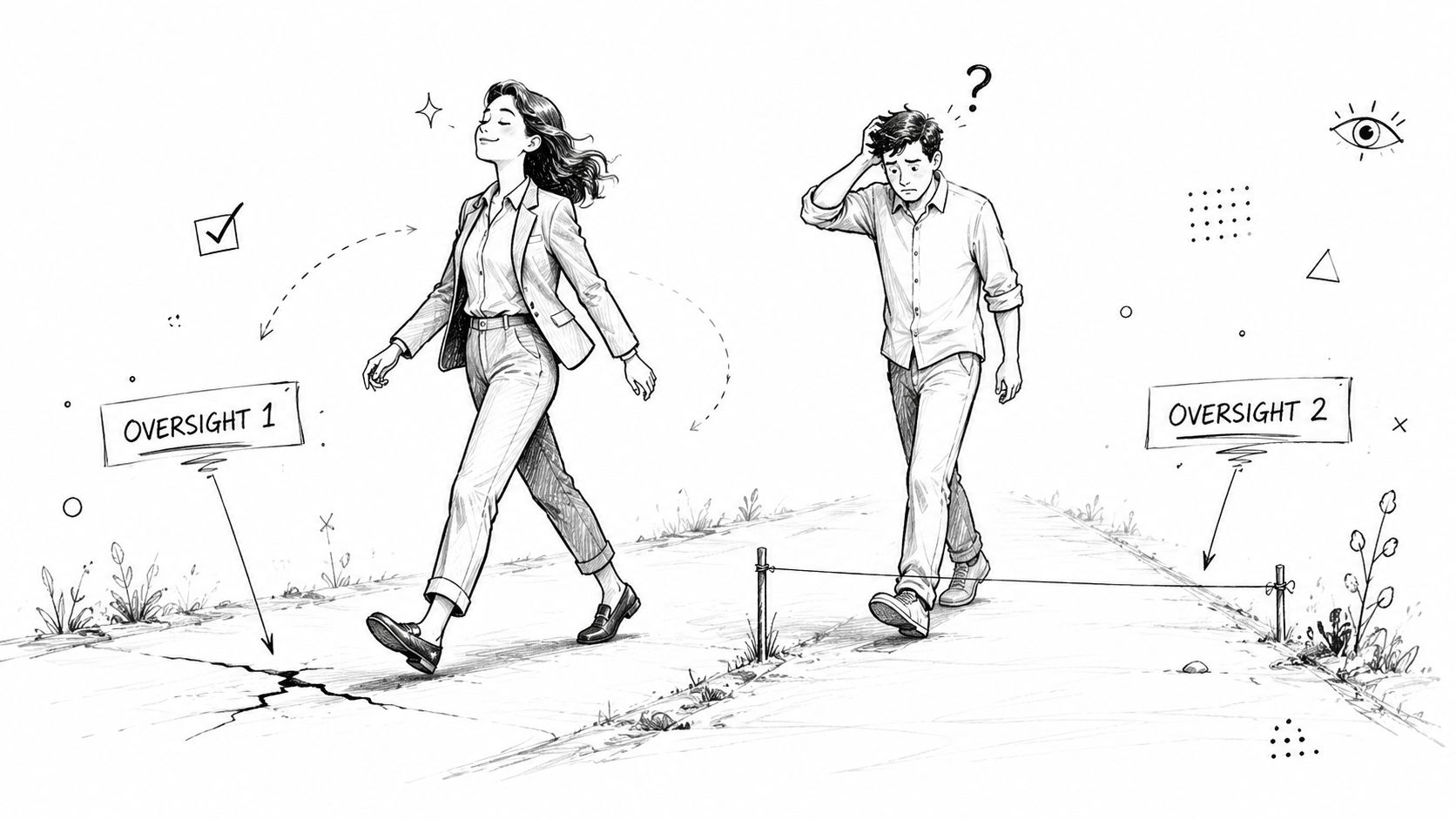
Teams rarely fail because they picked the wrong algorithm. They fail because they model the wrong problem or act on the wrong threshold.
Pitfall one ignores involuntary churn signals
A lot of churn programs focus almost entirely on voluntary behavior. Usage drops. Support complaints. Cancellation reasons. That's all useful, but it misses a major source of preventable revenue loss.
Research summarized by Paddle notes that most churn prediction frameworks fail to model involuntary churn precursors, even though teams need those signals to separate recoverable billing problems from genuine exit intent. The same source also notes that many frameworks rely on a single threshold, even when practitioners report that this causes high-value accounts to be missed while low-value ones create noise. Paddle highlights that recalibrating thresholds by segment improves recall without sacrificing precision in practice, as discussed in Paddle's analysis of churn prediction gaps.
If your model treats failed payment risk as a back-office event instead of a predictive signal, you'll stay reactive. That usually means you only engage after the charge fails, when some recoverable accounts have already slipped.
Pitfall two treats every account with one threshold
One universal risk cutoff sounds efficient. It usually isn't.
A low-value self-serve account and a high-MRR account shouldn't always trigger the same action at the same score. Lifecycle stage, plan type, contract shape, and account value change how you interpret risk. A threshold that works fine for the long tail can miss the accounts your business most needs to save.
A better operating rule is segment-level calibration:
- By lifecycle stage: onboarding accounts behave differently from mature accounts
- By value: intervention priority should reflect MRR impact, not just score rank
- By plan type: annual, monthly, self-serve, and sales-led users churn differently
- By failure mode: billing risk and product dissatisfaction need different treatment
Teams get sharper results when they calibrate risk to account context instead of forcing every customer through one rule.
If you want to connect churn prediction to actual recovered revenue, Revcover is built for that workflow. It helps subscription software teams intercept cancellation intent, coordinate save offers and payment recovery, and attribute outcomes to recovered MRR so Growth and RevOps can prove what's working.