
30-60-90 Day Plan for SaaS Retention Teams

Ayush Soni
Founder, Revcover

On this page
- What a 30-60-90 Day Plan Looks Like for SaaS Retention
- The three-phase model for retention teams
- Why retention is a strong fit for this cadence
- Days 1 to 30 Building the Retention Baseline
- Instrument the cancellation path before you argue about offers
- Audit failed payments and talk to the people closest to the churn
- What you should have by day 30
- Days 31 to 60 Shipping the First Save and Recovery Experiments
- Design save offers as hypotheses, not permanent policy
- Build the payment-recovery sequence with restraint
- Decide what counts as a win by day 60
- Metrics That Matter MRR Churn Save Rate and Recovery
- Cancel Flow Designs Single Wall vs Routed vs Hybrid
- Single hard wall
- Routed flow
- Hybrid model
- Templates You Can Steal Cancel Flow and Payment Recovery
- Cancel flow template
- Payment recovery cadence
- Days 61 to 90 Accelerating and Setting Up Next Quarter
- Turn winners into operating rhythm
- Set the next-quarter review doc
Your retention queue is already telling the story. A handful of customers hit cancel, a few cards fail, support starts copying and pasting the same recovery replies, and the team is left arguing about whether the problem is pricing, product value, or billing friction.
A 30-60-90 day plan gives that chaos a shape. For SaaS retention work, the first quarter shouldn't be a generic onboarding ramp. It should be a measured experiment cycle around cancellation intent, save offers, and failed-payment recovery, with each month producing something the team can use.
What a 30-60-90 Day Plan Looks Like for SaaS Retention
A retention-focused 30-60-90 day plan works because subscription revenue gives you repeated chances to learn. Revenue shows up monthly, customer exit intent shows up in product, and billing failures leave a clean trail. That makes the first quarter less about vague onboarding and more about building a small system that turns cancellation and payment friction into measurable recovery.
The three-phase model for retention teams
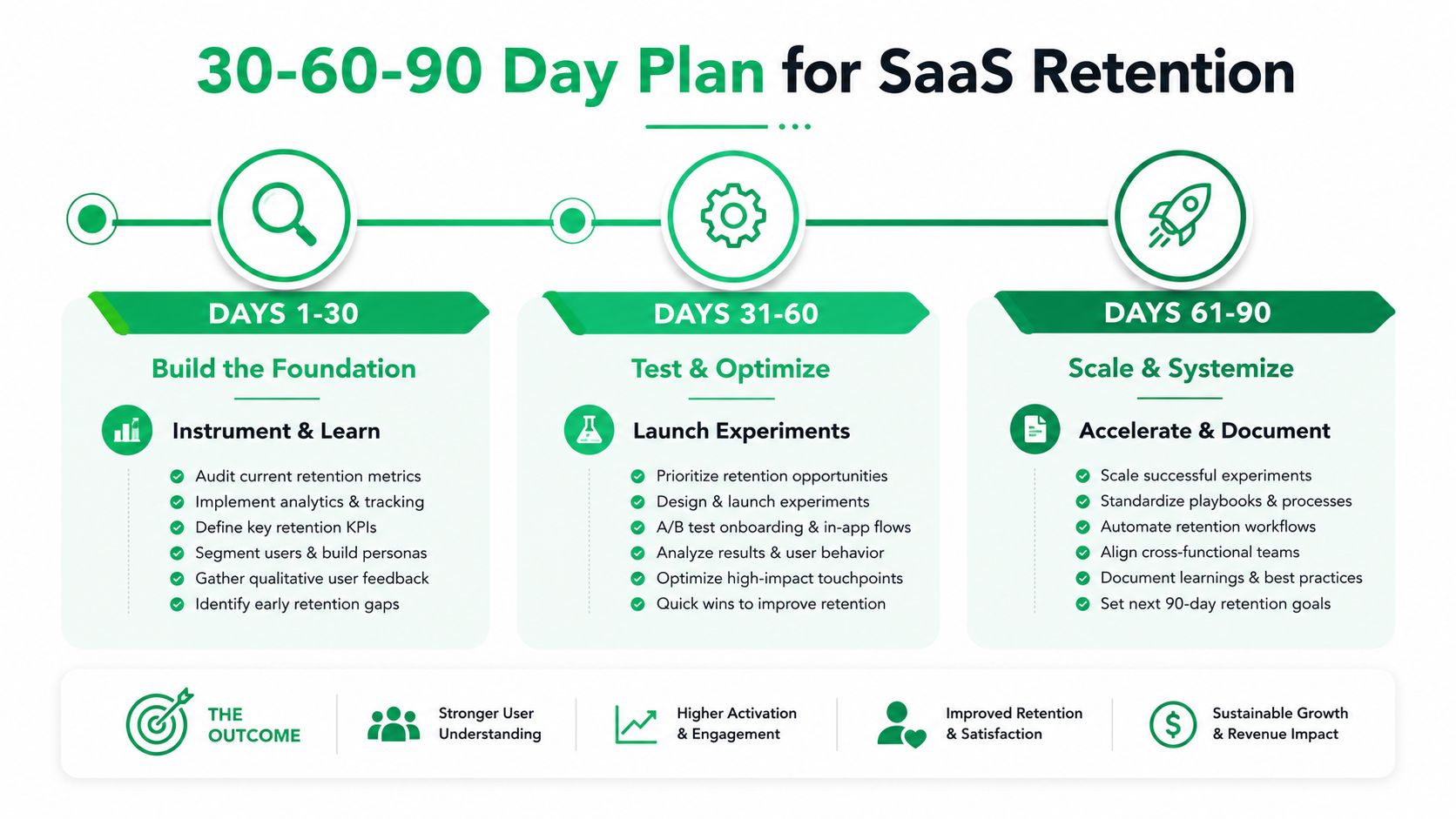
Think of the first 90 days as learn, ship, and accelerate. In days 1 to 30, the goal is to understand where churn comes from and to instrument the paths customers take when they cancel or fail to pay. In days 31 to 60, the team should launch the first save-offer and recovery experiments. In days 61 to 90, the winning moves get scaled, the losers get cut, and the dashboard becomes the team's operating rhythm.
For a retention team, the first quarter should produce three artifacts. First, a working cancellation flow with reason capture and routing. Second, a baseline view of voluntary churn and involuntary churn. Third, an experiment log that shows which offers or retry cadences recovered revenue and which ones didn't.
Practical rule: if the first 90 days don't end with a flow, a baseline, and an experiment readout, the plan was probably activity, not execution.
Why retention is a strong fit for this cadence
For many roles, 30 days is too short to know anything meaningful. Retention is different because the work is already tied to events that happen on a schedule, and the first quarter often defines the playbook the team will use all year. Guidance on 30-60-90 plans also recommends keeping objectives tight, often 3 to 5 goals per phase, and attaching a key metric to each goal so progress can be reviewed at the 30-, 60-, and 90-day checkpoints, which fits retention work well (Forbes Advisor).
The plan gets even more useful when it's treated like a working operating system. A well-built draft usually starts with stakeholder input, becomes a small set of SMART goals, and ends with a manager review before launch, which is exactly the cadence a retention lead needs when dealing with product, support, finance, and billing constraints (Sarah M. Hoban).
Days 1 to 30 Building the Retention Baseline
The biggest mistake in the first month is treating it like a passive listening tour. Retention leaders don't earn their keep by collecting anecdotes and waiting for intuition to sharpen. They earn it by instrumenting the cancellation path, pulling a usable baseline, and making sure the team can see where money is leaking before the first experiment goes live.
Instrument the cancellation path before you argue about offers
Start inside the product, not in a spreadsheet. Capture cancellation intent at the moment it appears, ask for reason codes, and preserve freeform feedback so you can later group themes by revenue impact. If you can't see whether a customer is leaving because of missing value, missing budget, a competitor, or a billing issue, every save strategy will be a guess.
Then map the current path from intent to exit. Note which customers see a survey, which see a support handoff, which get a pause option, and which can cancel with one click. Track the opt-in rate for each path so you know what the current funnel does rather than what the team thinks it does. A clean baseline for voluntary churn and involuntary churn belongs in the same month, because separating those two from the start prevents a lot of bad analysis later. For a deeper measurement approach, I like the framing in customer retention analytics for subscription teams.
Audit failed payments and talk to the people closest to the churn
Failed-payment recovery needs its own baseline. Pull Stripe data, sort by plan, billing state, and usage pattern, and look for clusters in failed charges and retry outcomes. Then define routing rules for what should happen when a card fails, what should happen after a grace period, and what should never be blocked too early.
The qualitative side matters just as much. Spend time with support, customer success, and finance. They already know which complaints show up before cancellation, which billing problems create repeat tickets, and which “product reasons” are pricing or onboarding confusion. The point isn't to collect opinions, it's to build a reason taxonomy that matches the reality of the business.
A baseline is only useful if the team trusts it. If support says the reasons are wrong and finance says the billing states are muddy, the first month is already behind.
What you should have by day 30
- A live cancel flow: reason capture, clean handoff points, and visible exit paths.
- A churn baseline: voluntary and involuntary churn separated, with simple trend tracking.
- A save-path map: pause, downgrade, support handoff, discount, and clean cancel, with current opt-in or conversion noted.
Those three outputs give you enough structure to stop guessing and start testing.
Days 31 to 60 Shipping the First Save and Recovery Experiments
The second month is where a retention plan stops being a document and starts behaving like a revenue loop. By now, the team should know where churn shows up and which billing failures are common. The job is to turn those observations into a few disciplined experiments, then read the early data without letting noisy first-week behavior drive the wrong decision.
Design save offers as hypotheses, not permanent policy
A save offer only works if you know what problem it is solving. A pause offer is for customers who aren't ready to leave forever. A downgrade is for accounts that still see value but can't justify the current tier. A targeted discount is for cases where price friction is real and the customer has otherwise healthy product usage. A support handoff makes sense when the issue is unresolved, and a clean cancel keeps the experience honest when none of the save paths fit.
Each one needs a clear hypothesis. For example, if you present a pause option to customers who cite temporary budget pressure, you should expect a higher retention outcome than a generic discount applied to everyone. The test needs a decision window, a defined sample, and a metric that says whether the offer is improving recovered MRR or just delaying churn.
Build the payment-recovery sequence with restraint
Failed-payment recovery is often more predictable than cancel recovery, but only if the sequence is clean. Set a retry schedule, send in-app and email reminders, offer a friction-light card update path, and use temporary feature gating only after polite attempts have already failed. The point is to reduce payment friction, not punish the customer before they've had a fair chance to fix it.
Use the same logic for every step. A retry on day 0 should be fast and gentle. A reminder on day 3 should explain what happened and how to update the card. A final pass around day 7 can introduce a stronger action if the account is still unresolved. If the sequence starts with pressure, it usually creates more support load than recovered revenue. A useful operational frame for this is the one used in dunning management for subscription billing.
Decide what counts as a win by day 60
The day-60 checkpoint should be a stop-or-scale meeting, not a status update. Look at whether the offer is moving the outcome it was designed to move, whether the sample is big enough to trust the signal, and whether the support burden is acceptable. A small lift that creates downstream mess is not a win.
If a test is noisy, extend it. If it's clearly underperforming, kill it quickly. If it's promising, expand the segment and tighten the copy. That discipline matters more than squeezing every idea into a quarter.
A useful way to keep the team honest is to write down the decision before the test launches. That prevents retrospective storytelling, which is how mediocre save offers survive longer than they should.
Metrics That Matter MRR Churn Save Rate and Recovery
Retention teams get overwhelmed when they track every available number. The better move is to build one view that tells the whole 90-day story: what was lost, what was saved, what was recovered, and what each experiment changed. That doesn't mean ignoring detail, it means choosing a handful of metrics that force the team to make decisions.
| Metric | Definition | Review cadence | Healthy 90-day signal |
|---|---|---|---|
| Gross MRR churn | Revenue lost before offsets | Weekly and monthly | Downward trend or stable after instrumentation |
| Net MRR churn | Revenue lost after saved or recovered revenue is counted | Monthly | Smaller gap versus gross churn when saves are working |
| Voluntary churn | Customers who cancel by choice | Weekly | Clear reason themes and stable or improving save performance |
| Involuntary churn | Revenue lost from failed payments or billing failure | Weekly | Recovery cadence reduces unresolved failures |
| Save rate per offer | Share of eligible cancels that accept a specific save path | Weekly during tests | One or two offers outperform the rest |
| Payment recovery rate | Share of failed charges that return to active status | Weekly | Early retries capture more recoveries than later ones |
| Time to recovery | Time between failed charge and successful recovery | Weekly | Faster recovery without excessive friction |
| Recovered MRR per experiment | Revenue returned by a specific save offer or retry path | Monthly | Enough lift to justify keeping the flow live |
The most important distinction is between gross and net churn. Gross churn tells you how much business walked away. Net churn tells you how much of that loss the team recovered through save offers, payment retries, or follow-up actions. If those two numbers are too far apart, the team may be preserving revenue in a way that's hard to see. If they move closer together over the quarter, the playbook is getting cleaner.
Important: a high save rate can still be a bad outcome if the accounts you save were going to leave again anyway. Revenue attribution has to follow the offer that influenced the decision, not just the subscription that stayed active for a few more days.
The dashboard should show one quarter at a time, not a pile of disconnected exports. Retention work breaks down when cancel data sits in one place, billing data in another, and win-back data in a third. A single screen with the main churn split, the offer outcomes, and the recovery path keeps everyone focused on the same business question.
Cancel Flow Designs Single Wall vs Routed vs Hybrid
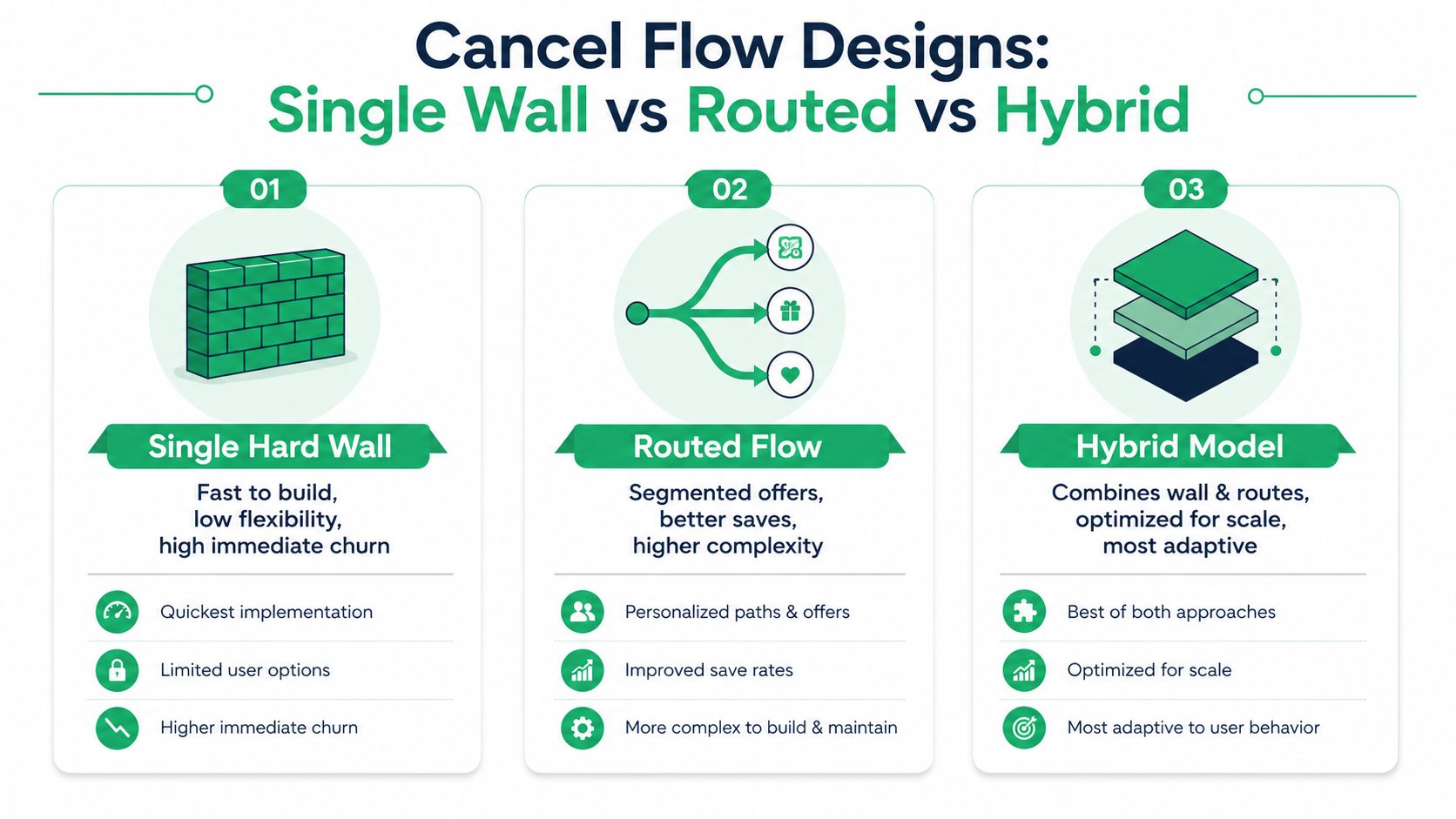
The cancel flow is where most retention teams overcomplicate the product or oversimplify the strategy. A single wall is easy to build and easy to explain. A routed flow is smarter and usually better for recovery. A hybrid model sits in the middle and is often the most practical choice when the team needs speed without giving up too much control.
Single hard wall
This is the blunt instrument. Everyone sees the same stop point, the same question, and the same exit path. It's fast to implement, which can be useful when engineering time is scarce or the team needs a temporary guardrail.
The downside is obvious. High-value accounts get treated like low-fit accounts, and the flow gives you little room to distinguish between a user who needs help and one who wants out. It also tends to make save-rate analysis messy because the team has fewer branches to learn from.
Routed flow
A routed flow uses plan, usage, stated reason, and billing state to send customers into different paths. It's better for a retention team that wants to personalize pause, downgrade, discount, support, or clean-cancel outcomes. It also plays nicely with payment recovery because an account in dunning should not be treated the same way as a healthy subscriber who is voluntarily leaving.
The trade-off is surface area. More routing means more copy, more logic, and more testing. But if the team is serious about recovered MRR, that added complexity usually pays for itself because the offers align more closely with the reason the customer is leaving.
Hybrid model
The hybrid approach keeps a simple first step for transparency and only routes the segments that matter most. That might mean high-value accounts, high-risk usage patterns, or accounts in billing trouble. It gives the team a clean default experience without sacrificing the chance to intervene where the revenue is most sensitive.
For most SaaS teams, the hybrid model is the most sensible starting point. It avoids a brittle, overdesigned flow while still letting the team learn from real customer behavior. The single wall is best when the company needs speed. The routed flow is best when the team already has enough traffic and operational maturity to support experimentation. The hybrid is usually the right middle ground for the first quarter.
Templates You Can Steal Cancel Flow and Payment Recovery
A usable template should do two things at once. It should be easy to implement, and it should make the metrics section easier to read later. If the template can't be tied back to a number, it's decoration, not an operating tool.
Cancel flow template
Use this order:
- Intent capture. Ask for the cancel reason at the moment of exit intent, and keep one freeform field for detail.
- Segment check. Route by plan, usage, reason, and billing state.
- Save offer. Show the most relevant option first, pause, downgrade, support handoff, targeted discount, or clean cancel.
- Outcome capture. Record accepted offer, abandoned session, or completed cancellation.
- Reason clustering. Group feedback by theme so the product and customer teams can read patterns instead of raw comments.
Each screen should map to a different metric. Intent capture supports reason analysis. Segment check supports routing quality. Save offer supports save rate. Outcome capture supports recovered revenue. If the flow doesn't tell you what changed, it won't help you decide what to keep.
Payment recovery cadence
| Step | Timing | Message focus | Path offered | Metric it should move |
|---|---|---|---|---|
| First retry | Day 0 | Friendly notification that payment failed | Card update | Recovery speed |
| Second touch | Day 3 | Reminder plus clear update link | Card update and billing help | Recovery rate |
| Third touch | Day 7 | Final reminder with firmer urgency | Card update, then temporary gating if needed | Unresolved failed charges |
The sequence above is deliberately simple. It gives the customer multiple chances to resolve the issue without making the experience feel adversarial. It also creates a clean record of what worked, which makes it easier to evaluate the retry path later.
For a working example of how teams structure a repeatable operating flow, the playbook format in this retention playbook example is a useful model for translating ideas into a sequence the team can run.
Days 61 to 90 Accelerating and Setting Up Next Quarter
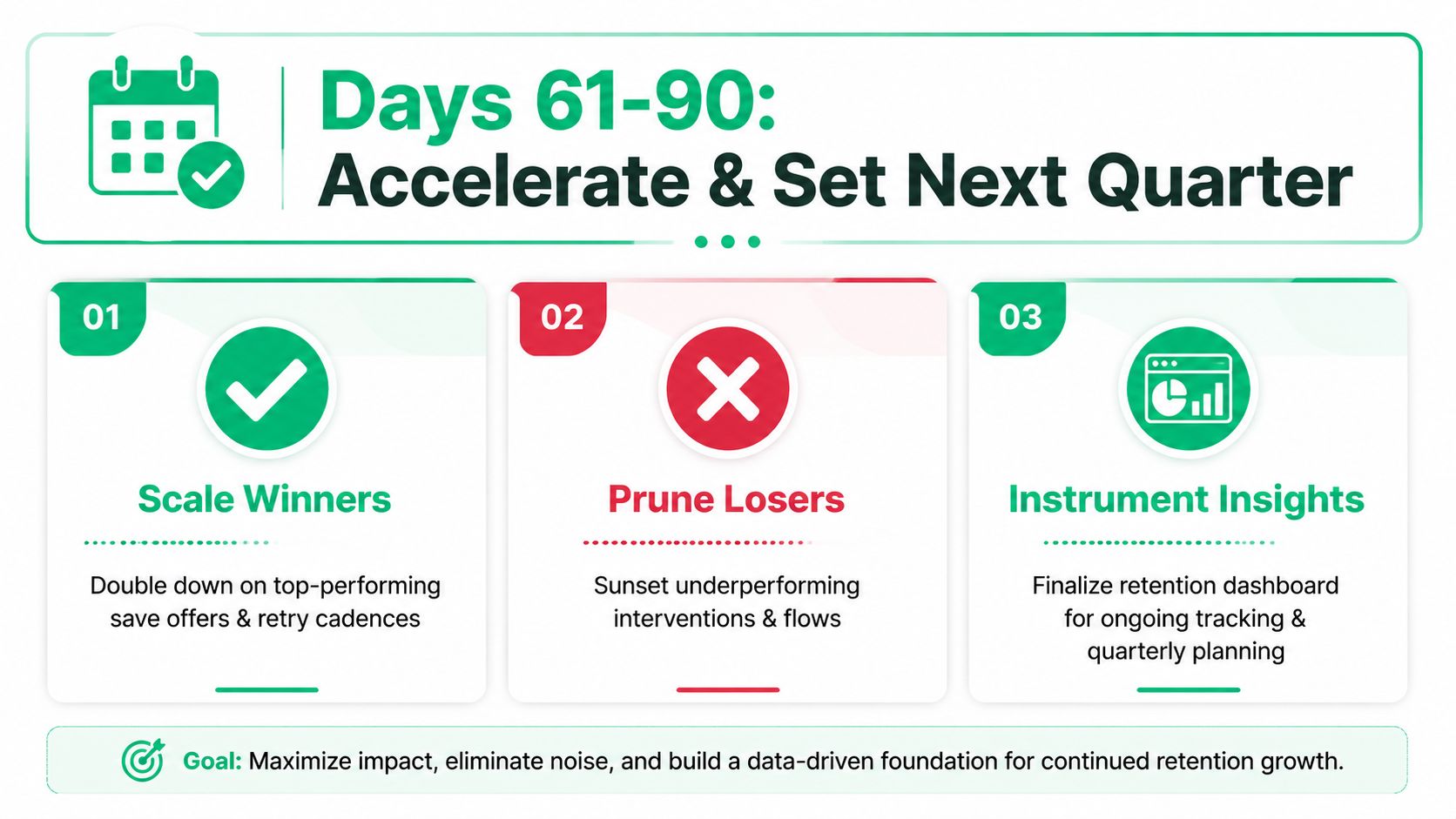
By day 61, the team should know which save offers are pulling their weight and which recovery steps are mostly noise. The job now is to scale the winners, prune the losers, and turn the dashboard into a recurring review habit instead of a quarter-end scramble. A good 90-day finish leaves the team with a tighter system, not just a longer backlog.
Turn winners into operating rhythm
The strongest save offer and the strongest retry cadence should become defaults for the relevant segments. That doesn't mean freezing the system. It means establishing weekly reviews for test performance and monthly checkpoints for revenue impact so the team can keep making decisions without reopening old debates every time a cancellation comes in.
The losing variants should be cut cleanly. Teams waste too much time protecting flows that feel clever but don't move revenue. The best retention operators are willing to delete work that looked promising in week one and never got better.
Set the next-quarter review doc
A short review document should explain what was tested, what recovered revenue, what failed, and what the team will do next. It should also note which at-risk and recently-lost segments will feed win-back into ads, email, and CRM so the follow-up motion doesn't disappear after the quarter ends.
The main habit that separates compounding teams from reset-every-quarter teams is simple. They treat retention as a system of decisions, not a pile of campaigns. They keep the measurement loop open, they retire weak ideas quickly, and they make sure every quarter starts with better input than the last one.
If you want a retention system that connects cancellation intent, save offers, failed-payment recovery, and revenue attribution in one place, Revcover is built for that workflow. Visit Revcover to see how it helps SaaS teams turn the first 90 days of retention work into a repeatable operating cycle.