
Definition of Dynamic Pricing: A Complete Guide for SaaS

Ayush Soni
Founder, Revcover
On this page
- What Dynamic Pricing Means
- How that differs from a normal discount
- Why the wording causes confusion
- How Dynamic Pricing Works as a Real-Time Control Loop
- The loop is closed, not one-way
- Why SaaS teams should care
- The Main Types of Dynamic Pricing Explained
- Dynamic Pricing Types at a Glance
- Real-World and SaaS Examples in Action
- The subscription version looks different
- Benefits and Risks Including Legal and Ethical Concerns
- What the upside really is
- Why the risks get attention
- The trade-off for SaaS leaders
- Implementing Dynamic Pricing in Subscription Businesses
- Build the logic around measurable drivers
- Keep the first experiment small
- Unify the adjacent flows
- Next Steps and Resources for Experimentation
Dynamic pricing is a pricing strategy where sellers adjust prices rapidly and frequently in response to demand conditions, usually through rules or algorithms instead of a fixed list price. In SaaS, that can mean a save offer, a downgrade path, or a recovery discount changing in real time based on account context.
You're probably looking at a pricing page, a cancellation flow, or a billing recovery screen and wondering why a customer should see one offer instead of another. That's where the definition of dynamic pricing gets practical, because it's not just about charging more when demand spikes, it's about matching price to what's happening right now.
What Dynamic Pricing Means
A SaaS trial ends with a user clicking cancel at 2 AM after hitting a usage limit. Another account upgrades right after a product launch and suddenly your sales team is fielding a wave of inbound interest. A renewal comes up after a support outage, and the account owner is weighing whether to stay, downgrade, or ask for a concession. In each case, static pricing gives you one blunt answer. Dynamic pricing gives you a system that can respond to the situation in front of you.
The cleanest definition is simple. Dynamic pricing is a strategy where prices change rapidly and frequently in response to demand conditions, instead of staying fixed. The UK government describes it that way, and related definitions in academic and industry sources treat it as real-time or near-real-time pricing driven by signals like demand, supply, time, and location (UK government review).
How that differs from a normal discount
A one-off promo code is not dynamic pricing if someone manually set it last week and forgot about it. Dynamic pricing means the offer itself can shift as conditions change, often through rules or automated decisioning. That is why the modern version is so closely tied to digital systems and algorithmic pricing rather than a rep clicking “edit price” in a dashboard.
Practical rule: if the price changes because the business wants it to change on a schedule or in response to live signals, you are in dynamic pricing territory. If it changes because someone made an ad hoc decision, you are usually just repricing.
For subscription teams, this matters because the "price" is not always a public plan price. It can be a retention offer, a pause length, a downgrade recommendation, or a recovery discount shown only when billing risk appears. A cancellation flow and a failed-payment flow can both use dynamic pricing logic, and the same logic can surface a better save offer when an account is likely to leave than when it is just exploring a cheaper tier. A careful real-time notification flow can carry those offers at the right moment without making them feel random.
Why the wording causes confusion
People often hear “dynamic pricing” and think only of surge pricing. That is too narrow. Britannica makes clear that dynamic pricing includes price decreases as well as increases, so it can work when demand softens or supply is abundant, not just when demand spikes (Britannica).
That broader definition is the one most useful for SaaS. It lets product and growth teams think about pricing as a response system, not a penalty system. In practice, the core question is not “can we raise the price?” It is “what is the right offer for this account, at this moment, given what we know?”
How Dynamic Pricing Works as a Real-Time Control Loop
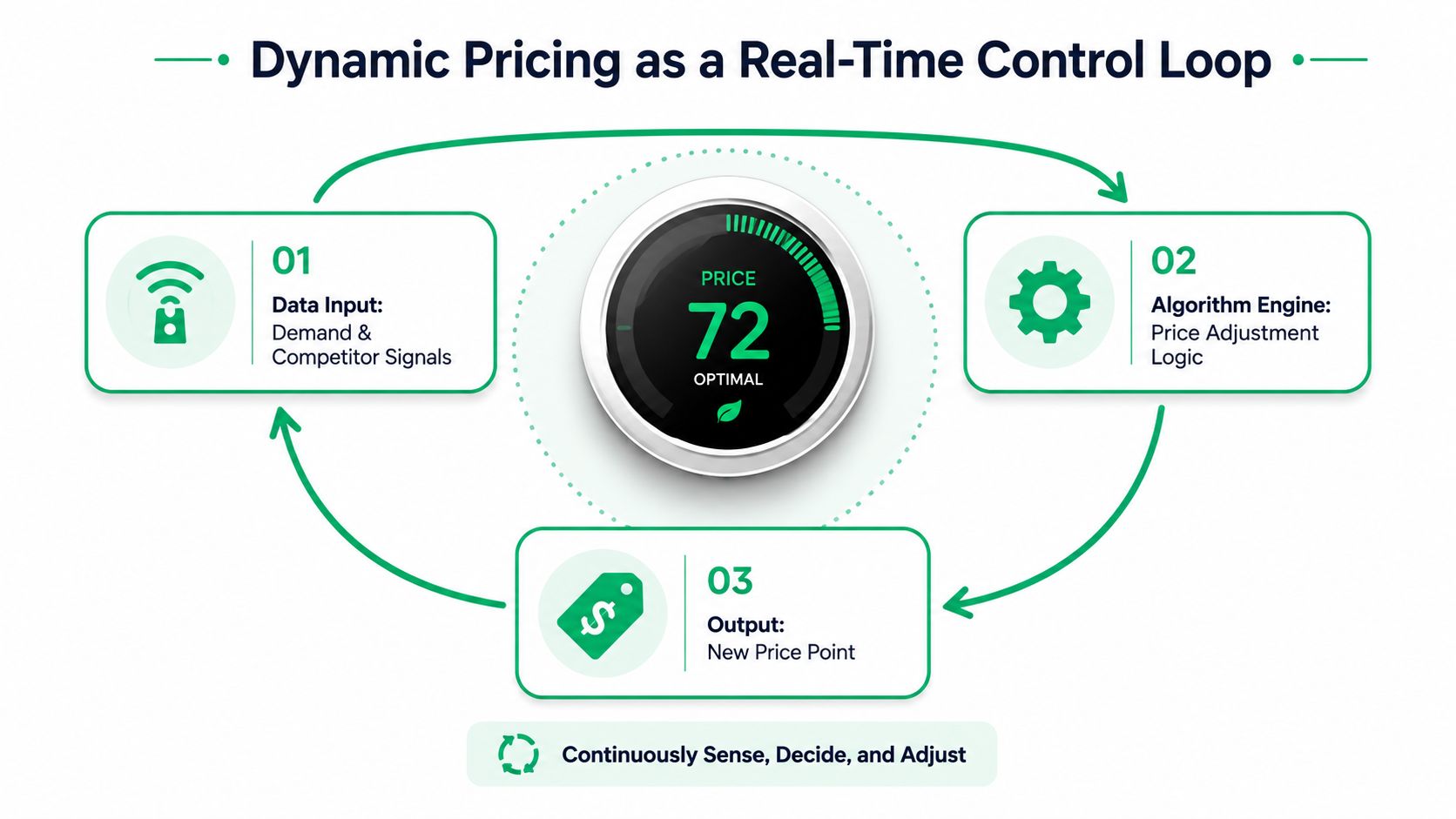
Think of a thermostat. It reads the room, compares that reading to a target, and adjusts output until the environment moves closer to the goal. Dynamic pricing works the same way, except the “room” is the market and the “output” is the offer a customer sees.
At a technical level, dynamic pricing is an algorithmic, real-time pricing control loop. The system ingests live demand, inventory, competitor, and customer-behavior signals, then recalculates prices through rules engines or machine-learning models rather than manual updates (Salesforce). That loop matters because the price you set changes behavior, and that behavior becomes the next input.
The loop is closed, not one-way
The key idea is feedback. New market data changes the price, and the new price changes subsequent demand. That makes the pricing function endogenous to the market, which is a fancy way of saying the system reacts to itself as conditions evolve. In operational terms, that's why these systems can update hourly, minute by minute, or even faster in some implementations.
A good mental model is this:
- Input signals: demand volume, inventory position, competitor pricing, customer behavior, account value, timing, and geography.
- Decision layer: a rules engine or machine-learning model weighs the signals and applies guardrails.
- Output: a new price, offer, discount, pause option, or downgrade path.
- Feedback: the customer responds, and the system learns from that response.
New prices don't sit in isolation. They change demand, and that new demand changes the next price decision.
Why SaaS teams should care
In subscription businesses, “price” often means more than a checkout number. A cancellation save flow might offer a discount to a high-value account and a pause to a seasonal user. A payment recovery flow might show a card-update path first, then a temporary feature gate, then a different nudge depending on billing state.
That's where dynamic pricing becomes an operating system for monetization, not just a revenue trick. The business is still making a pricing decision, but the decision is embedded in a workflow. If the account is healthy, the system can preserve margin. If the account is at risk, it can shift toward retention or recovery without rebuilding the whole billing stack.
For teams building around billing events and save offers, the same logic shows up in workflow design, including systems that trigger timely customer messages such as a real-time notification flow. The point is less about speed for its own sake and more about matching the response to the moment.
The Main Types of Dynamic Pricing Explained
A pricing team usually makes better decisions once it stops treating dynamic pricing as one broad tactic. Different motions solve different problems. Some change by time, some by demand, some by account context, and some by the value a customer is getting in that moment. In subscription businesses, those motions often show up in renewal saves, recovery flows, and targeted offers, not just in checkout pricing.
Dynamic Pricing Types at a Glance
| Type | Definition | Real-World Example | SaaS Application |
|---|---|---|---|
| Time-based | Prices change by time of day, week, season, or lifecycle window. | Airlines and hotels adjust around travel demand. | Annual billing incentives, renewal windows, or limited-time save offers. Use Stripe Billing rules to apply time-based discounts during renewal windows. |
| Demand-based | Prices move with shifts in demand. | Higher prices during peak travel periods, lower prices when demand weakens. | Usage-tier adjustments, upgrade prompts, or recovery discounts during slow periods. |
| Personalized | Prices or offers vary by customer segment or account context. | Different offers for loyalty tiers or regions. | Save paths based on plan, usage, account value, or cancellation reason. |
| Surge | Prices rise sharply during short spikes in demand. | Ride-sharing fares during busy periods. | Temporary upsell pricing during launch spikes or peak onboarding demand. |
| Value-based | Price reflects the value delivered in the moment. | Premium services that charge more for urgent or high-value delivery. | Enterprise add-ons, premium support, or recovery offers tied to account value. |
| Odd-even pricing | Prices are set just below or just above a round number to shape perception. | Retail tags that end in .99 or .95. | Trial offers, save discounts, or renewal pricing that feels more deliberate. See the odd-even pricing example for a practical breakdown. |
Time-based pricing is the easiest place to start because it follows a calendar the business already understands. Renewal cycles, seasonality, and monthly budget patterns all create predictable windows where the same offer can perform differently. For SaaS teams, that often means annual billing incentives, renewal-window discounts, or save offers that only appear at the right point in the customer journey.
Demand-based pricing moves with interest, usage, or purchase intent. That makes it useful for usage-based products, trial conversion, and recovery flows where demand softens after a cancellation attempt or a failed payment. A simple rule set can do a lot here, for example, a subscription team can use Stripe Billing rules to apply time-based discounts during renewal windows while keeping the base price stable elsewhere.
Personalized pricing asks a different question. Instead of asking what the market is doing, it asks what this account looks like right now. That can be powerful for retention because a high-value account and a low-engagement account do not need the same offer, but it also raises fairness concerns if the logic is opaque or inconsistent.
Surge pricing is the most visible version of the idea. It is the short, sharp price move people usually associate with dynamic pricing, but it is only one slice of the category. A sudden spike in demand can justify a higher price, and a slow period can justify a lower one, so the motion matters more than the label.
Value-based pricing ties the offer to what the customer gains, not just to supply and demand. For SaaS, that can mean pricing premium support, enterprise add-ons, or save offers around account value, urgency, or the cost of losing the relationship. It is a cleaner fit for teams that want pricing to reflect business impact instead of just traffic patterns.
Odd-even pricing uses psychology instead of capacity. A price ending in .99 can feel different from a round number even when the gap is small, which is why this technique still shows up in offers meant to influence conversion. For subscription teams, the same logic can shape renewal saves, trial extensions, or downgrade alternatives without changing the underlying product value.
A simple way to classify the motion is to ask what triggers it. Time, demand, account identity, urgency, delivered value, or perception. If the trigger is clear, the pricing motion is usually clear too, and the team avoids treating every offer like a surge event.
Real-World and SaaS Examples in Action
Dynamic pricing didn't start in software. It became a formal topic in the 1970s, especially in airlines and hotels, with early research by Rothstein (1971) and Littlewood (1972) helping establish the field. The 1978 U.S. Airline Deregulation Act then pushed airlines toward more market-based pricing, which accelerated interest in structured pricing and revenue management (historical review).

Airlines and hotels make the pattern easy to see. They have perishable inventory, a fixed amount of capacity, and demand that shifts by time, route, season, or event. If a seat or room goes unsold, the revenue is gone forever, so price has to move with the market instead of staying frozen.
The subscription version looks different
A B2B SaaS company doesn't have empty airplane seats, but it does have cancellation risk, payment failures, and a range of customer values. That's where dynamic pricing becomes a retention tool. A high-value account that clicks cancel might see a targeted discount, while a lower-value account might get a clean cancellation path or a pause option.
A streaming product or usage-based platform can do something similar. Heavy users may see a plan recommendation that reflects their actual consumption, while lighter users may be better served by a downgrade or pause. The offer is still dynamic pricing, because the system is matching price or plan structure to live account context.
The best SaaS pricing teams don't ask whether to use dynamic pricing. They ask where to use it without creating friction that damages trust.
The payment recovery side is just as important. If a card fails, a business can coordinate smart retries, card-update prompts, and temporary access limits before the customer churns. Those are pricing-adjacent decisions because they shape the recovery path and the cost of staying active.
A lot of teams miss this nuance. They think dynamic pricing only matters at acquisition, but the same logic can protect revenue after signup. If you run cancellation, recovery, and win-back as separate systems, you lose context. If you connect them, the offer can reflect the account's state instead of a generic rule.
One especially useful pattern is to route users to different save paths based on plan, usage, stated cancellation reason, account value, or billing state. A retention flow can then choose between a discount, downgrade, pause, support handoff, or clean exit. That's the practical SaaS interpretation of the same dynamic pricing logic airlines pioneered decades ago.
Benefits and Risks Including Legal and Ethical Concerns
A dynamic pricing system can improve revenue decisions, but it can also make those decisions harder to justify. That is why strong teams treat it as both a pricing tool and a trust test.
What the upside really is
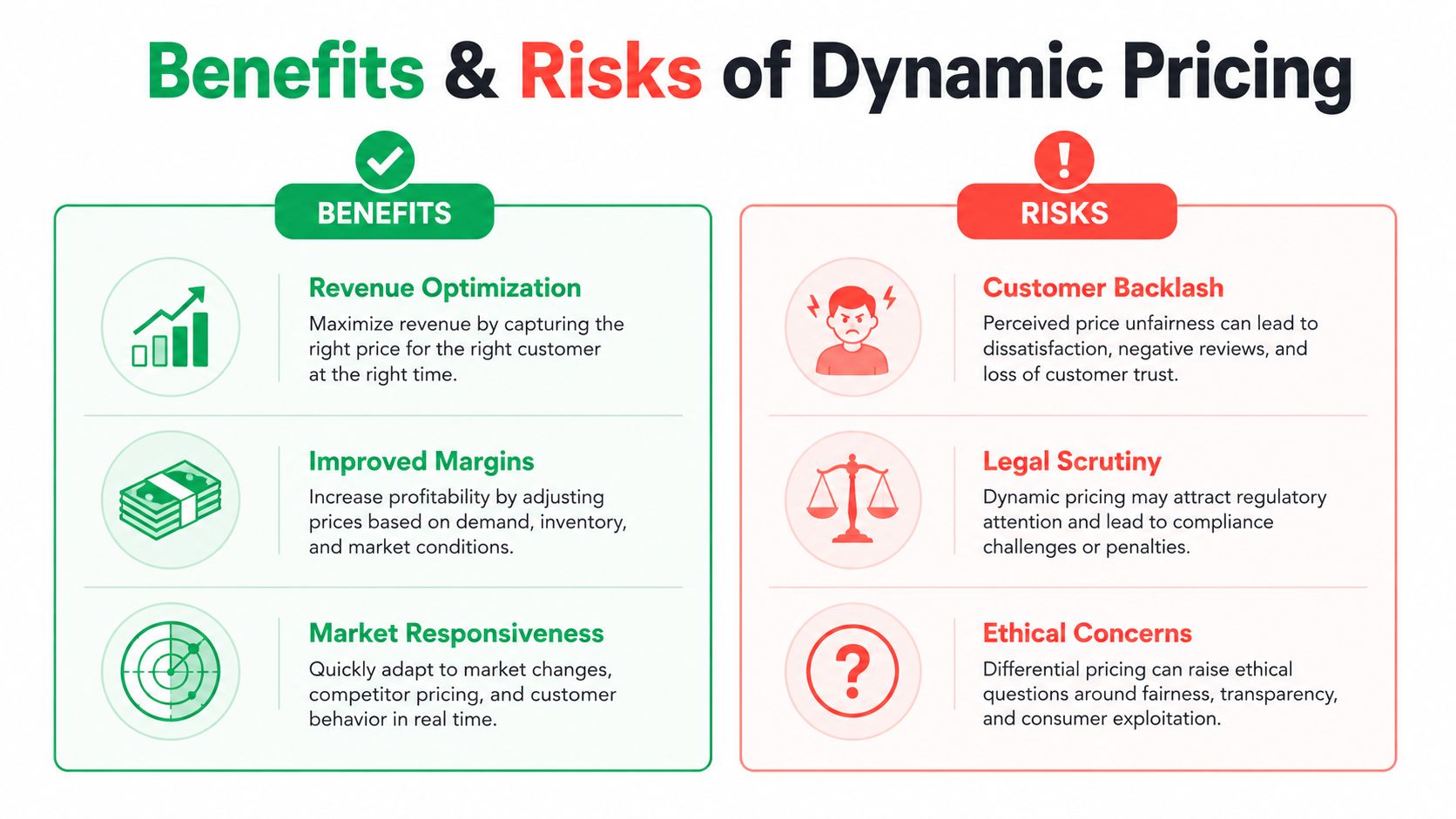
The main upside is better matching between price and demand. If demand rises, businesses can protect margin instead of leaving money on the table. If demand softens, they can reduce friction and move customers toward the right plan, retention offer, or recovery path.
That matters in subscription products because value is not only created at checkout. It also shows up in save offers, renewal flows, downgrade paths, pause options, and payment recovery. A pricing team that can adapt those moments to account context is using the same logic that airlines and hotels use, just applied to recurring revenue.
Dynamic pricing also helps with capacity allocation. In subscription businesses, that does not look like physical inventory, but it still means putting limited attention, support effort, and premium plan value where they do the most good. If your highest-value accounts receive the strongest save options, you are directing effort where it is most likely to protect revenue.
Why the risks get attention
The risk is perception. If a customer feels the business is changing prices in a way that seems arbitrary, exploitative, or hidden, trust can fall quickly. Brookings highlights fairness concerns around real-time price changes and calls for better consumer protections, while U.S. News separates dynamic pricing from price gouging and notes that the practice is legal when it stays within consumer protection rules (Brookings).
That legal distinction matters, but it does not solve the trust problem. Customers do not judge your pricing logic like lawyers do. They judge whether the offer feels honest, understandable, and consistent with the relationship they already have with the product.
The regulatory side deserves the same attention. If you design auto-renewal dynamic offers, review the FTC's Negative Option Rule guidance for subscription offers before you decide how those offers are presented, disclosed, and accepted. That review helps teams avoid building a clever flow that creates compliance risk later.
A few safeguards help:
- Clear guardrails: set minimum and maximum thresholds so offers do not swing wildly.
- Transparent logic: explain discounts, pauses, or renewal offers in plain language.
- Clean exits: always provide an honest cancellation path instead of trapping users.
- Reviewable rules: document when personalization is allowed and who approves it.
The trade-off for SaaS leaders
If you work in growth or product, the question is not whether dynamic pricing is powerful. It is. The question is whether the lift in conversion or retention is worth the added complexity and scrutiny. In consumer software, that often comes down to whether the logic helps a user make a better choice or hides a worse one.
The strongest implementations are narrow, documented, and measurable. They protect revenue without pretending every user should see the same offer. They also treat fairness as part of the product experience, not just a legal review.
Implementing Dynamic Pricing in Subscription Businesses
Start with the decision you need to make. For most SaaS teams, that's not “Should we change all prices?” It's “Which account context should change the offer shown in a cancel, save, or recovery flow?”
Build the logic around measurable drivers
The 2023 revenue-management framing is useful here because it narrows dynamic pricing to four driver groups, people, product configurations, periods, and places (academic definition). In SaaS terms, that means customer segment, plan shape, billing period, geography, usage pattern, and time window.
Once those inputs are clear, connect them to a pricing workflow. A billing system like Stripe can remain the source of truth while a pricing layer decides which path to show. That separation matters because you want the logic to be adjustable without rebuilding the billing core.
Keep the first experiment small
A good first test is a single save offer for high-value accounts with cancellation intent. You can compare a discount, a pause, a downgrade, or a support handoff, but don't test all of them at once. The point is to learn which path preserves revenue while still respecting customer choice.
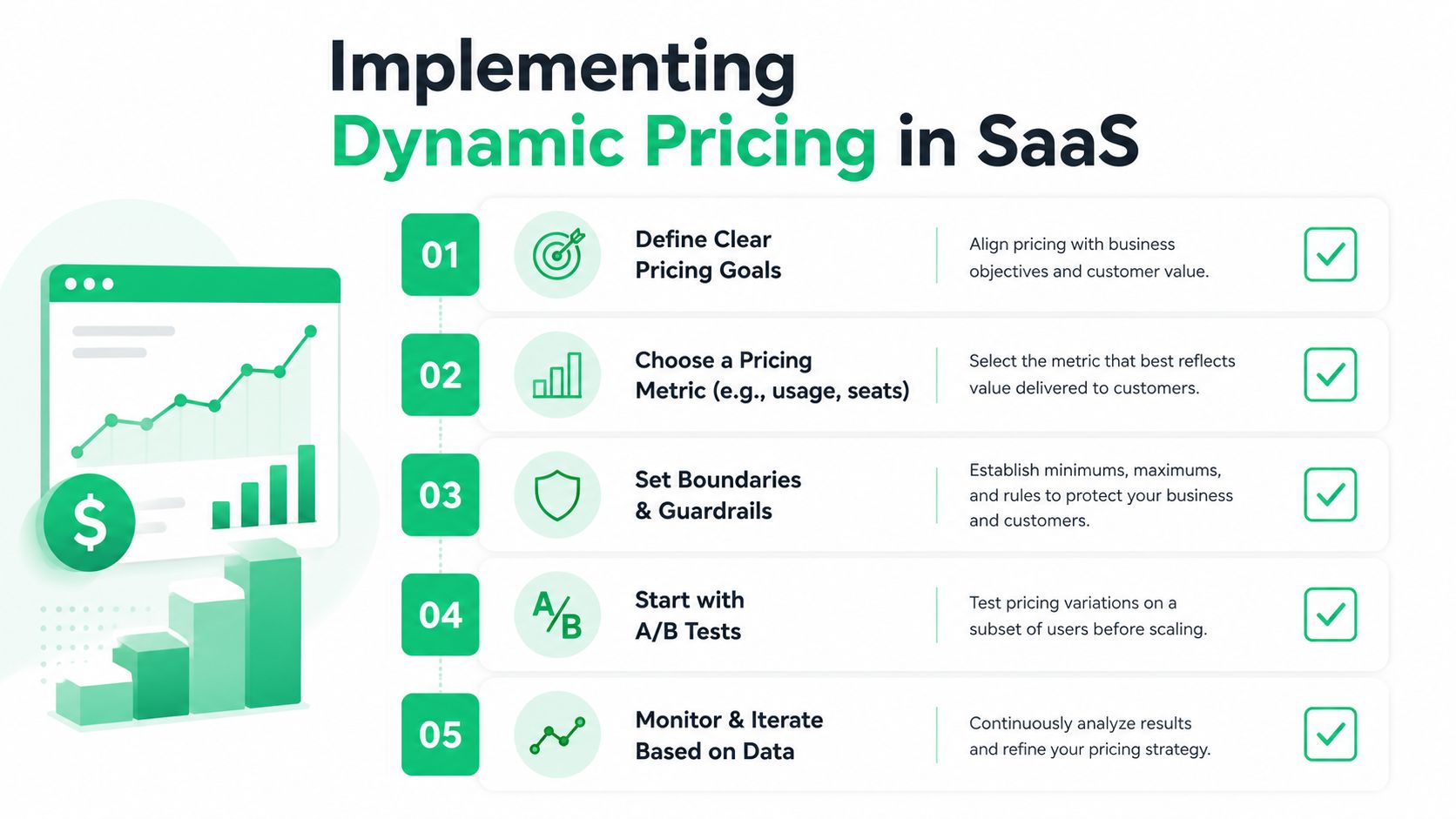
A simple starting checklist looks like this:
- Define the goal: recovered revenue, retained accounts, or reduced involuntary churn.
- Choose the input signals: plan, usage, cancellation reason, account value, billing status.
- Set guardrails: floor prices, approved offers, and clean cancellation fallback.
- Measure outcomes: accepted offers, abandoned sessions, cancellation reasons, and recovered revenue.
- Review the loop: update the offer library based on what converts.
Unify the adjacent flows
Subscription businesses usually split cancellation, failed-payment handling, and customer feedback into separate tools. That creates blind spots. A stronger setup treats them as one loop, so the same account context can inform the save path, the retry path, and the win-back path.
Real-time alerts help too, especially when a high-value account is at risk or a payment failure needs human follow-up. The point isn't to automate everything. It's to let automation handle the routine cases so people can focus on the cases that need judgment.
A pricing program gets better when every offer has a reason, every reason has a record, and every record feeds the next test. That's the difference between experimenting and guessing.
Next Steps and Resources for Experimentation
The safest way to use dynamic pricing in SaaS is to start with one narrow flow and one clear outcome. A context-aware save offer for high-value accounts is a good candidate because the business impact is measurable and the user intent is already obvious.
From there, keep the learning loop tight. Use the pricing history, cancellation reason, and billing outcome to refine the offer library, and resist the urge to rebuild billing logic every time you change the script. The systems that work best are the ones that let pricing, retention, and recovery teams iterate without turning each test into an engineering project.
If you want to go deeper, spend time with revenue management research, pricing experimentation frameworks, and the consumer protection angle around fairness and transparency. Those three lenses keep teams from treating dynamic pricing like a growth hack when it's really a governed pricing system.
Start small, keep the rules visible, and measure the revenue tied to each decision. Then use that evidence to decide where dynamic pricing belongs in your subscription lifecycle, and where a fixed offer is the better choice.
Revcover helps subscription teams connect cancellation intent, save offers, and payment recovery in one measurable flow, so dynamic pricing can support retention instead of creating chaos. If you're working through cancellation paths, failed payments, or recovery experiments, visit Revcover and see how it fits into your Stripe-based stack.